The post Closing Washington’s China Gap with Middle East Partners appeared first on CANADA VOICE.
]]>
Washington institute \ by Michael Singh
- Michael Singh is the Managing Director and Lane-Swig Senior Fellow at The Washington Institute.
Also available in العربية
For the first time in decades, America’s top strategic priority diverges from that of its key regional partners, but Washington can close the gap by increasing their understanding of China and removing the blinders from their threat perceptions.
As U.S. policymakers have focused more on competition with China in recent years, their concerns over Middle East relations with Beijing have grown as well. This has contributed to a vicious cycle—growing Chinese influence and ambitions around the world result in decreased American attention to the Middle East, which in turn incentivizes U.S. regional partners to deepen their ties with Beijing, which in turn increases tensions with Washington and leads some to conclude that the Middle East is a lost cause. Underlying this dynamic are frequent suspicions of bad faith. Washington worries that its partners are cynically using China ties as leverage to extract favors from the United States or, worse, that they share an authoritarian affinity with Beijing; for their part, regional partners worry that Washington is either unreliable or so focused on domestic politics that it no longer ascribes strategic value to its Middle East relationships.
What these assumptions often neglect are two more fundamental differences. First, the parties differ substantially in the threat they perceive from Beijing. From the U.S. perspective, there is no greater threat than China’s growing economic and military might and revisionist intentions. Yet Middle Eastern partners perceive only minor threats from China, if any. They are far more likely to see Beijing as a valuable trading partner and a benign, even helpful, political partner and occasional great-power counterweight, especially when faced with inconvenient U.S. demands. These differences mean that for the first time in decades, Washington and its regional partners sharply diverge on what they consider their primary national security threat.
Second, both sides differ in their capacity to understand China. In the modern era, Beijing has had little meaningful engagement in the Middle East, while regional elites have spent relatively little time there compared to other international capitals. Compounding this unfamiliarity is the scarce analytical capacity of most Middle Eastern governments. Even Israel, the most capable regional intelligence ally, naturally directs most of its analytical resources toward what it considers its top threats (e.g., Iran and terrorism). This gap in understanding only widened over the past few years as the United States directed more of its resources toward the Indo-Pacific and China underwent historic political change, from dramatically concentrating domestic power to embracing a more ambitious foreign policy. The speed of these shifts has left Middle Eastern partners struggling to keep up.
Closing the Gap
Given these differences, America’s numerous warnings about Chinese technology, military activities, diplomatic initiatives, and other matters tend to be received skeptically in the region. In many cases, partners view these messages as requests for favors to the United States with little connection to their own interests or priorities; in other cases, they believe they are being asked to act against their interests and essentially choose between Washington and Beijing. More cynically, U.S. requests have created leverage for partners to play the two great powers off one another in hopes of extracting maximal benefits from both.
Compounding these difficulties is the fact that American concerns about China often straddle the boundaries of foreign policy, economics, and technology in ways that conversations about Iran, terrorism, and other traditional Middle East topics do not. This can place U.S. officials at a disadvantage, as they tend to be more specialized portfolio-wise than their regional counterparts (especially in the Persian Gulf) and may therefore know less about broader trade or technology matters—or even about U.S. policy on these global issues. In such cases, Middle Eastern officials will not hesitate to draw on their deeper knowledge to point out hypocrisy or double standards when rebuffing Washington’s requests.
Attempting to close these analytical and policy gaps is a tall order and may prove quixotic in some respects. The increase in Middle East ties with Beijing stems not just from Washington pursuing the right or wrong policies, but also from deeper tectonic shifts that are unlikely to abate in the foreseeable future: namely, China’s growing (and the West’s declining) demand for oil, Beijing’s determination to play a diplomatic and security role in the region, and the decreasing importance of Middle Eastern conflicts in Washington’s national security strategy. Yet none of this should dissuade U.S. policymakers from doing what they can to reach a better mutual understanding with regional partners on the China challenge.
Policy Recommendations
In light of all these factors, the U.S. government should take the following steps:
Doctor, heal thyself. First and foremost, the State Department should reconsider its recent “China watcher” model at U.S. embassies in the Middle East, under which officers with specialized training are designated to handle issues related to great power competition. This program was based on the “Iran watcher” program of the early 2000s, but unlike that relatively narrow portfolio, China competition has come to dominate U.S. national security strategy and should be treated accordingly. All American diplomats overseas need to understand the key tenets of U.S. policy toward Beijing and have at least a basic grounding in Washington’s concerns about trade, technology, and related matters—particularly the steps that have been taken to restrict Chinese trade and investment. Some of this training is already taking place, but it must be accelerated and greatly expanded.
Creating a China knowledge network. The U.S. intelligence community should partner with allies in the Indo-Pacific (e.g., Japan and Australia) to train their Middle Eastern counterparts—especially in the Gulf—on China analysis. This training should not focus specifically on Beijing’s policy in the region, but rather on broader issues such as China’s civil-military fusion, recent domestic changes, and problematic activities worldwide (e.g., espionage, cyberattacks, influence operations, technology transfer). The ultimate purpose should be to cultivate a network of China experts in Middle Eastern governments and provide them with the tools and data to vet China-related risks to their national interests, while keeping relevant channels open so they can turn to their U.S. counterparts when needed. To make this initiative less provocative to Beijing—and, by extension, more likely to elicit regional participation—the training should also focus on other global challenges such as Russia and Iran.
Replicate the U.S.-Israel Strategic Technology Dialogue. In September 2022, Washington and Jerusalem launched a bilateral “Strategic High-Level Dialogue on Technology.” Led by two countries’ national security advisors, the interagency group’s mandate covers clean energy technology, pandemic preparedness, artificial intelligence, and other tech issues. Although China was not mentioned in statements announcing the group’s initial meeting or latest talks, it was undoubtedly what spurred the dialogue’s creation, as U.S. concerns over Israeli tech cooperation with Beijing had become a significant irritant in the relationship. The United States should consider replicating this model with the United Arab Emirates, Saudi Arabia, and perhaps Qatar. Although their tech sectors are not as well-developed as Israel’s, all three are investing heavily on this front and have partnered extensively with Beijing in ways concerning to Washington. If the bilateral dialogues prove viable and successful, Washington should consider combining them into a multilateral framework.
Reframe threat perceptions. Despite demarche after demarche, even America’s closest partners in the Middle East simply do not see China as a threat to their interests (apart from the friction that their Chinese ties are creating with Washington, perhaps). This is not to say they are blindly trusting of Beijing’s intentions, merely that they do not view its actions as threatening. In fact, they see China’s desire to be more active in the Middle East as an opportunity, whether in terms of attracting trade and investment or balancing their dependence on the United States.
Yet this threat perception is deeply mistaken. For example, if China attempts to take Taiwan by force or other methods, the resulting crisis would likely entail enormous disruptions in global trade that wreak severe economic damage in the Middle East. Even short of that drastic scenario, Beijing could weaponize its economic leverage over the region at any time for political purposes, as it has already attempted to do against Australia, Japan, South Korea, the Philippines, and others. Chinese cooperation with Iran remains deeply problematic as well—despite Beijing’s efforts to frame it in positive terms (e.g., the recent Iran-Saudi rapprochement), such activity has helped shield Tehran from economic and diplomatic isolation while enhancing the threat it poses to neighbors.
U.S. officials should emphasize these threats rather than rehashing messages about democracy vs. autocracy or risks to the international order, which do not resonate among most U.S. partners in the Middle East. Much like China, the majority of these partners see themselves as rising powers who have not been accorded their fair share of global influence.
In addition to pointing out threats, U.S. officials should work with regional partners on initiatives that appeal to them while still tacitly countering Beijing. For example, Saudi Arabia and the UAE have the capital to rival Chinese investments in infrastructure and mineral extraction in the developing world and could benefit from Western partnership in this regard. Failing that, they may wind up facilitating Beijing’s strategy by pursuing such opportunities with Chinese partners, which are proffered more readily at present.
Michael Singh is the managing director and Lane-Swig Senior Fellow at The Washington Institute and interim director of its Diane and Guilford Glazer Foundation Program on Great Power Competition and the Middle East.
The post Closing Washington’s China Gap with Middle East Partners appeared first on CANADA VOICE.
]]>The post Palestinians Surprisingly Split on Saudi-Israel Normalization appeared first on CANADA VOICE.
]]>

washington institute \ by Catherine Cleveland, David Pollock
- Catherine Cleveland is The Washington Institute’s Croft-Wagner Family Fellow and editor of Fikra Forum.
- David Pollock is the Bernstein Fellow at The Washington Institute, focusing on regional political dynamics and related issues.
In Gaza, most residents are strongly supportive of increased Arab involvement in the conflict and half are open to normalizing ties with Israel were Saudi Arabia to do so. A majority of West Bank residents, however, remain hesitant about such a proposal.
After years of stagnation and conflict, a new Israeli-Palestinian deal is once again on the international agenda—only this time, remarkably, in return for steps toward “normalization” of Israeli relations with Saudi Arabia. The possibility of such an agreement has been rumored for years and is now an explicit goal of Israeli prime minister Binyamin Netanyahu. Informal ties are already warming, including the opening of Saudi airspace to Israeli flights and early public joint ventures between Saudi and Israeli companies.
But further progress, according to Saudi officials, will depend on some Israeli concessions to the Palestinians. The kingdom has publicly emphasized this factor by appointing the country’s first-ever nonresident Ambassador to the State of Palestine this week. And one key component to this conversation has been missing: How do Palestinians—the people themselves, not their leaders—see the potential of Saudi normalization?
In July, The Washington Institute conducted a poll with the Palestine Center for Public Opinion—based in Beit Sahour just outside Bethlehem—with over 1,500 face-to-face interviews in the West Bank, Gaza, and East Jerusalem. The results provide a unique snapshot of Palestinian public opinion on this and other key issues. Specifically, respondents were asked whether they agreed with this statement: “If Saudi Arabia normalizes relations with Israel, Palestinian leadership should also normalize relations and end the conflict.”
Contrary to common misconception, there is no one attitude on this and other issues relating to normalization across Palestinian society. And on this question—as with many others—attitudes sharply diverge between the West Bank and Gaza. Two-thirds of West Bank residents reject this proposal to normalize ties in the face of a Saudi-Israeli deal. But turn instead to Gaza, and attitudes are split: 50% of Gazans would support normalizing relations with Israel were Riyadh to do so. Strikingly, 21% of Gazans agree strongly with this idea—statistically equivalent to the 23% of Gazans who strongly disagree.

This split is also evident in attitudes about the impact of the Abraham Accords on the region—47% of Gazans say they have had at least a somewhat positive impact, versus 29% of West Bankers. Similarly surprising is that nearly half (42%) of Gazans agree with this statement: “I hope someday we can be friends with Israelis, since we are all human beings after all.” In the West Bank, the corresponding figure drops to just 30%. Even more striking is that in East Jerusalem, whose nearly 400,000 legal Palestinian permanent residents have daily contact with Israelis, the clear majority (63%) agree at least “somewhat” with that purposely provocative proposition about friendship with Israelis someday.
More broadly, however, the majority of Gazans and West Bankers alike (58% and 61%) agree with this statement: “Arab governments are neglecting the Palestinians and starting to make friends with Israel because they think the Palestinians should be more willing to compromise.” In the case of Gaza, a similar percentage has expressed this attitude for years—including when first asked in 2019. Among West Bankers, by contrast, the prevalence of this attitude is much newer. When presented with the same question in June of last year, just 38% of West Bank residents had agreed with this statement, but 61% do so now.
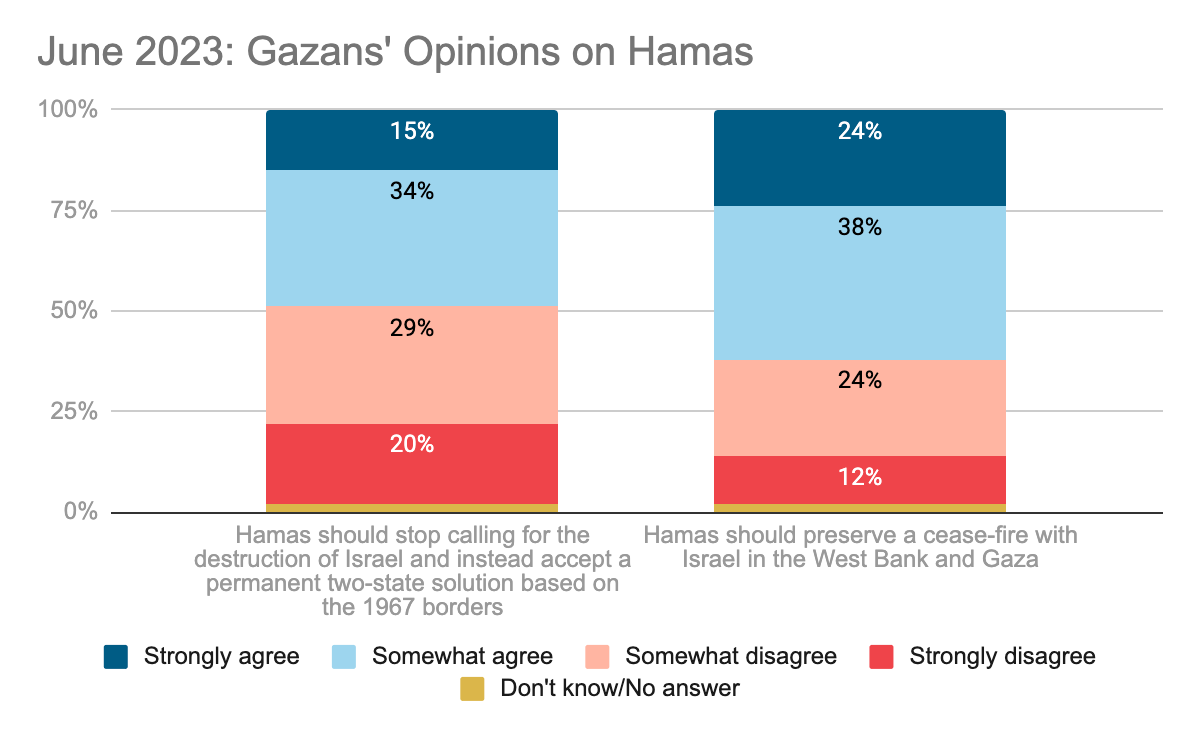
Today, moreover, fully three-quarters of Gazans support Arab governments taking “a more active role in Palestinian-Israeli peacemaking, offering incentives to both sides to take more moderate positions” —with almost half (48%) saying they “strongly” agree. And when it comes to Jerusalem in particular, a remarkable three-quarters of Palestinians in each of the three territories polled also say that Saudi Arabia should have some role in the holy city’s future: Gazans, 73%; West Bankers, 71%; East Jerusalem Palestinians, 77%.
These numbers also reflect a desire among many Palestinians for change to the status quo, including—again contrary to conventional wisdom—by peaceful means if possible. Half of Gazans agree that Hamas should “stop calling for the destruction of Israel and instead accept a permanent two-state solution based on the 1967 borders.” And at least half in Gaza and the West Bank alike support the Palestinian resumption of negotiations with Israel, 58% in the former and 50% in the latter.
As private Israeli-Saudi negotiations continue, Saudi engagement and the resulting concessions on the Palestinian issue it may obtain from Israel are likely to find favorable reception among many in Gaza. In the West Bank, more residents may be cautious about whether such an agreement is in their interests. But the majority of Palestinians are clearly searching for change, one way or another. If steps toward Saudi-Israeli normalization can provide meaningful improvements in Palestinian life—even without full Palestinian statehood—many Palestinians are not likely to see them as the “stab in the back” that some of their leaders have proclaimed. And for the United States, these striking new survey findings demonstrate that if Palestinians continue to view Saudi Arabia as working for their interests, they are likely to see the current U.S. push for this historic agreement as beneficial.
Methodological Note:
This analysis is based on a face-to-face survey conducted July 8-27, 2023, with a true random geographical probability sample of 1,572 Palestinian adult (age 18+) residents of the West Bank, Gaza, and East Jerusalem. The authors personally reviewed the questionnaire’s translation, sampling procedures, quality controls, assurances of confidentiality, and other fieldwork protocols with the entire Palestinian professional team based in Beit Sahour in the West Bank. The statistical margin of error for a sample of this size and nature is approximately 4% per area sub-sample, at the 95% confidence level. Additional methodological details, including full responses to all questions in the survey, are available upon request or on The Washington Institute’s new interactive polling data platform.
The post Palestinians Surprisingly Split on Saudi-Israel Normalization appeared first on CANADA VOICE.
]]>The post Hezbollah’s Grip on Lebanon Is Weakening. Here’s How Washington Can Help appeared first on CANADA VOICE.
]]>
The Washington institute\ by Hanin Ghaddar
- Hanin Ghaddar is the Friedmann Fellow at The Washington Institute’s Geduld Program on Arab Politics, where she focuses on Shia politics throughout the Levant.
Also published in Politico
Instead of continuing to work with corrupt Lebanese state institutions, the United States should pursue opportunities with the business community and civil society, whose members are eager to separate themselves from the group.
In a televised speech last week, Hezbollah’s leader, Hassan Nasrallah, outlined a detailed plan for how a militia under U.S. sanctions will send tankers of U.S.-sanctioned fuel to be distributed by a U.S.-sanctioned company. Hezbollah is planning to use a subsidiary firm to sell Iranian fuel in Lebanon amid severe shortages of fuel and diesel. This violation of U.S. sanctions could trigger penalties on Lebanon, which is already buckling under a historic economic crisis. Yet Lebanon’s brand-new government did not say a word. Not a single minister from the new governing coalition—formed earlier this month after over a year with no government—commented on how the country would address Hezbollah’s defiant and arguably illegal plan.
Hezbollah, long designated a terrorist organization by the United States, has been effectively running Lebanon for years. The group maintains a marriage of convenience with the country’s political class: Both sides benefit from a status quo in which political elites are protected and Hezbollah can continue regular violence against Israel and regional warfare on behalf of Iran, while ordinary Lebanese people suffer.
None of this is surprising. But what is surprising is that Hezbollah’s iron grip on Lebanon’s politics and economy is starting to loosen—which gives the Biden administration a chance to change an approach that’s long been failing. Even as the country’s leaders remain beholden, Hezbollah no longer enjoys the support it once had among Shias. In particular, many businesspeople are more interested in jobs than in Hezbollah’s resistance struggles, while today’s youth grew up long after the Lebanese civil war and the subsequent period of Syrian dominance that helped bring Hezbollah to power.
Lebanese politics sadly haven’t changed much over the last decade or two—and neither has the U.S. playbook for addressing the country’s intermittent crises. Now, however, the Biden administration has an opportunity to take advantage of Hezbollah’s weakness and bolster the viable political alternative to the group’s rule that Washington has long hoped for. By jettisoning its traditional focus on Lebanon’s failed institutions and instead investing in the business leaders, activists and youth who are increasingly frustrated with Hezbollah, the U.S. can empower a new generation of Lebanese Shias who actually do want change—and may finally have the power to make it.
Since its inception, Hezbollah has portrayed itself to its fellow Shias as a protector and a provider. Its popular support was based on three pillars: providing social services, resisting Israel’s occupation of southern Lebanon and forging a common Shia identity. Today, Hezbollah’s social services network has shrunk because of financial problems caused in part by U.S. sanctions. The idea of resistance has lost its power since Hezbollah intervened in the Syrian war to protect Bashar-al Assad. And Shia identity no longer binds many Lebanese to Hezbollah as strongly, as the community has started to feel more isolated from the region.
In 2019, Lebanese from all sects hit the streets to protest corruption and economic difficulties. Since then, political alternatives to Hezbollah within the Shia community have become more robust. Emerging groups are starting to express significant opposition to Hezbollah: business networks, students who participated in the protests (which Hezbollah opposed, in some cases with physical violence), social media–savvy activists and young professionals with no memory of the post–civil war years that brought Hezbollah into the political fold. These groups’ primary concerns are economic and social rather than political or ideological.
Meanwhile, Hezbollah’s parallel economy is collapsing. U.S. sanctions on Iran have crippled the flow of cash from Iran to Hezbollah, and the group’s involvement in regional military operations—mainly in Syria—have further drained its coffers. This has affected its ability to provide social services, aid and nonmilitary employment opportunities.
There are also signs of a rift between Hezbollah and its traditional supporters. The group is increasingly in conflict with the Amal Movement, a political party that has long allied with Hezbollah. Other allies have been sanctioned by the United States and lost popularity, particularly after the 2019 protests drew attention to their corruption. According to a survey earlier this year, Hezbollah’s main Christian ally, the Free Patriotic Movement, has the support of just 15 percent of Lebanese Christians. Within Hezbollah’s own ranks, financial difficulties are widening the gap between military and nonmilitary members. Hezbollah is still paying its military personnel in dollars while the rest receive their payments in the Lebanese pound, which has lost around 90 percent of its value.
In light of this weakness, new groups are emerging that could be critical to breaking Lebanon’s vicious cycle. Shias, who constitute more than 30 percent of Lebanon’s population, are the most important constituency for building an anti-Hezbollah coalition because they form the bulk of the group’s support. Lebanon’s other groups—notably, Sunnis, Christians and Druze—will likely support a strong Shia alternative to Hezbollah, in part because they increasingly share a frustration with the country’s broken politics.
I’ve interviewed many Shia businesspeople in Lebanon, Africa and the Gulf who have expressed willingness to work with the international community—and outside Hezbollah’s orbit—to provide jobs and loans. They have been giving political and financial support to activist and civil society groups in Shia towns and cities. Their motivation is to establish roots in their communities, but also to spare themselves from sanctions or financial isolation by distancing themselves from Hezbollah. Prior to his assassination earlier this year, Shia political activist and intellectual Lokman Slim was closely involved with this informal grouping of civil society and business leaders.
This enthusiasm suggests a different political path for Lebanon and an opportunity for the United States and the international community to change their focus. Instead of continuing to work with Lebanese state institutions that are weak, corrupt, and Hezbollah-controlled, the U.S. should divert its focus to invest in this unofficial but increasingly influential group. The eventual goal would be a more structured civil society organization that enjoyed strong relationships with the U.S., Europe and international institutions and focused on creating economic opportunities, empowering new political voices and offering a meaningful alternative to Hezbollah for frustrated Lebanese Shias.
The group should include business leaders, civil society representatives, members of the Lebanese diaspora, activists and other influential Shias. Donor nations including the United States and international institutions like the World Bank and IMF could work with the Lebanese business community to structure, develop, fund and manage the organization. The critical thing is that this would take place outside Lebanon’s state institutions and political parties.
To avoid the potential pitfalls of working outside formal government structures, international involvement will be critical. The international community should focus on investing in basic services such as health and education, expanding economic opportunities outside Hezbollah, and protecting journalists and activists. This can be done by supporting private-sector initiatives, grassroots organizations working to provide services in smaller communities and independent media organizations. Creating economic opportunities is especially important today, as the Lebanese private sector has collapsed and the middle class has mostly disappeared. Hezbollah has become the largest employer with the best access to hard currency. Many Shia—Hezbollah’s traditional hiring base—are faced with a choice between relying on Hezbollah or starving.
This doesn’t mean the U.S. should stop its longstanding policies of providing assistance to the Lebanese Army—especially given increased security concerns—and humanitarian aid. However, the U.S. can reorient those traditional aid channels to match its new focus on civil society rather than on formal institutions. Aid to the military should be structured to make sure pro-Hezbollah elements within the army do not benefit—elements that have reportedly targeted Lebanese activists. The U.S. can make protection of activists a condition of continued military aid. In addition, humanitarian aid should only go through civil society organizations, not politically affiliated NGOs. The United States in recent years has tended to target aid to organizations and charities linked to Lebanon’s powerful political elites, rather than genuinely grassroots organizations. Meanwhile, aid to some anti-Hezbollah civil society initiatives has diminished since the U.S. began nuclear negotiations with Iran.
In parallel, the U.S. can continue sanctioning corrupt political leaders. Sanctions—such as through the Magnitsky Act—are a powerful tool to contain corruption when they are part of a broader policy, and the penalties on Hezbollah’s allies have already hit the group hard. Finally, if sanctions are lifted on Iran as part of a new nuclear deal, robust mechanisms should be put in place to limit Hezbollah’s access to hard currency from its sponsors in Tehran.
Both Hezbollah and Iran have long understood something that the United States and its European allies haven’t: soft power. While the West aided Lebanon the old-fashioned way—supporting the political opposition, providing security assistance to the military and funding development programs—Iran was funding the Shia business community, media organizations, education and nontraditional initiatives like cybersecurity training, musicians and a pro-Iran youth group called the Mahdi Scouts. Hezbollah, with Iranian support, created an alternative state and parallel economy that provided services and jobs. Now, as Hezbollah weakens, the United States can use a similar soft-power approach to help Lebanese get access to the economic opportunities they want—and weaken Hezbollah in the process.
Waiting for Hezbollah and the Lebanese political class to change has proven a waste time and time again. But Lebanon itself is changing. Washington has an opportunity to take advantage of these changes by investing in the civil society groups that are already emerging as a viable alternative to Hezbollah. Lebanon’s people are ready, and the opportunity is ripe.
Hanin Ghaddar is the Friedmann Fellow in The Washington Institute’s Geduld Program on Arab Politics and a former journalist in Lebanon. This article was originally published on the Politico website.
The post Hezbollah’s Grip on Lebanon Is Weakening. Here’s How Washington Can Help appeared first on CANADA VOICE.
]]>The post Will China replace Islam as the West’s new enemy appeared first on CANADA VOICE.
]]>
Middle east eye / Peter Oborne
China is being presented as the new existential enemy, just as Islam was 20 years ago
It’s just over a quarter of a century since the American political scientist Samuel Huntington wrote his famous essay on the Clash of Civilisations. It set the tone for a series of wars.
Huntington was writing after the fall of the Berlin Wall, and the end of the Cold War between Soviet Russia and the West. Rather than an era of peace, Huntingdon forecast a new struggle between what he viewed as irreconcilable enemies: Islam and the West.
-
The West likes, perhaps needs, an enemy and the latest target is China
Huntington asserted that identity, rather than ideology, lay at the heart of contemporary politics. “What are you?”, he asked, “and as we know, from Bosnia to the Caucasus to the Sudan, the wrong answer to that question can mean a bullet in the head.”
He added:”Islam has bloody borders.”
Western politicians like former US President George W Bush and former British Prime Minister Tony Blair followed Huntington’s lead. For the last quarter century, many Muslim countries have been the target of the US and its allies.
Meanwhile Muslims have often been portrayed in Western media as lawless, radical ideologues and an existential threat to the world. This has given rise to virulent Islamophobia in the West with the rise of far right political parties in Europe.
I will argue today that much of this noxious hostility may soon abate in the aftermath of the coronavirus tragedy. This is partly because (especially in Britain) the sacrifices made by Muslims are so obvious and have been so great that this may lead to a belated change in public attitudes. The first four medics to die from the outbreak were all Muslim.
But there is a second factor at work: the coronavirus pandemic is reshaping global geopolitics. The West likes, perhaps needs, an enemy and the latest target is China.
Targeting China
China is being presented as the new existential enemy, just as Islam was 20 years ago. And by the very same people. The same newspaper columnists, the same think tanks, the same political parties and the same intelligence agencies.
After Huntington’s famous essay that led the charge against Muslims – or what they often call radical Islam – now they have turned their attention to the Far East.
US President Donald Trump, the world’s Muslim-basher-in-chief, has now started to attack China, rather as Bush, his Republican predecessor, attacked Iraq in 2003 and the “axis of evil” 20 years ago. During his campaign in 2016 he accused China of “raping” the US economy.
However, since the outbreak of Covid-19, Trump’s attacks have gained speed and traction. He has accused China of covering up the virus and lying about its death toll.
Earlier this month, he even stopped US funds to the World Health Organization, calling it too “China-centric”. British newspapers, which have cut down entire forests to vent their spleen against Muslims, have pivoted to the Chinese menace.
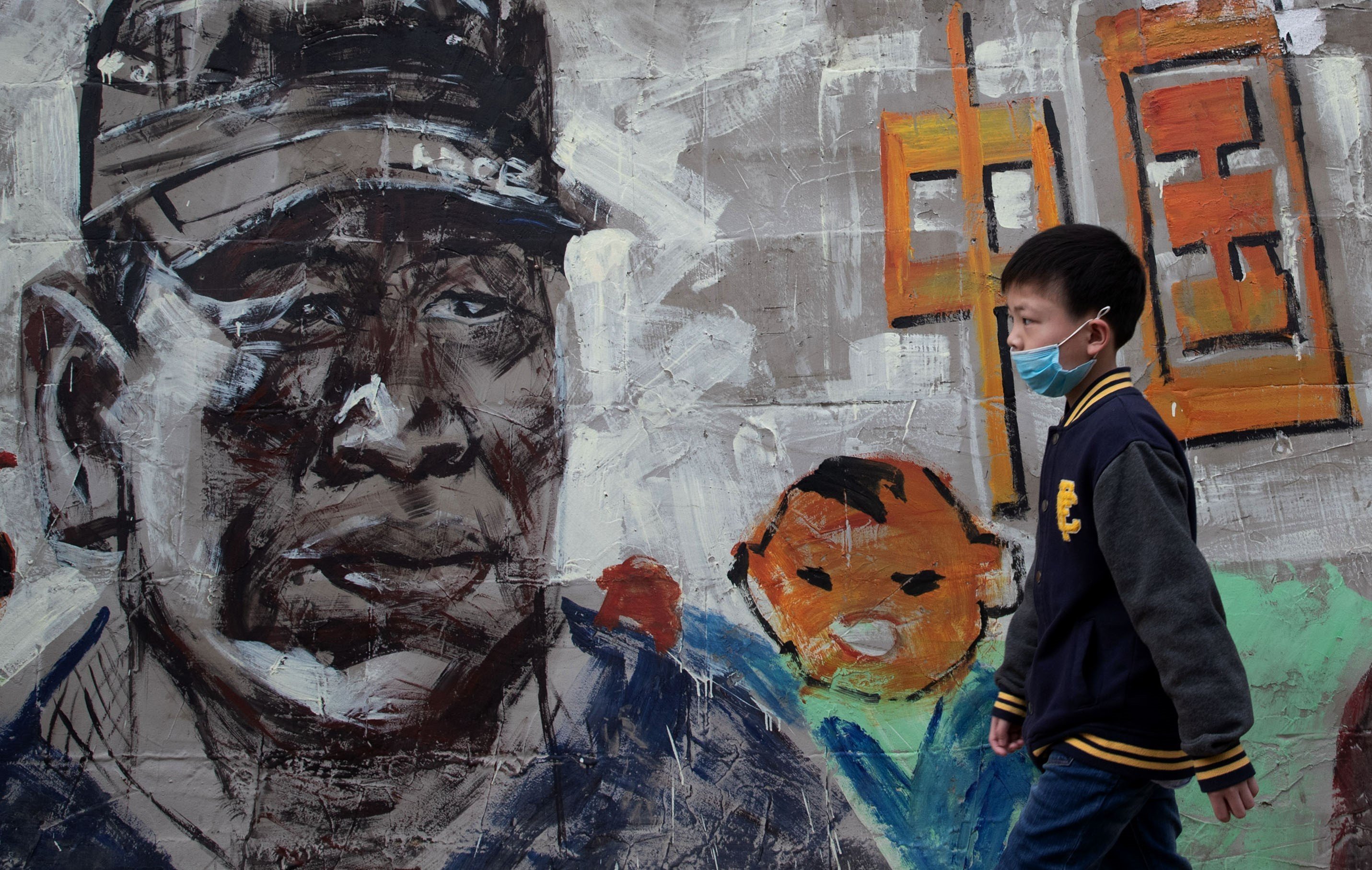
A boy wearing a face mask amid concerns of the coronavirus walks along a street in Wuhan, in China’s central Hubei province on 24 April (AFP)
The Sun – which banged the drum to invade Iraq in 2003 – ran a story on a report alleging the virus was developed deliberately by China to “prove it’s greater than the US at battling deadly diseases”. Britain’s foreign intelligence agency, MI6, helped to build the case for Blair’s calamitous attack on Iraq in the notorious dossier on Weapons of Mass Destruction.
Now it has China in its sights.
Speaking on BBC’s Today Programme, former MI6 chief Sir John Sawers greatly surprised me by showing sympathy for Trump’s removal of funding from the WHO. He said: “There’s deep anger in America over what they see as having been inflicted on us all by China, and China is evading a good deal of responsibility for the origin of the virus, for failing to deal with it initially.”
In Britain speeches by former spy chiefs are always seen as representing the current view inside the office.
Meanwhile Britain’s acting prime minister, Dominic Raab, said that after coronavirus there is “no doubt” it will not be “business as usual” with China. Senior newspaper columnists Melanie Phillips, a long-time critic of so-called radical Islam, recently used her column in The Times to warn that the West can no longer “turn a blind eye” to China.
The cover-up
Of course, there are good reasons to criticise China. There is evidence to suggest that China has not been transparent over the early stages of the outbreak or its number of cases. On the other hand, plenty of other countries (including Britain) are guilty of cover-ups and deception too.
- Coronavirus is pushing the US and China toward a new cold war
This is what makes the change of atmosphere around China so remarkable. Even the neoconservative think tanks, that have fulminated against manifestations of Islam for so long, have found a new opponent.
The Henry Jackson Society (HJS) has been one of most consistent critics of what it likes to describe as radical Islam or Islamism. Now it’s led the way with a series of recent reports and media appearances attacking China. Indeed their attacks on China in recent months have increased exponentially.
The latest was a poll conducted by HJS. It formed the basis of a Times article last week which found that “more than 80 percent of Britons want Boris Johnson to push for an international inquiry into China’s handling of the initial coronavirus outbreak”.
HJS associate Dr John Hemmings wrote in The Telegraph in support of Trump withdrawing WHO funding and warned of China’s growing “malign” influence. Matthew Henderson, director of Asia Studies Centre at HJS, launched a new series of videos with The Sun called “Hot Takes”.
The first episode asks “Is the coronavirus outbreak China’s Chernobyl?”
It was also an HJS report that provided the basis for a Mail on Sunday article suggesting Britain should pursue Beijing in the international courts for £351bn ($437bn) compensation over the outbreak. The Gatestone Institute has made the comparison between China and radical Islam most directly.
It ludicrously described the outbreak of coronavirus as “another 9/11 moment for the West”. My old friend Con Coughlin is the Telegraph’s defence and foreign affairs editor and distinguished senior fellow at the Gatestone Institute. He supported the Iraq war passionately. Now he has called on the WHO’s “pro-China” chief to resign.
MEE reached out to Henry Jackson Society for a comment but did not receive a response.
The new faultline
Some might say that since the collapse of the Soviet Union, the West has been in need of a replacement enemy.
- We may now be reaching the end to the long period when the main ‘faultline’ was Islam
Bear in mind that Huntington’s Clash of Civilisations warning that “the faultlines between civilisations will be the battle lines of the future” didn’t only concern Islamic civilisation. Huntington warned of a second “challenger” civilisation besides Islam.
China, according to Huntington, was the most powerful long-term threat to the West.
Not everything will change overnight. I sense that Iran will remain in the sights of the White House, such is the strength of the personal bond between Trump and Israeli Prime Minister Benjamin Netanyahu.
But we may now be reaching the end to the long period when the main “faultline” was Islam. It may well be that the West has now found itself a new enemy. If so, Muslims can breathe a little more freely.
The views expressed in this article belong to the author and do not necessarily reflect the editorial policy of Middle East Eye.
- Peter Oborne
- Peter Oborne won best commentary/blogging in 2017 and was named freelancer of the year in 2016 at the Online Media Awards for articles he wrote for Middle East Eye. He also was British Press Awards Columnist of the Year 2013. He resigned as chief political columnist of the Daily Telegraph in 2015. His books include The Triumph of the Political Class, The Rise of Political Lying, and Why the West is Wrong about Nuclear Iran.
The post Will China replace Islam as the West’s new enemy appeared first on CANADA VOICE.
]]>The post How Israel is using the coronavirus emergency to annex the West Bank appeared first on CANADA VOICE.
]]>
Middle east eye / Fareed Taamallah
Israeli Prime Minister Benjamin Netanyahu and his main rival, Benny Gantz, signed a deal this week to form an “emergency” coalition government.
According to Israeli media, Netanyahu’s Likud party and Gantz’s Blue and White alliance envision a rotation agreement for the premiership. Netanyahu would initially remain as prime minister with Gantz as his deputy, and they would rotate after 18 months.
The first response from the US administration came through Secretary of State Mike Pompeo on Wednesday, who said that annexing parts of the West Bank is “ultimately Israel’s decision to make”. This rude statement reflects the American administration’s bias towards Israel.
As a Palestinian, I have witnessed the formation of several Israeli governments during the course of the occupation – none seriously looking for a peaceful resolution of the conflict or a halt to the construction of illegal settlements in the West Bank.
Setting a date for annexation
This latest coalition is no exception. What is different is that for the first time, an Israeli government has officially and unashamedly set an exact date to carry out the annexation of West Bank land to Israel.
On 1 July, the Knesset will be able to vote on the annexation of parts of the West Bank, on the basis of the Trump administration’s “deal of the century”. US President Donald Trump’s deal was pre-emptively rejected by Palestinians, as it gives Israel full military control over Palestinians, much of their land, and all of Jerusalem and Israeli settlements.
Palestinians must unite behind a new, clear and more determined strategy to confront the annexation of their land
The vote would be held “as quickly as possible”, the agreement states, with no delays at the committee stages. Although coalition members would be able to vote as they see fit, the pro-annexation camp in the Knesset is likely to have a majority.
The so-called “emergency” coalition government, which will last 36 months, was justified to deal with the outbreak of the coronavirus pandemic in Israel. But why is the implementation of the deal of the century considered an emergency for Israel?
Netanyahu has declared many times before that he is willing to annex the Jordan Valley and West Bank settlements upon forming a new government. US and Israeli teams have already drafted maps of the planned annexed territories.
Some experts predict that Israel will annex at least 30 percent of the West Bank. It goes without saying that the annexation would not come in the context of negotiations or an agreed-upon exchange of territories; rather, it would be a unilateral decision that undermines the establishment of any future Palestinian state, putting an end to the “two-state solution” doctrine and resulting in a bantustan-like Palestinian entity.
Propaganda move
This annexation would have a disastrous impact on the Palestinian people’s aspirations for self-determination, and on me personally, as a Palestinian farmer who owns land in Area C.
Should the Israeli government follow the map drawn by Trump’s team, part of Qira, the village in the Salfit area of the West Bank where I am from – as well as perhaps my own farm – would be annexed to the nearby illegal settlement of Ariel.
Palestinian President Mahmoud Abbas has warned the US and Israeli governments not to annex any part of the Palestinian territories. “Do not think that because of the coronavirus we have forgotten about the annexation, Netanyahu’s measures or the ‘deal of the century,’” he said this month, adding that the Palestinian leadership would continue to work against these plans.
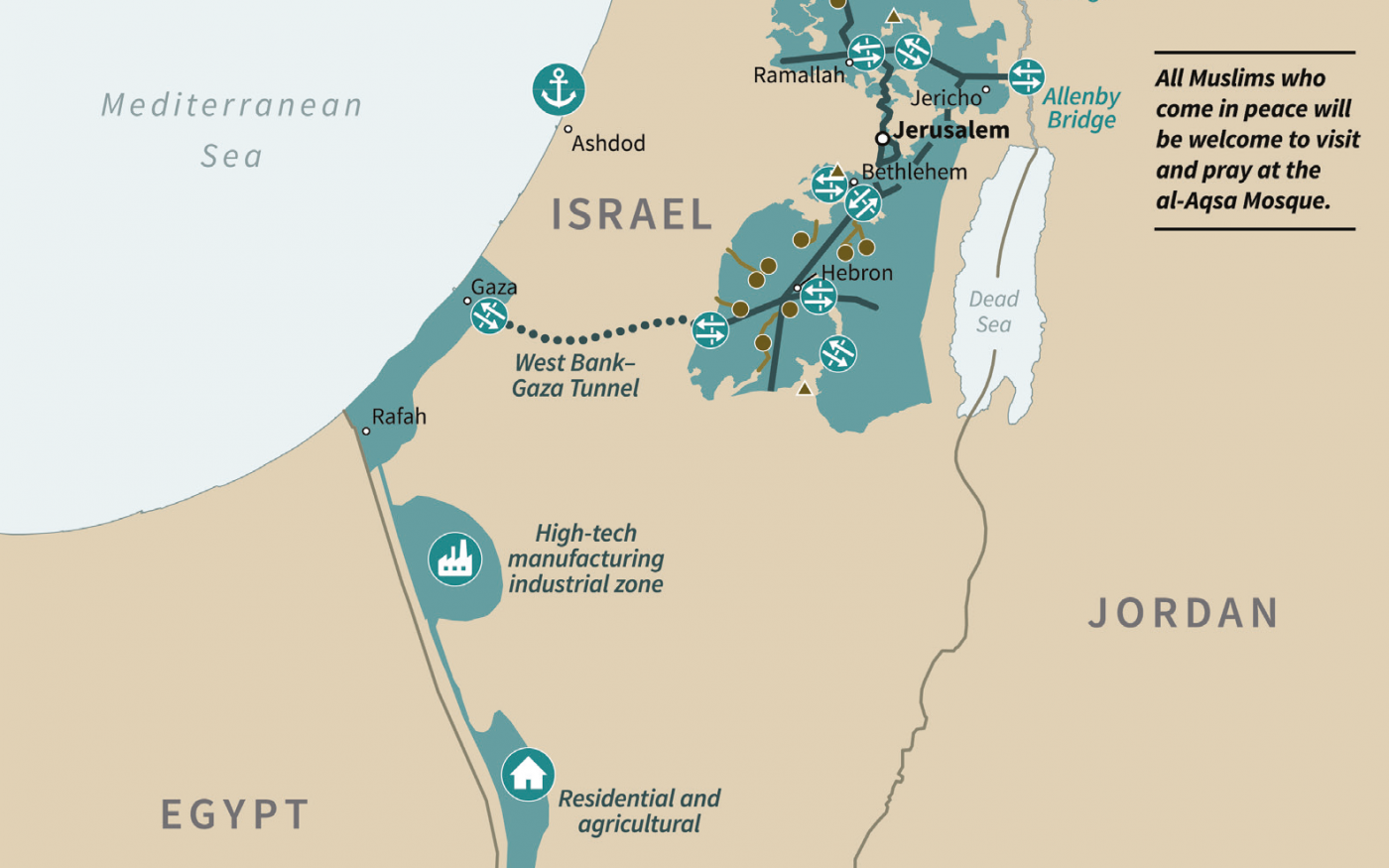
The Trump plan would further erode the Palestinian territories (AFP)
It is clear the formation of the coalition government has nothing to do with the pandemic emergency, but rather with political aims. Netanyahu, and now Gantz as well, want to take advantage of the pandemic to implement the Trump deal and annex parts of the West Bank, while both the world and Palestinians are exhausted fighting the outbreak.
The US presidential election is set for November, and this would also be a good propaganda move to facilitate Trump’s reelection.
The Israeli political establishment has united around the agenda of permanent colonisation and annexation, exploiting the unique local and international situation to dictate the status quo as a reality on the ground, with the full support and backing of the US administration.
The need for Palestinian unity
According to Hanan Ashrawi, a member of the Palestine Liberation Organisation executive committee, the unity deal “reveals the true colours of Israeli political parties and proves beyond doubt the death of the so-called left in Israel”. I agree, and would add that the unity government evokes, more than ever, the need to end the Palestinian split between the West Bank and Gaza and to seek reconciliation among all Palestinian political factions.
- Trump’s deal is a show hiding the real problem: Ongoing Israeli apartheid
Palestinians must unite behind a new, clear and more determined strategy to confront the annexation of their land, as Israel and the US have left them with no other option but to resist the plan.
It is time for Palestinians to stop chasing the futile “two-state” illusion and start looking for the “one democratic state” real solution, which grants all people between the Jordan River and the Mediterranean Sea the same rights and obligations as equal citizens, regardless of religion or race.
This remains the only viable solution for the conflict of the century.
The views expressed in this article belong to the author and do not necessarily reflect the editorial policy of Middle East Eye.
- Fareed Taamallah
- Fareed Taamallah is a Palestinian farmer and political activist
The post How Israel is using the coronavirus emergency to annex the West Bank appeared first on CANADA VOICE.
]]>The post Why US sanctions cannot remove Iran as a key player in the Middle East appeared first on CANADA VOICE.
]]>
Middle East Eye. / Shireen T. Hunter
While money has temporarily helped to increase Iran’s regional influence, ideological affinities and unresolved conflicts have been equally important
One of the stated objectives of US sanctions on Iran has been to end what Washington characterises as “nefarious” activities in the Middle East, including helping Hezbollah, Hamas, Shia militias in Iraq, and the Houthis in Yemen.
From the perspective of the US and several European states, the best way to stop such behaviour is a total change of regime in Tehran – or at least a transformation of its character and foreign policy objectives through radical reforms.
Failing that, Washington hopes that stopping Iran’s cash flow will force it to cut or drastically reduce its financial and other help to its regional allies. This, the US believes, will prompt Iran’s allies to cut their ties with Tehran, seriously eroding Iran’s regional influence.
Regional ambitions
The US also counts on the financial power of its Arab allies, especially Saudi Arabia and the UAE, who share Washington’s view of Iran’s regional role and have their own regional ambitions to lure Iran’s allies away from Tehran.
Saudi Arabia has used the draw of financial assistance to Iraq to weaken Baghdad-Tehran bonds, while the UAE is reportedly trying to distance Syrian President Bashar al-Assad from Iran by offering financial help.
But how successful is this strategy likely to be? To judge this, one must first determine the sources of Iran’s regional influence and the relative role of cash as compared with other factors.
-
Throughout the Middle East, Iran has played the fool, spending blood and treasure without gaining anything lasting
Clearly, money has been a key factor in extending Iran’s influence to places such as Lebanon, Syria and Iraq. There are no reliable statistics about the magnitude of Iran’s financial help to these actors.
US and Western sources tend to exaggerate the volume of this help, putting it at tens of billions of dollars, while Iranian sources tend to underreport it. According to some sources, Iran gave Syria a line of credit totalling $6.6bn since 2011, topped up with an additional $1bn in 2017.
The other conundrum is how much Iranian help has actually been in cash, and how much in the form of oil or military and other supplies. A good part of Iranian aid to its Middle Eastern allies comes in the form of the latter, plus the stationing of members of the Revolutionary Guards in places such as Syria.
Even so, over the years, Iran has spent large sums of cash on Hezbollah and Hamas. Some estimates put its annual help to Hezbollah at between $700m and $1bn and to Hamas at $100m. Some other Palestinian groups, such as Islamic Jihad, also receive help from Iran.
Mistakes of other players
In Iraq, Iran helps groups such Asaib Ahl al-Haq and Kataeb Hezbollah, as well as the government, through the supply of energy, including natural gas. Even before the US sanctions, Iraq was not paying for these supplies. Iranian Oil Minister Bijan Namdar Zangeneh complained that Iraq was buying Iranian gas but not paying. In Yemen, Iran’s help to the Houthis has been mostly military.
Other factors, including sectarian and ideological affinities, local conditions, and policy mistakes of other players have also helped Iran to increase its regional influence.
In Lebanon, the history of discrimination against Shia Muslims, plus centuries-old ties between Iran’s Shia establishment and that of Lebanon, have contributed to Iran’s influence.
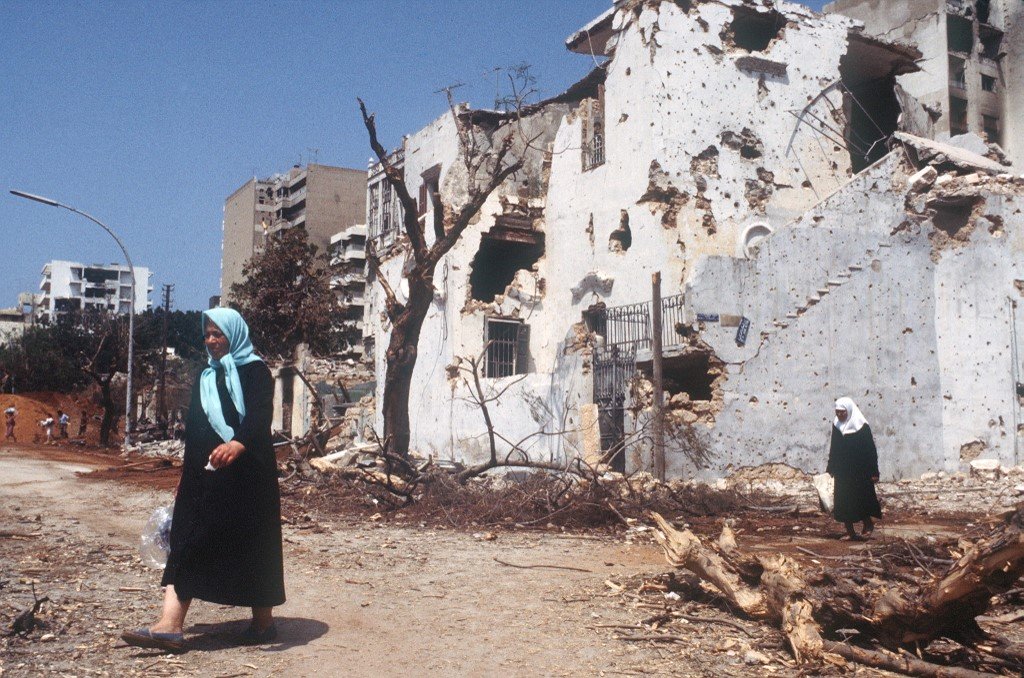
Lebanese women walk along a Beirut street devastated by Israeli shelling in 1982 (AFP)
The sectarian policies of actors such as Saudi Arabia have also benefitted Iran. The 1982 Israeli invasion of Lebanon enabled Iran to establish a foothold there and to help develop Hezbollah into a significant force. Even so, until the withdrawal of Syrian troops from Lebanon in 2005, Damascus, not Tehran, was the main influencer in Lebanon.
In Iraq, Iran has been helped by sectarian and ethnic bonds; many Iraqis are of Iranian origin or have mixed parenthood. The Shia history of past persecution, Iran’s help to them during Saddam Hussein’s rule, the hostile reaction of Sunni Arab states to the emergence of a Shia-majority government after the 2003 US invasion, and Iran’s help in subduing the Islamic State group have enhanced Tehran’s influence. In other words, Iran has benefitted from others’ mistakes.
Geopolitical loneliness
In Syria, Western and Arab insistence on Assad’s immediate departure, and their unwillingness to consider a UN proposal for a step-by-step process of ending hostilities and implementing political reform, opened the way for Iran to expand its influence. Attacks by religious extremists on Shia shrines enabled Iran to send volunteers from several Shia-majority countries to prop up Assad’s regime.
Still, Iran’s influence, including in Lebanon and Iraq, is limited. Despite Western and Arab claims, and ill-considered boasts by some Iranian officials, Iraq has not been Tehran’s puppet.
All post-2003 Iraqi governments have refused to reinstate the 1975 Algiers Agreement on the division of Shatt al-Arab, and have not been forthcoming on many other issues, such as building a railway from Iran to Basra. Only last year they agreed to resume the Algiers Agreement. Iraq has also used Iran to bargain with the West and Arab states.
In Syria, the Assads, father and son, have also used Iran. Hafez al-Assad used Iran to contain Saddam Hussein, balance Egypt, and get Iranian free oil. But Syria never changed its basic policies to please Iran; in the 1990s, Hafez rebuffed Tehran by going to the Madrid Conference on Middle East peace. Had Bashar al-Assad reclaimed the Golan and received more money and recognition from the West, he would have abandoned Iran. It was geopolitical loneliness that pushed Bashar towards Tehran.
In Yemen, the 2015 Saudi invasion enhanced Iran’s presence.
Throughout the Middle East, Iran has played the fool, spending blood and treasure without gaining anything lasting. In Syria, it has lost ground to Russia and even Turkey in places such as Idlib. In Iraq, its presence has become more precarious.
While money has temporarily helped to increase Iran’s regional influence, sectarian and ideological affinities, unresolved conflicts and other players’ mistakes have been equally important. Thus, while economic sanctions could reduce Iran’s influence, they cannot eliminate it as a key player in the Middle East.
The views expressed in this article belong to the author and do not necessarily reflect the editorial policy of Middle East Eye.
- Shireen T. Hunter
- Shireen T. Hunter is an affiliate fellow at the Georgetown University Center for Muslim -Christian Understanding. Dr. Hunter’s areas of expertise include the Middle East (especially the Persian Gulf region), the Mediterranean, Russia, Central Asia, and the Caucasus (North and South). Dr. Hunter was educated at Teheran University (BA and all-but-thesis for a doctorate in international law), the London School of Economics (MSc in international relations), and the Graduate Institute of International Affairs and Development Studies, in Geneva (PhD in international relations). She has published 19 books.
The post Why US sanctions cannot remove Iran as a key player in the Middle East appeared first on CANADA VOICE.
]]>The post Is Boris Johnson really Britain’s Trump appeared first on CANADA VOICE.
]]>
The United Kingdom has a new prime minister, again, roughly three years after Theresa May took over to clean up David Cameron’s Brexit mess. The new PM is Boris Johnson, one of the many European politicians to be portrayed as a local equivalent of the US president Donald Trump in the US media. This time, however, the similarities are indeed striking.
Both are loudmouthed man-children, with a history of adultery and other scandals, whose professional success is a combination of immense privilege, unscrupulous opportunism, and relentless self-promotion, all happily promoted by a complicit media environment. They share an “unorthodox” approach to politics as well as a “tell it like it is” communication style – media euphemisms for reckless opportunism and a combination of homophobia, racism and sexism.
While Trump mainly lies about himself, from his richness to the size of his inauguration crowd, Johnson mostly lies about the European Union. After first being fired by the Times (of London), for making up a quote from his godfather (historian Colin Lucas), he was quickly picked up by the Daily Telegraph as its EU reporter. From Brussels, where his father had served as a Member of the European Parliament and a top Eurocrat at the European Commission, Johnson filed report after belligerent report bursting with lies and myths about alleged EU regulations and scandals, eagerly repeated by the Eurosceptic elites and masses.
Writing for the paper-of-record for the Conservative party, it set him up perfectly for a political career in a party that was increasingly moving away from Brussels. For years the MP for Henley in Oxfordshire used his Daily Telegraph column to advance his political career, something he continued to do as he was launching his campaign as the next leader of the Conservative party – and, by extension, the next prime minister of the United Kingdom.
Like Trump, Johnson’s “gaffes,” another media euphemism almost exclusively reserved for upper-class white men, include a litany of racist, homophobic, and sexist statement, from referring to Africans as “piccaninies” with “watermelon smiles”, to Muslim women wearing burqas as “bank robbers” and “letter boxes”, to gay men as “tank-topped bumboys” and to female Labor MPs as “hot totties”.
However, there are also important differences between the American president and the British premier. Trump was actually elected by a much larger percentage of the population than Johnson. While Trump lost the popular vote decisively against Hillary Clinton, he was at least elected by 46.1 % of the voting population. In sharp contrast, Johnson was chosen by the membership of the Conservative party, which accounts for roughly 0.02% of the British population. This makes Johnson’s electorate not just smaller than Trump’s, but also even older and whiter.
And while the two share a remarkable flexibility in terms of policy positions, Johnson is much more solidly Conservative than Trump is Republican. Both politically and socially he is the product of an elitist upbringing that is uniquely British and Conservative. As Simon Kuper has so brilliantly described, Johnson is a perfect example of the public schoolboys that brought us Brexit (confusingly, private schools are called public schools in the UK).
This is not to say that Johnson is any less a loose cannon than Trump, but he is much more a professional politician. He is also, professionally and socially, fully connected to the British political and social elites – consequently, unlike Trump, Johnson does not really have a chip on his shoulder about being scolded by “the elite”. His support is therefore much more partisan and much less charismatic – in Trump’s terms, Johnson could not kill someone at Oxford Circus and get away with it.
In short, Boris Johnson is probably as close to a European Trump as you can find – just as Britain is the most American country in Europe. But Johnson is ultimately British, just as Trump is essentially American. He is a product of a specific elitist class culture, steeped in privilege and tradition, to which he has both an allegiance and responsibility.
It is this rootedness in Britain’s elite culture and society that propelled him to power but that will also lead to his downfall. Unlike Trump, who is largely a one-man movement that captured an establishment party with an increasingly anti-establishment electorate, Johnson is the voice of both the establishment and the anti-establishment. And it is this dependence on both elements of the Conservative party, which he perfectly embodies in his own schizophrenic political career, that will make it more likely he goes down into the history books as the shortest term prime minister rather than the prime minister who delivered Brexit.
The post Is Boris Johnson really Britain’s Trump appeared first on CANADA VOICE.
]]>The post En 2030, aucun pays n’aura atteint l’égalité femmes-hommes appeared first on CANADA VOICE.
]]>L’égalité de genre ne sera toujours pas réelle, et ce, dans aucun pays du monde, en 2030. Telle est la conclusion d’un nouvel index global de l’égalité femmes-hommes, qui suit la réalisation d’objectifs définis par l’ONU : malgré des progrès significatifs, les États n’en font pas assez contre les inégalités.
Les femmes ne seront toujours pas égales aux hommes en 2030. Les dix années à venir ne suffiront pas à assurer aux unes les mêmes droits et conditions de vie que les autres. C’est la conclusion de Equal Measures 2030 (EM 2030), un groupe d’organisations et d’entreprises à l’origine d’un nouvel index global de l’égalité de genre. Porté par la Fondation Bill et Melinda Gates, la Coalition internationale pour la santé des femmes ou encore l’ONG Plan International, Equal Measures 2030 a annoncé les résultats de trois ans de collecte et d’analyse de données ce lundi 3 juin 2019.
129 pays où vivent 95% des femmes et filles de la planète ont ainsi été passés en revue grâce aux données des agences des Nations unies, de la Banque mondiale ou encore d’ONG et de think tanks. Le but du SDG Gender Index est simple : mesurer les efforts réalisés pour remplir les objectifs de développement durable (SDG) définis par l’ONU et adoptés par 193 pays en 2015. Pour leur étude, les équipes d’EM 2030 ont pris en compte 14 objectifs sur 17 : ceux qui visent spécifiquement l’égalité de genre, mais aussi tous les domaines qui affectent plus durement les femmes que les hommes, comme l’accès à Internet, à un compte bancaire ou à l’eau potable. Chaque pays est noté de 0 à 100, soit de l’inégalité totale à l’égalité parfaite. Et les notes sont mauvaises.
“Aucun pays” n’en fait assez pour assurer l’égalité
Pour noter les 129 pays étudiés, EM 2030 a commencé à les étudier en 2016. Selon le barème présenté dans l’étude, seule une note supérieure à 90 montre des efforts «excellents» en matière d’égalité. Problème : aucun pays n’est aussi bien noté pour l’instant. Le Danemark, qui arrive en tête, a obtenu la note de 89,3. La Finlande, la Suède et la Norvège suivent et constituent le peloton de tête. La France arrive en 14e position avec 84. Les États-Unis, eux, ne sont classés qu’à la 28e position. Leur note, 77,6, est probablement liée aux récents reculs des droits des femmes après le vote de plusieurs lois très restrictives en matière d’avortement.
En vidéo, les chiffres des inégalités en France
«Je ne vois aucun pays mener les actions ambitieuses et nécessaires pour s’attaquer à des problèmes difficiles à résoudre, y compris les pays les mieux notés, a commenté Alison Holder, directrice de EM 2030, citée par le Guardian. Et je ne vois pas comment ces problèmes pourraient disparaître naturellement. Même dans les pays les mieux notés, il y a des problèmes massifs.» Les États sont encore impuissants face à la faible représentation des femmes aux parlements, les inégalités salariales et la violence sexiste. Le rapport du SDG Gender Index révèle même que plus de la moitié des pays n’en font pas assez pour remplir l’objectif numéro 5 des SDG, qui vise à lutter contre toutes les formes de violence de genre, les mutilations génitales, les mariages précoces et le manque de soins reproductifs et sexuels.
Le SDG Gender Index doit être mis à jour en 2021. Grâce à ces chiffres, les organisations membres de Equal Measures 2030 espèrent peser sur les politiques publiques, comme l’a expliqué Memory Kachwamba, directrice exécutive du Réseau de développement et de communication des femmes africaines, membre d’EM 2030. «Quand nous parlons à des décideurs politiques, ils disent vouloir des preuves, a-t-elle déclaré. Maintenant, nous avons ces preuves.»
La rédaction vous conseille :
- L’entrepreneuriat des femmes africaines, une priorité pour la Banque mondiale
- Au Liban, des centaines de personnes manifestent contre les mariages précoces
- Marlène Schiappa veut relever à 50% les quotas de femmes “dans tous les domaines”
Tags : droits des femmes, Égalité, monde, Femme
The post En 2030, aucun pays n’aura atteint l’égalité femmes-hommes appeared first on CANADA VOICE.
]]>