The post Are Trump officials driving Alberta’s separatist movement in Canada appeared first on CANADA VOICE.
]]>Alberta separatists seek funding from the Trump administration after three reported meetings.

ALJAZEERA By Elizabeth Melimopoulos
Published On 30 Jan 202630 Jan 2026
Canada’s Prime Minister Mark Carney has said that he expects the United States to respect the country’s sovereignty after reports that Alberta separatists have met several times with officials of the Donald Trump administration.
The Financial Times reported that US State Department officials held meetings with the Alberta Prosperity Project (APP), a group calling for a referendum on whether the energy-rich western province should leave Canada.
Recommended Stories
Canada’s Carney hails new trade deals, ‘expects’ US to respect sovereignty
Speaking in Ottawa on Thursday, Carney said he has been clear with US President Donald Trump on the issue.
“I expect the US administration to respect Canadian sovereignty,” he said, adding that after raising the issue, he wanted the two sides to focus on areas where they can work together.
Carney is himself an Albertan, raised in Edmonton, the provincial capital. The province has had an independence movement for decades.
Trump has repeatedly threatened to make Canada the “51st state” of the American Union.
Here is what we know:
What have the reports said about US contacts with Alberta separatists?
Leaders of the APP have reportedly met with US State Department officials in Washington at least three times since last April. Trump entered office for a second time in January.
These meetings have prompted concern in Ottawa regarding potential US interference in Canadian domestic politics.
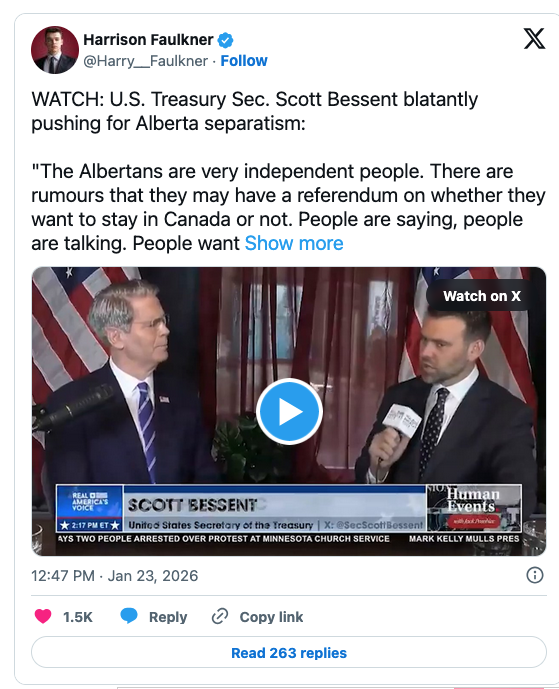
This follows comments by US Treasury Secretary Scott Bessent last week, who described Alberta as “a natural partner for the US” and praised the province’s resource wealth and “independent” character during an interview with the right-wing broadcaster Real America’s Voice.
“Alberta has a wealth of natural resources, but they [the Canadian government] won’t let them build a pipeline to the Pacific,” he said. “I think we should let them come down into the US,” Bessent said during an interview with the right-wing broadcaster.
“There’s a rumour they may have a referendum on whether they want to stay in Canada or not.”
Asked if he knew something about the separation effort, Bessent said, “People are talking. People want sovereignty. They want what the US has got.”
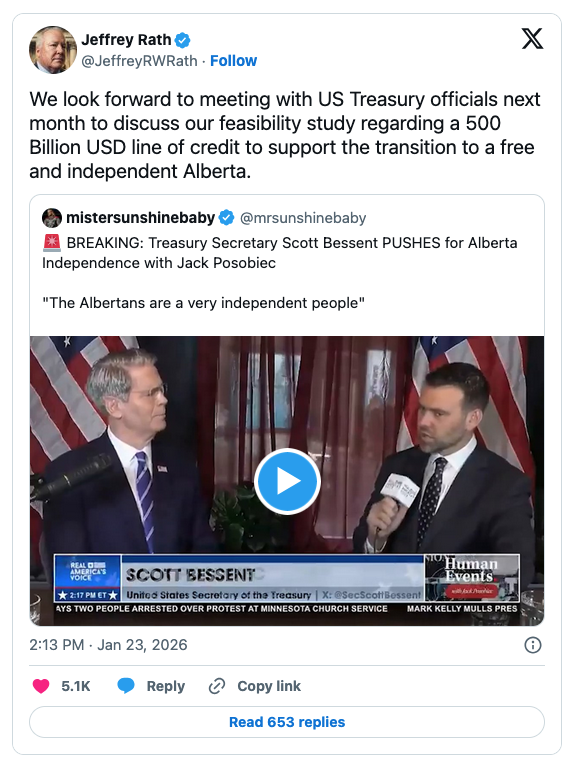
After Bessent’s comments, Jeffrey Rath, a leader of the APP, said that the group was seeking another meeting with US officials next month, where they are expected to ask about a possible $500bn credit line to support Alberta if a future independence referendum – which has not yet been called – were to be held.
The developments come at a sensitive moment in US-Canada relations, with trade tensions still simmering and after a recent speech at the World Economic Forum in Davos where Carney warned that Washington was contributing to a “rupture” in the global order.
Trump has repeatedly threatened to make Canada part of the American Union. His expansionist ambitions have been further underscored by his recent push to acquire Greenland from Denmark, which, like Canada, is a NATO ally. At the start of the year, the US military also abducted Venezuelan President Nicolas Maduro, and has since attempted to take control of the South American nation’s massive oil industry.
How have Canadian leaders reacted to the reports?
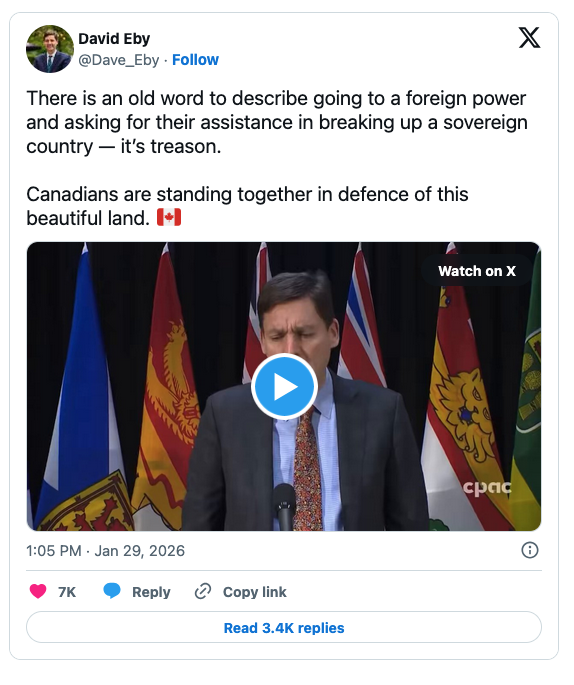
Speaking on Thursday, British Columbia Premier David Eby described the reported behind-the-scenes meetings as “treason”.
“To go to a foreign country and to ask for assistance in breaking up Canada, there’s an old-fashioned word for that – and that word is treason,” Eby told reporters.
“It is completely inappropriate to seek to weaken Canada, to go and ask for assistance, to break up this country from a foreign power and – with respect – a president who has not been particularly respectful of Canada’s sovereignty.”
Ontario Premier Doug Ford appealed for Canadian unity on Thursday morning.
“You know, we have a referendum going on out in Alberta. The separatists in Quebec say they’re gonna call a referendum if they get elected. Like, folks, we need to stick together. It’s Team Canada. It’s nothing else,” he said.
Alberta Premier Danielle Smith, however, said she won’t demonise the Albertans who are open to separation because of “legitimate grievances” with Ottawa and said she did not want to “demonise or marginalise a million of my fellow citizens”.
Smith has long been pro-Trump and visited the US president’s Mar-a-Lago estate in January 2025, at a time when most other Canadian leaders were joining hands to criticise his demand that the country become a part of the United States.
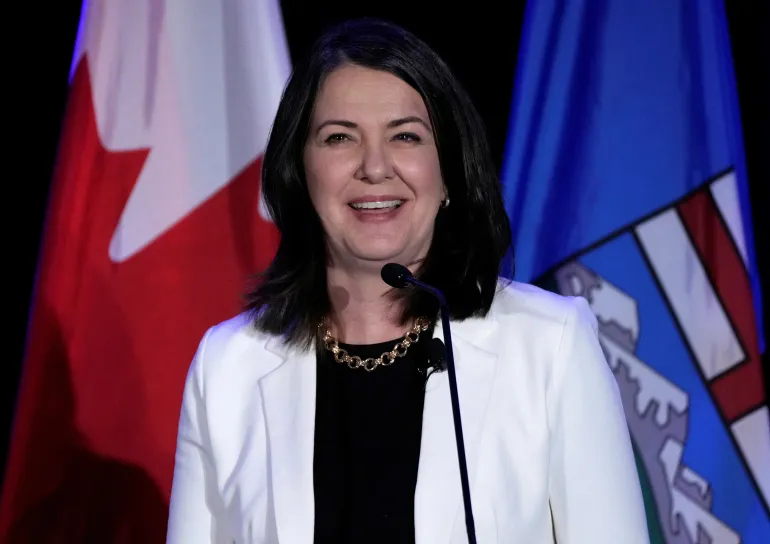
Alberta Premier Danielle Smith [FILE: Todd Korol/Reuters]
What do we know about a potential referendum in Alberta?
Anger towards Ottawa has been building in Alberta for decades, rooted largely in disputes over how the federal government manages the province’s vast oil and gas resources.
Many Albertans feel federal policies – particularly environmental regulations, carbon pricing and pipeline approvals – limit Alberta’s ability to develop and export its energy.
As a landlocked province, Alberta depends on pipelines and cooperation with other provinces to access global markets, making those federal decisions especially contentious.
Many Albertans believe the province generates significant wealth while having limited influence over national decision-making. In 2024-25, for instance, it contributed 15 percent of Canada’s gross domestic product (GDP), despite being home to only 12 percent of the population.
Alberta consistently produces more than 80 percent of Canada’s oil and 60 percent of the country’s natural gas.
Yet, many Albertans say that the federal government does not give the province its fair share from taxes collected. Canada has a system of equalisation payments, under which the federal government pays poorer provinces extra funds to ensure that they can maintain social services. While Quebec and Manitoba receive the highest payments, Alberta – as well as British Columbia and Saskatchewan – at the moment receive no equalisation payments.
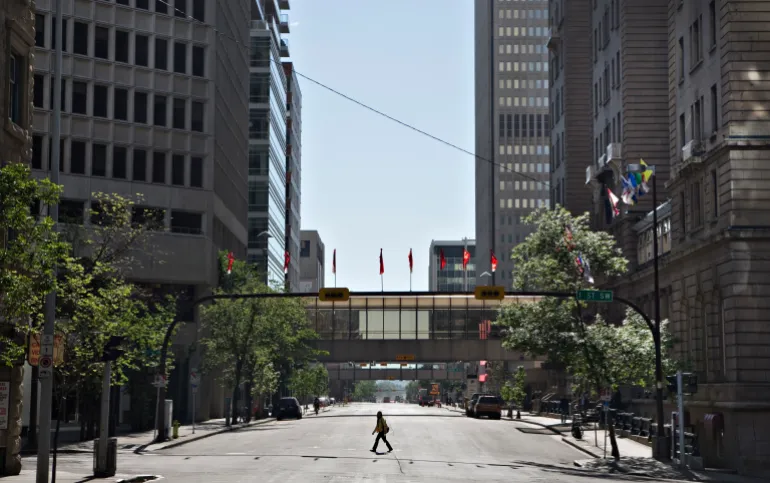
A woman crosses an empty downtown street in Calgary, Alberta [FILE: Andy Clark/Reuters]
Carney recently signed an agreement with Alberta, opening the door for an oil pipeline to the Pacific, though it is opposed by Eby and faces significant hurdles.
Recent Ipsos polling suggests that about three in 10 Albertans would support starting the process of leaving Canada.
But the survey also found that roughly one in five of those supporters viewed a vote to leave as largely symbolic – a way to signal political dissatisfaction rather than a firm desire for independence.
A referendum on Alberta independence could happen later this year if a group of residents can collect the nearly 178,000 signatures required to force a vote on the issue. But even if the referendum passes, Alberta would not be immediately independent.
Under the Clarity Act, the federal government would first have to determine whether the referendum question was clear and whether the result represented a clear majority. Only then would negotiations begin, covering issues such as the division of assets and debt, borders and Indigenous rights.

What is the Alberta Prosperity Project and what does it want?
The APP is a pro-independence group that is campaigning for a referendum on Alberta leaving Canada.
It argues that the province would be better off controlling its own resources, taxes and policies, and has been working to gather signatures under Alberta’s citizen-initiative rules to trigger a vote.
While it describes itself as an educational, non-partisan project, the group has drawn controversy over its claims about the economic viability of an independent Alberta.
On its website, the APP says, “Alberta sovereignty, in the context of its relationship with Canada, refers to the aspiration for Alberta to gain greater autonomy and control over provincial areas of responsibility.”
“However, a combination of economic, political, cultural and human rights factors … has resulted in many Albertans defining ‘Alberta sovereignty’ to mean Alberta becoming an independent country and taking control of all matters that fall within the jurisdiction of an independent nation,” it adds.

What else has Washington said?
White House and State Department officials told the FT that administration officials regularly meet with civil society groups and that no support or commitments were conveyed.
A report published by Canada’s public broadcaster CBC earlier this year quoted US national security analyst Brandon Weichert as saying that Trump’s talk of Canada becoming the “51st state” was, in reality, aimed at Alberta.
Appearing on a show hosted by former Trump chief strategist Steve Bannon, Weichert suggested that a vote for independence in Alberta would prompt the US to recognise the province and guide it towards becoming a US state.
Has the Trump administration tried this elsewhere?
Yes, in Greenland.
As with Canada, Trump has repeatedly called for Greenland to be incorporated into the US. His threats to annex Greenland have prompted strong opposition from the government of the Arctic island, Denmark — which governs Greenland — and Europe.
But as with Alberta, Trump’s administration has also attempted to test separatist sentiment. In August 2025, the Danish government summoned the top US diplomat in Copenhagen after Denmark’s national broadcaster reported that three Trump allies had begun pulling together a list of Greenlanders supportive of the US president’s efforts to get it to join the United States.
The post Are Trump officials driving Alberta’s separatist movement in Canada appeared first on CANADA VOICE.
]]>The post Business insider: Maple Leaf Makeover / By Emily Stewart appeared first on CANADA VOICE.
]]>
Business insider / By Emily Stewart – Senior Correspondent
It’s a best-of-times, worst-of-times scenario for Canada on the global stage.
To get the bad out of the way, its most important ally — the United States — has grown increasingly antagonistic, with renewed tariff threats and talk of annexation coming from the White House. On the upside, Canada is signaling it can stand more firmly on its own. Canadian Prime Minister Mark Carney has identified a “rupture” in North American integration and is moving his country in a more self-sufficient direction — both economically and politically. There’s a recognition that Canada and the US will always be deeply intertwined — Americans aren’t suddenly going to stop watching “Heated Rivalry” or “Schitt’s Creek,” and the Toronto Maple Leafs aren’t going to stop traveling south of the border — but some level of unwinding may now be unavoidable.
“Every country has to take care of itself,” says Tony Stillo, director of Canada Economics at Oxford Economics, “and Canada’s putting Canada first.”
In a speech at the World Economic Forum in Davos in January, Carney struck a determined, defiant tone toward the US and a decades-old rules-based international order that, in his view, is now falling apart. “Canadians know that our old comfortable assumptions that our geography and alliance memberships automatically conferred prosperity and security — that assumption is no longer valid,” he said. In turn, he’s made the choice to take on “the world as it is, not wait around for a world we wish it to be.”
The pope himself, I think, would struggle to find the patience to deal with the US administration right now.
Carney is walking a fine line. He is right that the US is no longer as reliable a partner as it once was in the economy, security, and trade. And as much as President Donald Trump has turned the divide into a chasm, the fracture has been forming for years, as both Democratic and Republican administrations in the US have taken a more protectionist stance.
At the same time, Canada can’t just walk away. Exports account for a third of Canada’s GDP, and more than 75% of its exports go to the US. By comparison, exports are about one-tenth of the US’s GDP, and around 16% of its exports go to Canada. Many of the two countries’ biggest industrial sectors, including automotives and energy, are almost irreversibly interwoven. The uncertainty emanating from the US has a big impact on Canada’s economy — as the saying goes, when the US catches a cold, Canada gets the flu.
There is also a short-term impetus to keep relations amicable. The US-Mexico-Canada trade deal (formerly known as NAFTA) is up for review mid-year, and the US, thanks to its sheer size, has more leverage.
“The prime minister’s in an impossible situation. It is incredibly challenging for any Canadian on the international side right now to both vigorously defend our economy and to do that without escalating an already volatile relationship,” says Dan Kelly, the president of the Canadian Federation of Independent Business. “The pope himself, I think, would struggle to find the patience to deal with the US administration right now.”
Canada is trying to reduce its reliance on the US through a series of policies aimed at growing and integrating its domestic economy. The federal government removed internal trade barriers that prevented goods and even workers from flowing between provinces. The IMF estimates that fully eliminating them would boost real Canadian GDP by 7%. Many Canadian consumers are opting to buy Canadian products where possible. Under Carney, the country established the Major Projects Office as part of a push to advance nation-building ventures and streamline regulatory approvals for ambitious programs in mining, energy, ports, and rail.
“The government isn’t trying to just invest, they’re trying to catalyze and incentivize private money to come in,” Stillo says.
These are steps in the right direction, but the major projects will take years to build. This is a long-term undertaking.
“We have high-talent workers. We’re the most educated in the OECD. We have real innovation in areas like AI and quantum computing, and we have natural resources — critical minerals, LNG, oil and gas — most countries would absolutely love to have,” says Matthew Holmes, the chief of public policy at the Canadian Chamber of Commerce. “We have all the preconditions to be an energy superpower and a major player economically, but we need to get our domestic economy fundamentals.”
Kelly tells me about a third of CFIB’s members, which are small- and medium-sized businesses, have started to do more business internationally in countries beyond the US, and a third are doing more internal trade. A recent business survey from the Bank of Canada found that sentiment remains “subdued,” though firms’ overall outlook has improved slightly.
We’re just looking to take a couple of eggs out of this basket and spread them around the world.
Part of the problem Canada faces is that any move it makes to cultivate ties elsewhere may elicit an outsize reaction from its neighbors to the south. Just look at its recent trade negotiations with China. Carney visited China in January and subsequently announced that Canada would allow 49,000 Chinese electric vehicles into the Canadian market at a 6.1% tariff rate, while China agreed to lower tariffs on Canadian canola seed. When Trump caught wind of it, he threatened to put 100% tariffs on Canadian goods coming into the US. Canada has tried to calm the situation, emphasizing that it’s not entering a free trade agreement with China, it’s just settling some preexisting disputes. The tit-for-tat also comes as Canadian oil sales in China surge, as it pushes into Asia.
“We’re not running into the arms of China,” says Julian Karaguesian, a course lecturer in McGill University’s economics department. “We’re just looking to take a couple of eggs out of this basket and spread them around the world. And China’s the largest economy in the world after the United States.”
Canada has trade opportunities outside the US and has set a goal to double non-US exports over the next decade. It already has a robust set of free trade agreements and is the only G7 nation to have them with all other G7 members. It’s also likely looking toward India and MERCOSUR, a trade bloc in South America.
Commerce Secretary Howard Lutnick has downplayed the ongoing spat, calling it “political noise” coming out of the prime minister. He said Canada has the “second-best deal in the world” with the US, behind Mexico. Lutnick also indicated that getting too close to China could hurt Canada amid the USMCA talks set for the summer and create a “road map” for overhauling the entire deal. Given the constantly changing nature of the US and Canada’s relationship as of late — and Trump’s ever-shifting focus on a variety of issues — the possible scenarios for USMCA negotiations run the gamut, from minor adjustments to a total breakdown in talks.
“With USMCA, the gloves are going to be off,” Karaguesian says.
— — — —
None of this is to say that Canada is in sterling shape. Its economy is growing at a lackluster pace, and its labor market is doing OK, but not great. Productivity has been lagging for years. It would surely prefer the US were not so adversarial. At the same time, the country and its leaders are clear-eyed about what’s happened and are laying out a plan for what’s next, internationally and domestically. Holmes, from the Chamber of Commerce, says Canada has had a sort of “it’s the economy, stupid” moment under Carney.
Peter Morrow, an economist at the University of Toronto, says that Canada is doing better than was feared a year ago. “There were a lot of concerns about dramatic levels of protectionism in the United States and all but complete collapses of manufacturing in Canada,” he says. “The realized tariffs have not been as dramatic as they might have been otherwise,” he says. The effective tariff rate on Canadian goods coming into the US is still under 10%. Carney has a “very good relationship with reality,” Morrow says, and as much as economic nightmare scenarios haven’t come to pass, the geopolitical outlook is worse than expected, given the instability of the NATO alliance and the deterioration of the global rules-based system that’s been in place since World War II.
Most of the economists and business people I spoke to for this story agreed that Canada coming into its own was a long time in the making. From Bush’s “you’re with us or against us” mentality post-9/11 to Obama’s “Buy America” push to Biden’s industrial policy, America has been acting like a less friendly friend for a while. Trump has taken it to an extreme, often failing to differentiate between international friend and foe. If it nudges Canada further out of America’s shadow, the thinking goes, so be it. Carney’s declaration that the global economy’s middle powers need to band together and his suggestion that the US cannot be trusted is a sentiment he’s not alone in — he’s just saying it out loud.
“Carney is saying things that obviously encapsulate well how many, many countries, companies, and leaders are feeling, including many parts in many parts of the United States,” Kelly says, adding that Carney’s economic background and focus are also a plus. “For a decade, anything economic was kind of issue number 500 on the Trudeau government’s list of priorities. And now it seems very much like ensuring our economy is in high gear is the top job for the prime minister.”
One of the main pieces of certainty Canada can have, at least in the immediate future, is that there’s going to be a lot of uncertainty coming from the US. In many ways, America has become a threat actor and cause of decline. This has fostered a novel level of pro-Canadian sentiment within the country’s borders and also boosted Carney’s profile on the international and domestic stage — his approval rating jumped to 60% in a recent poll.
This is also landing at what’s culturally a bright moment for Canada. Canada’s men’s hockey team is favored to win gold at the coming Winter Olympics, following up its victory in 2025’s Four Nations tournament. Its women’s team will likely be in contention for a medal as well. The gay hockey romance “Heated Rivalry,” out of Ontario, is everywhere. Tourists are turning up in Hamilton, Ontario, where the show is partially filmed, to check out some of the spots featured. The town is inviting them in.
“All these kinds of things to brand Canada’s reputation as a welcoming place to everyone is not unhelpful,” Kelly says. Especially as the US is moving in a different and much more unwelcoming direction.
Emily Stewart is a senior correspondent at Business Insider, writing about business and the economy.
Business Insider’s Discourse stories provide perspectives on the day’s most pressing issues, informed by analysis, reporting, and expertise.
The post Business insider: Maple Leaf Makeover / By Emily Stewart appeared first on CANADA VOICE.
]]>The post Man is shot and killed during Minneapolis immigration crackdown, National Guard activated appeared first on CANADA VOICE.
]]>MINNEAPOLIS (AP) — A federal immigration officer shot and killed a man Saturday in Minneapolis, drawing hundreds of protesters onto the frigid streets and ratcheting up tensions in a city already shaken by another fatal shooting weeks earlier.
Family members identified the man who was killed as Alex Pretti, a 37-year-old intensive care unit nurse who had protested President Donald Trump’s immigration crackdown in his city. After the shooting, an angry crowd gathered and protesters clashed with federal immigration officers, who wielded batons and deployed flash bangs.
The Minnesota National Guard was assisting local police at the direction of Gov. Tim Walz, officials said. Guard troops were sent to both the shooting site and to a federal building where officials have squared off with protesters daily.
Information about what led up to the shooting was limited, Minneapolis Police Chief Brian O’Hara said.
Department of Homeland Security spokesperson Tricia McLaughlin said in a statement that federal officers were conducting an operation and fired “defensive shots” after a man with a handgun approached them and “violently resisted” when officers tried to disarm him.
In bystander videos of the shooting that emerged soon after, Pretti is seen with a phone in his hand but none appears to show him with a visible weapon.
O’Hara said police believe the man was a “lawful gun owner with a permit to carry.”
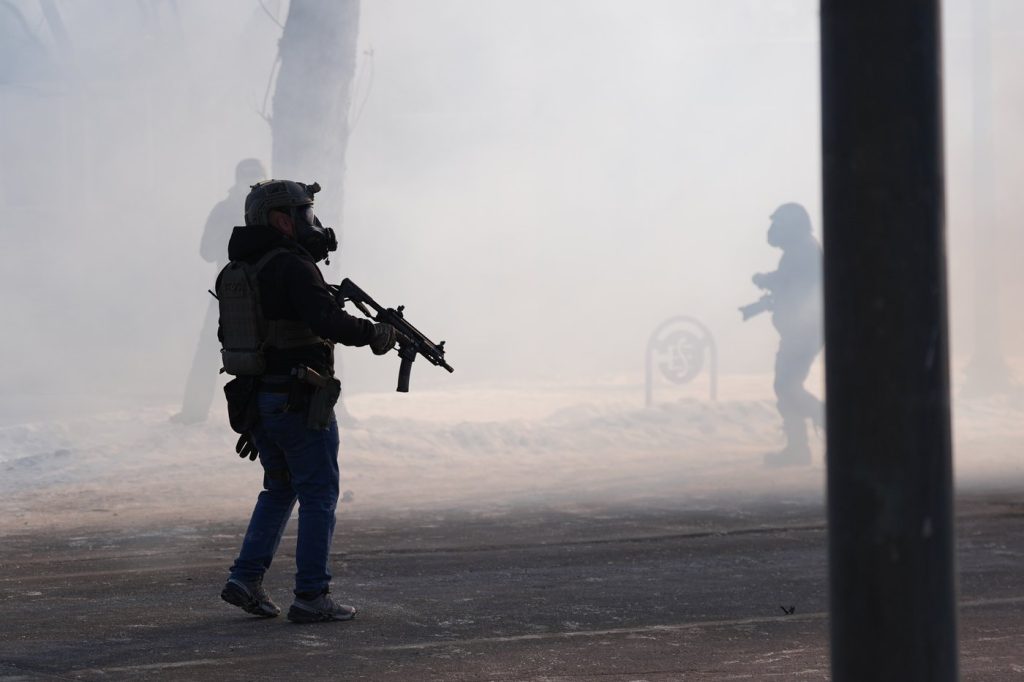
Federal immigration officers deploy tear gas after a shooting in Minneapolis, on Saturday, Jan. 24, 2026. (AP Photo_Abbie Parr) Copyright 2026 The Associated Press. All rights reserved
DHS Secretary Kristi Noem said during a news conference that Pretti had shown up to “impede a law enforcement operation.” She questioned why he was armed but did not offer detail about whether Pretti drew the weapon or brandished it at officers.
The officer who shot the man is an eight-year Border Patrol veteran, federal officials said.
Trump weighed in on social media by lashing out at Walz and the Minneapolis mayor.
Trump shared images of the gun that immigration officials said was recovered and said: “What is that all about? Where are the local Police? Why weren’t they allowed to protect ICE Officers?”
Trump, a Republican, said the Democratic governor and mayor are “are inciting Insurrection, with their pompous, dangerous, and arrogant rhetoric.”
Pretti was shot just over a mile from where an Immigration and Customs Enforcement officer shot and killed 37-year-old Renee Good on Jan. 7, sparking widespread protests.
Pretti’s family released a statement Saturday evening saying they are “heartbroken but also very angry,” and calling him a kindhearted soul who wanted to make a difference in the world through his work as a nurse.
“The sickening lies told about our son by the administration are reprehensible and disgusting. Alex is clearly not holding a gun when attacked by Trump’s murdering and cowardly ICE thugs. He has his phone in his right hand and his empty left hand is raised above his head while trying to protect the woman ICE just pushed down all while being pepper sprayed,” the family statement said. “Please get the truth out about our son. He was a good man.”
Video shows officers, man who was shot
In a bystander video of Saturday’s shooting obtained by The Associated Press, protesters can be heard blowing whistles and shouting profanities at federal officers on Nicollet Avenue.
The video shows an officer shoving a person who is wearing a brown jacket, skirt and black tights and carrying a water bottle. That person reaches out for a man and the two link up, embracing. The man, wearing a brown jacket and black hat, seems to be holding his phone up toward the officer.
The same officer shoves the man in his chest and the two, still embracing, fall back.
The video then shifts to a different part of the street and then comes back to the two individuals unlinking from each other. The video shifts focus again and then shows three officers surrounding the man.
Soon at least seven officers surround the man. One is on the man’s back and another who appears to have a canister in his hand strikes a blow to the man’s chest. Several officers try to bring the man’s arms behind his back as he appears to resist. As they pull his arms, his face is briefly visible on camera. The officer with the canister strikes the man near his head several times.
A shot rings out, but with officers surrounding the man, it’s not clear from where the shot came. Multiple officers back off the man after the shot. More shots are heard. Officers back away and the man lies motionless on the street.
The police chief appealed for calm, both from the public and from federal law enforcement.
“Our demand today is for those federal agencies that are operating in our city to do so with the same discipline, humanity and integrity that effective law enforcement in this country demands,” the chief said. “We urge everyone to remain peaceful.”
Gregory Bovino of U.S. Border Patrol, who has commanded the Trump administration’s big-city immigration campaign, said the officer who shot the man had extensive training as a range safety officer and in using less-lethal force.
“This is only the latest attack on law enforcement. Across the country, the men and women of DHS have been attacked, shot at,” he said.
Walz said he had no confidence in federal officials and that the state would lead the investigation into the latest fatal shooting.
But Drew Evans, superintendent of the Minnesota Bureau of Criminal Apprehension, said during a news conference that federal officers blocked his agency from the shooting scene even after it obtained a signed judicial warrant.
Amid the unrest, Senate Democratic Leader Chuck Schumer said Democrats will not vote for a spending package that includes money for DHS. Schumer’s statement increases the possibility that the government could partially shut down on Jan. 30 when funding runs out.
Protests continue in Minneapolis
Protesters converged at the scene of the shooting despite dangerously cold weather.
At midday Saturday, the worst of an extreme cold wave was over, but the temperature was still -6 degrees (-21 Celsius).
After the shooting, an angry crowd gathered and screamed profanities at federal officers, calling them “cowards” and telling them to go home. One officer responded mockingly as he walked away, telling them: “Boo hoo.” Agents elsewhere shoved a yelling protester into a car. Protesters dragged garbage dumpsters from alleyways to block the streets, and people who gathered chanted, “ICE out now” and “Observing ICE is not a crime.”
As dark fell, hundreds of people gathered quietly by a growing memorial at the site of the shooting. Some carried signs saying “Justice for Alex Pretti.” Others chanted Pretti’s and Good’s names. A doughnut shop and a clothing store nearby stayed open, offering protesters a warm place as well as water, coffee and snacks.
Caleb Spike said he came from a nearby suburb to show his support and his frustration. “It feels like every day something crazier happens,” he said. “What’s happening in our community is wrong, it’s sickening, it’s disgusting.”
___
The age of the man who was shot has been corrected to 37, per information from the police chief. The AP previously reported his age as 51 based on a hospital record.
___
Santana reported from Washington. Associated Press writers Giovanna Dell’Orto, Tim Sullivan and Sarah Raza in Minnesota, Jim Mustian in New York, Michael Catalini in New Jersey and Christopher Weber in Los Angeles also contributed.
Jack Brook, Steve Karnowski And Rebecca Santana, The Associated Press
The post Man is shot and killed during Minneapolis immigration crackdown, National Guard activated appeared first on CANADA VOICE.
]]>The post Trump says he’s withdrawing invitation for Carney to join his Gaza ‘Board of Peace’ appeared first on CANADA VOICE.
]]>Trump launched the new initiative at the World Economic Forum earlier this week

Darren Major · CBC News ·
U.S. President Donald Trump said late Thursday that he is withdrawing an invitation for Prime Minister Mark Carney to join his “Board of Peace” initiative for Gaza.
Trump launched the new initiative Thursday at the World Economic Forum, in Davos, Switzerland. Its stated aim is to rebuild the war-ravaged territory during a governance-transition period.
Some 35 countries have signed up to join the board, but Carney had not yet said if Canada would accept Trump’s invitation. The prime minister was not at the official launch in Davos and instead was attending the first day of a cabinet retreat in Quebec City.
In a post on his Truth Social website, Trump said Carney had been uninvited from joining the initiative.
Here are the countries joining Trump’s ‘Board of Peace’ so far
“Dear Prime Minister Carney: Please let this Letter serve to represent that the Board of Peace is withdrawing its invitation to you regarding Canada’s joining, what will be, the most prestigious Board of Leaders ever assembled, at any time,” Trump wrote in his post.
CBC News has reached out to the Prime Minister’s Office for comment.
Traditional U.S. allies reject invitation
Some key Middle East powers such as Israel, Turkey, Egypt, Saudi Arabia and Qatar have joined Trump’s initiative.
But traditional European allies like the U.K. and France have rejected the invitation — with France raising concerns that some of the initiative’s elements were contrary to the UN charter.
Many rights experts and advocates have previously raised concerns about Trump overseeing a board to supervise a foreign territory’s governance.
Trump threatens 200% tariffs on French wines to get Macron on ‘Board of Peace’
Putin says he’s considering ‘Board of Peace’ invite Trump claims was already accepted
Trump also extended an invitation to Russian President Vladimir Putin, a pariah in most international circles following the full-scale invasion of Ukraine. Putin has said he is considering joining the initiative.
To secure a permanent seat on the board, countries are expected to fork over $1 billion US.
Finance Minister François-Philippe Champagne said earlier this week that Ottawa does not plan to pay the hefty fee for a permanent spot.
“There [are] a lot of details to be worked out, but one thing which is clear is that Canada is not going to pay if we were to join the Board of Peace,” Champagne said.
Withdrawal of invite follows Davos speeches
Trump’s post uninviting Carney from his Gaza initiative comes after the two leaders both delivered speeches at the event in Davos.
In his Tuesday speech, Carney offered a stark assessment of the current state of global affairs, which has garnered international attention.
The prime minister argued that the “great powers” — like the U.S. — are using economic integration as “weapons,” and argued that negotiating with those countries bilaterally puts middle powers like Canada at disadvantage
‘The old order is not coming back,’ Carney says in provocative speech at Davos
Read Mark Carney’s full speech on middle powers navigating a rapidly changing world
Carney proposed that like-minded middle powers band together to push their priorities on the world stage, even if it’s issue by issue.
In his own World Economic Forum address, Trump complained that Canada should be “grateful” for the U.S.
“I watched your prime minister yesterday. He wasn’t so grateful — they should be grateful to the U.S., Canada. Canada lives because of the United States,” Trump said Wednesday.
“Remember that, Mark, the next time you make your statements,” Trump said in reference to Carney’s speech — though the prime minister had left Davos at that point.
‘Canada doesn’t live because of the United States,’ Carney says:
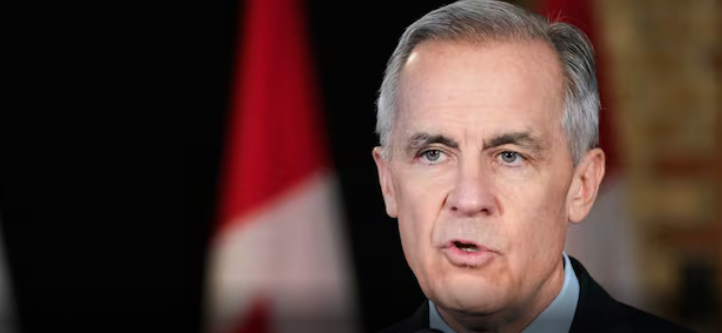
In a speech in Quebec City ahead of the federal cabinet retreat, Prime Minister Mark Carney issued a direct response to U.S. President Donald Trump, saying, ‘Canada thrives because we are Canadian.’ On Wednesday, Trump told the World Economic Forum that ‘Canada lives because of the United States.’
‘Canada thrives because we are Canadian’
Carney fired back at the president Thursday afternoon, in an address at his government’s cabinet retreat.
“Canada and the United States have built a remarkable partnership. In the economy, in security and in rich cultural exchange. But Canada doesn’t live because of the United States,” he said.
“Canada thrives because we are Canadian.”
The rhetorical spat between the two leaders comes as Canada, the U.S. and Mexico prepare to review the trilateral trade deal, known in Canada as the Canada-United States-Mexico Agreement (CUSMA), later this year.
ABOUT THE AUTHOR
Darren Major Senior writer
Darren Major is a senior writer for CBC’s parliamentary bureau in Ottawa. He previously worked as a digital reporter for CBC Ottawa and a producer for CBC’s Power & Politics. He holds a master’s degree in journalism and a bachelor’s degree in public affairs and policy management, both from Carleton University. He also holds master’s degree in arts from Queen’s University. He can be reached at darren.major@cbc.ca.
CBC’s Journalistic Standards and Practices·About CBC News
U.S. President Donald Trump unveiled his ‘Board for Peace’ in Davos, Switzerland, but so far, few Western allies have joined. Originally endorsed by the United Nations as part of a Gaza peace plan, its charter makes no mention of Gaza at all. Some critics are now accusing Trump of trying to set up his own rival UN.
The post Trump says he’s withdrawing invitation for Carney to join his Gaza ‘Board of Peace’ appeared first on CANADA VOICE.
]]>The post Video shows woman dragged from car by ICE agents in Minneapolis as she tells them she’s autistic appeared first on CANADA VOICE.
]]>The woman can be heard saying she is an ‘autistic disabled person’ trying to get to her doctor

Mark Gollom · CBC News ·
As violent clashes between ICE agents and protesters escalate in Minneapolis, video is now circulating of a woman who is dragged from her car and hauled away by masked agents as she says she is a disabled autistic person trying to get to the doctor.
The confrontation with the woman occurred on Tuesday, reportedly just a couple of blocks away from where Renee Nicole Good was shot to death by an ICE agent last week.
In the Tuesday video, which has been posted to YouTube by Freedom News TV, the woman is shown sitting behind the wheel of her vehicle, which is stopped on the street with the driver’s side window rolled down.
As violent clashes between ICE agents and protesters escalate in Minneapolis, video is now circulating of a woman who is dragged from her car and hauled away by masked agents as she says she is a disabled autistic person trying to get to the doctor.
The confrontation with the woman occurred on Tuesday, reportedly just a couple of blocks away from where Renee Nicole Good was shot to death by an ICE agent last week.
In the Tuesday video, which has been posted to YouTube by Freedom News TV, the woman is shown sitting behind the wheel of her vehicle, which is stopped on the street with the driver’s side window rolled down.
Multiple masked ICE agents approach her car and tell her to move it, as another agent points in the direction he wants her to go. She responds, but it’s not clear what she says or who she’s speaking to.
That same agent then pulls on the driver’s side door handle, but is unable to open it. The woman then drives slightly forward and stops. Agents again approach the car, demanding she move.
At that point, another agent, located on the passenger side of the vehicle, breaks the window in the passenger door. Throughout the altercation, protesters and ice agents can be heard yelling at each other and at the woman. Some people who appear to be protesters, tell her to drive away.
WATCH | Video of woman pulled from car, arrested by ICE:
The vehicle is then approached by several agents, and one opens the back door on the driver’s side, while two others try to get into the driver’s side front door.
Eventually, one agent grabs the woman, pulls her from the car and forces her to the pavement. Two agents then pull her to her feet and she grips the window with one hand and yells: “I’ve been beat up by police before. I’m disabled, trying to go to the doctor up there, that’s why I couldn’t move.”
Another agent then comes to the driver’s side of the vehicle and uses a knife to cut away the woman’s seatbelt that was wrapped around her.
Minneapolis, Portland shootings spur protests over ICE crackdowns as outcry grows
The woman again states that she’s an “autistic disabled person” and is trying to go to the doctor
At that point, a masked agent grabs her, turns her so she is facing the car, and two other agents join him to help force her arms behind her back. They handcuff her and carry her away as protesters continue to blow their whistles and yell at the agents.
Tear gas, flash bang grenades and pepper balls were also fired toward the protesters during the stand-off, according to multiple media reports.
CBC News requested comment from ICE about the incident, but did not hear back from the agency before publication.
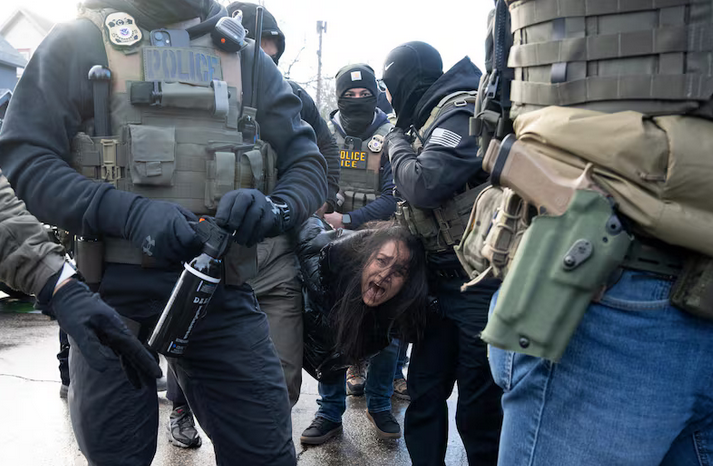
Federal agents carry a woman after they pulled her from her vehicle in Minneapolis, Minn., on Tuesday, Jan. 13, 2026. (Tim Evans/Reuters)
A spokesperson for the Department of Homeland Security told The Independent that ICE officers had been in the area to execute an arrest warrant for a 20-year-old man, originally from Ecuador, who they said had entered the U.S. illegally near El Paso, Texas, in 2019.
“As officers carried out their law enforcement duties, significant crowd surrounded them and began impeding law enforcement operations — a federal crime,” the spokesperson told the newspaper.
“One agitator ignored multiple commands by an officer to move her vehicle away from the scene, she was arrested for obstruction. Another agitator assaulted an officer by jumping on his back. Six of these agitators were taken into custody for assaulting law enforcement.”
In Minneapolis, ICE clashes with Minnesotans who want them out
As the federal law enforcement agency continues its crackdowns in Minneapolis, it’s become common for people to boo, taunt and blow whistles when they spot heavily armed immigration agents passing through in unmarked vehicles or walking the streets.
It’s all part of a grassroots effort to warn neighbours about ICE, confront agents over their actions and remind the government that residents are observing the agents as they execute warrants.
Homeland Security says it has made more than 2,000 arrests in the state since early December.
ABOUT THE AUTHOR
Mark Gollom – Senior Reporter
Mark Gollom is a Toronto-based reporter with CBC News. He covers Canadian and U.S. politics and current affairs.
With files from The Associated Press
CBC’s Journalistic Standards and Practices·About CBC News
Corrections and clarifications·Submit a news tip·
The post Video shows woman dragged from car by ICE agents in Minneapolis as she tells them she’s autistic appeared first on CANADA VOICE.
]]>The post As Iranians bury their dead, many are waiting for Trump’s next move appeared first on CANADA VOICE.
]]>
Briar Stewart · CBC News
While airing video on Wednesday of large funeral processions for some of the people killed during the protests that have recently gripped the country, Iran’s state broadcaster blamed the U.S. for whipping up and leading the “terrorist actions.”
That’s the clerical regime’s official narrative, which it has been amplifying while ruthlessly trying to silence all other accounts of what’s happening.
This wave of demonstrations began on Dec. 28, when merchants at Tehran’s Grand Bazaar protested the country’s deepening economic crisis and the further drop of the currency, the rial, to a record low.
The unrest quickly spread across the country, as people fed up with years of repression and restrictions took to the streets.
The U.S. and Canada are urging their citizens to leave Iran immediately as Iranians send urgent pleas for help and describe the violence inflicted by security forces. Meanwhile, the number of those killed during ongoing protests has surpassed 2,000, according to human rights groups.
For nearly a week, most of Iran’s 90 million citizens have been cut off from the internet and prevented in many cases from connecting with family and friends both inside and outside Iran.
“The signals were cut as the protests began and citizens were suddenly paralyzed,” wrote a 22-year-old man in a message to CBC News. “Communication is still extremely difficult. SMS (messaging) is down.”
CBC is not identifying the man because, like others, he is concerned about potentially severe repercussions from the Iranian regime.
Over the past two days, with the help of an Iranian journalist living in Europe, CBC has been able to connect with three individuals in Iran on the social messaging platform Telegram.
All three answered questions about the protests and the level of violence, as well as U.S. President Donald Trump’s threats to intervene because of the brutal crackdown on protesters.
The U.S.-based human rights group HRANA says it has verified more than 2,500 deaths.
“I personally witnessed gunfire and attacks … tear gas, sound bombs or flares, live ammunition and pellet guns,” said the 22-year-old, who is in the southern Iranian city of Bandar Abbas, which lies on the Strait of Hormuz.
“I witnessed the confirmed death of at least one person right next to me. The body was taken away by the repression forces.”
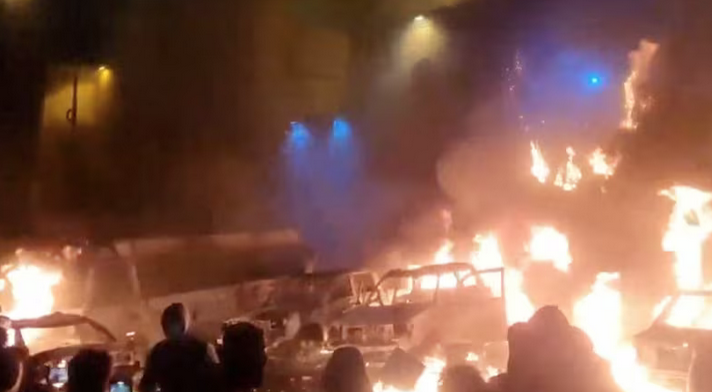
In this screen grab obtained from a social media video released on Jan. 9, protesters gather as vehicles burn in the Iranian capital, Tehran. (Reuters)
Thousands killed, even more arrested
In addition to those who have been killed, human rights groups estimate that thousands have been arrested during the protests. Iran’s judicial chief has vowed swift justice.
The 22-year-old said that security forces used motorcycles, armoured vehicles and water cannons to try to push demonstrators back.
He said one of his friends was hit by several pellets at a protest and that he knew of numerous people who were injured in the eyes and face by projectiles.
The man described the protests as unprecedented, even compared to previous uprisings, such as the 2022 demonstrations sparked by the death of 22-year-old Mahsa Amini in police custody.
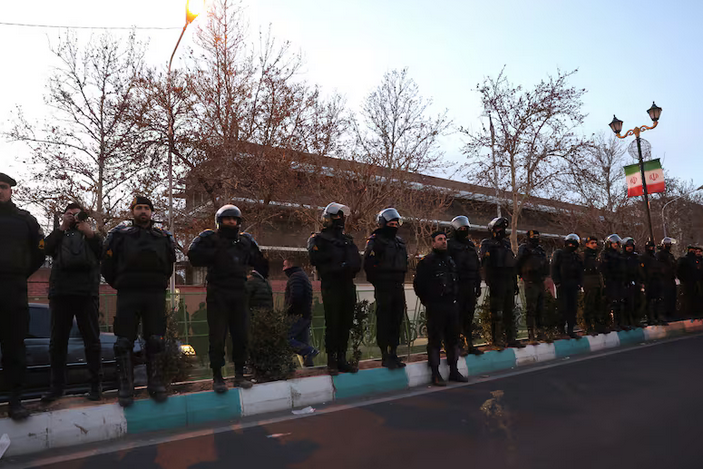
Members of the Iranian police stand guard in front of the British embassy following anti-government protests in Tehran on Jan. 14. (Majid Asgaripour/West Asia News Agency/Reuters)
That’s because several “different segments of society” have taken to the streets and banks and government facilities were burned. A CCTV video verified by Reuters and posted on social media last week showed footage of a mosque in Tehran being vandalized.
In the central Iranian city of Isfahan, a man told CBC the situation was so tense, even grocery stores didn’t “dare to open.”
He said after an office belonging to a subsidiary of Iran’s state broadcaster was set on fire on Jan. 9, pickup trucks arrived mounted with heavy machine guns. The guns were fired into the air to disperse the crowd.
“There were fatalities, but the numbers are very unclear,” he said of that particular incident.
Starlink banned
Iranians told CBC that it has been impossible to talk to people outside of the country unless you have access to a Starlink satellite internet system, which was formally banned in June, after the 12-day war between Israel and Iran.
Earlier this week, President Trump mused about sending Iran more of the systems. On Wednesday, Iran’s intelligence services said they confiscated a large shipment of Starlink kits in one of the country’s border areas.
Human rights groups reported that security forces had started seizing satellite dishes, in what is seen as an attempt to restrict access to foreign TV channels.
Awyar Shekhi, who is with the Norway-based Iranian Kurdish rights group Hengaw, said over the past two days, some people inside Iran were able to call out, but that calls into the country wouldn’t connect.
When she spoke with CBC by Zoom around 8 a.m. ET on Wednesday, she said Hengaw had not yet been able to connect with any of his sources on the ground that day.
Trump threats
In a defiant address delivered on Jan. 9, Iran’s Supreme Leader Ayatollah Ali Khamenei called the protesters troublemakers who were trying to please the U.S. president.
Trump has threatened to punish the long-ruling regime for using violence against demonstrators. He told Iranians to keep protesting, saying that “help is on the way,” without specifying what kind of response he is considering.
“Some think Trump won’t do anything. Some are upset with him, asking why he spoke if he didn’t intend to act,” wrote the 22-year-old from Bandar Abbas.
“People hope that the repressors, commanders and key figures of the Islamic regime will be targeted by drones and missiles.”
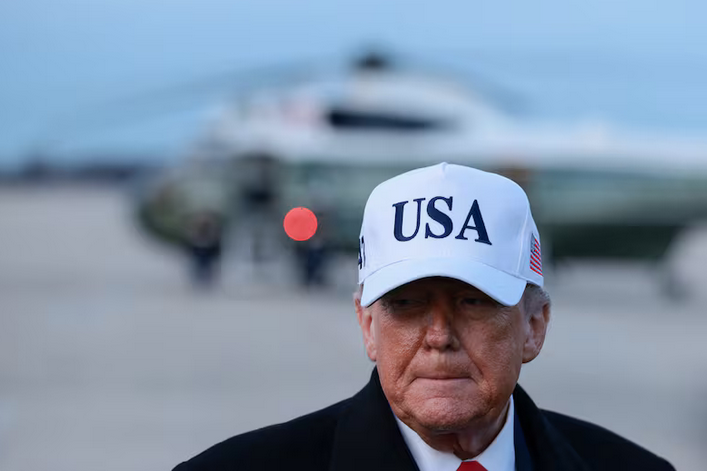
U.S. President Donald Trump is seen at Joint Base Andrews, Maryland, on Jan. 13, 2026. (Evelyn Hockstein/Reuters)
He hopes mounting international pressure leads to the regime’s demise, but others feel it is nowhere close to collapsing.
“These people are not going to disappear so easily,” said a 47-year-old living in Tehran in a voice message sent through Telegram. “This system is far more brutal, more complex and far more professional.”
He said security forces, including those in plain clothes, are on the streets, and public fear is pervasive. He notes that when he and others talk on the phone within Iran, they choose to temper their language, in case someone is listening.
There is widespread anxiety and anticipation about what could come next. He said people are hoping an outside power, potentially Trump, can help force a revolution.
“It is as if people are waiting for a saviour,” the man said.
In the northern part of the capital where he lives, he said people are still taking to the streets nightly, but are now mostly chanting broader slogans about change.
“I think people have pulled back for now because of the killings,” he said. “They are absorbing the shock, regrouping and then they will strike again.”
ABOUT THE AUTHOR
Briar Stewart – Foreign Correspondent
Briar Stewart is a CBC correspondent, based in London. During her nearly two decades with CBC, she has reported across Canada and internationally. She can be reached at briar.stewart@cbc.ca or on X @briarstewart.
With files from Mahtab Qolizadeh
CBC’s Journalistic Standards and Practices·About CBC News
Corrections and clarifications·Submit a news tip·
The post As Iranians bury their dead, many are waiting for Trump’s next move appeared first on CANADA VOICE.
]]>The post Here’s what New Year’s celebrations look like as the world rings in 2026 appeared first on CANADA VOICE.
]]>CBC / The Associated Press
For people in Canada, 2026 is getting ever closer after much of the world rang in the New Year at the stroke of midnight in their countries.
From Kirabati to the Croatia, billions of people have already kicked off the year with fireworks and light shows.
How to watch CBC’s Live Cross-Canada New Year’s Eve Countdown across all six time zones
Europe rings in a New Year
In Europe, fireworks were planned over a number of landmarks, from the Colosseum in Rome to the London Eye.
In Paris, revellers converged around the glittering Champs-Élysées Avenue. Taissiya Girda, a 27-year-old tourist from Kazakhstan, expressed hope for a calmer 2026.
“I would like to see happy people around me, no war anywhere,” she said. “Russia, Ukraine, Palestine, Israel, I want everybody to be happy and in peace.”

Fireworks explode over the London Eye to mark New Year’s celebrations. (Maja Smiejkowska/Reuters)
In Scotland, where New Year’s is known as Hogmanay, First Minister John Swinney urged Scots to follow the message of Auld Lang Syne by national poet Robert Burns and show small acts of kindness.
Greece and Cyprus turned down the volume, replacing traditional fireworks with low-noise pyrotechnics. Officials said the change is intended to make celebrations more welcoming for children and pets.
Middle Eastern countries throw grand celebrations
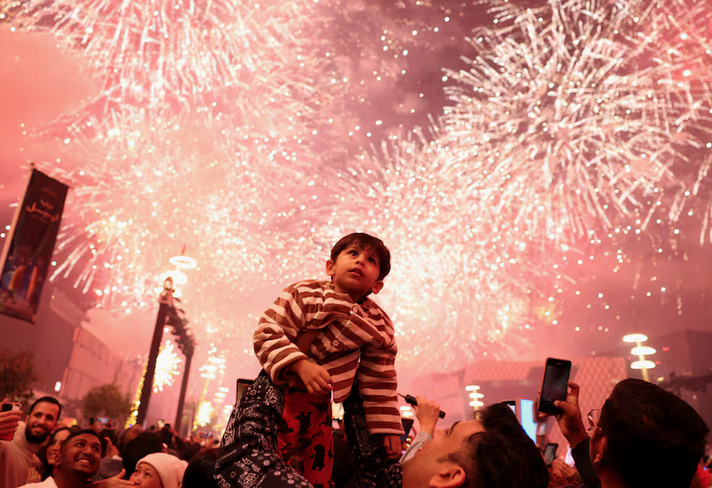
A child looks up as fireworks explode during New Year’s celebrations in Lusail, Qatar, on Thursday. (Mohammed Salem/Reuters)
Qatar and the United Arab Emirates lit up their night skies, holding grand celebrations to mark the start of 2026.
Thousands gathered in Qatar’s Lusail district to ring in the New Year on Thursday with a dazzling fireworks display.
In Dubai, the world’s tallest building was lit in celebration, as fireworks exploded around it. Abu Dhabi saw plenty of fireworks following a drone display that gave viewers unique visuals of the countdown appearing in the night sky.

Fireworks explode around the Burj Khalifa, the world’s tallest building, during New Year’s Eve celebrations in Dubai, United Arab Emirates, Thursday, Jan. 1, 2026. (Fatima Shbair/The Associated Press)
In Gaza, where hundreds of thousands have been displaced by more than two years of war, Palestinians said they hope the New Year brings an end to the conflict between Israel and Hamas.
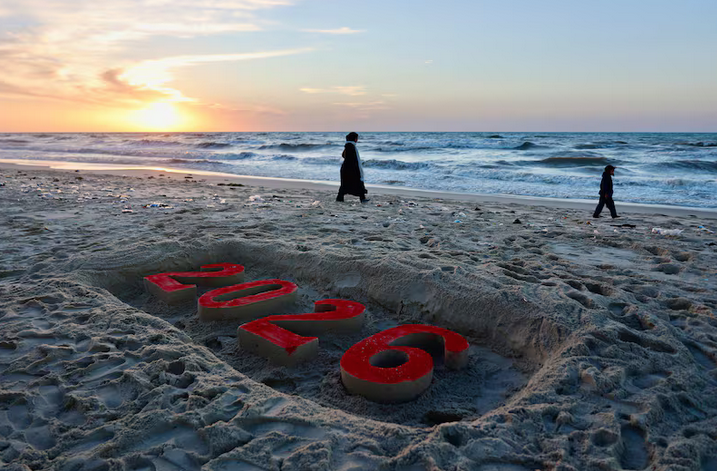
Palestinians walk past a sand sculpture reading ‘2026’ on the beach in Gaza City on New Year’s Eve. (Omar al-Qattaa/AFP/Getty Images)
“We hope that it will be a good year for our people in Palestine,” said local resident Faraj Rasheed, noting that thousands continue to live in harsh conditions in tent camps.
Others described 2025 as a year of loss.
“The war humiliated us,” said Mirvat Abed Al-Aal, displaced from the southern city of Rafah.
N.Z. lights up for 2026, defiant celebration in Australia
South Pacific countries were the first to bid farewell to 2025.
Clocks stuck midnight in Auckland 18 hours before the famous ball drop in New York’s Times Square.
Auckland was the first major city to ring in 2026 with a five-minute display, launched from New Zealand’s tallest structure, Sky Tower, involving 3,500 fireworks
Australia’s east coast welcomed 2026 two hours after New Zealand.

Fireworks light up the sky over the Sydney Harbour Bridge and the Sydney Opera House during New Year’s Eve celebrations. (Izhar Khan/Getty Images)
In Sydney, the country’s largest city, celebrations were held under the pall of Australia’s worst mass shooting in almost 30 years.
Two gunmen targeted a Hanukkah celebration at Bondi Beach on Dec. 14, killing 15 people and wounding 40.
A heavy police presence monitored the thousands who thronged to the waterfront to watch a fireworks show centred on the Sydney Harbour Bridge. Many officers openly carried rapid-fire rifles, a first for the annual event.
An hour before midnight, the massacre victims were commemorated with a minute of silence while images of a menorah were projected on the bridge pylons. The crowd was invited to show solidarity with Australia’s Jewish community.
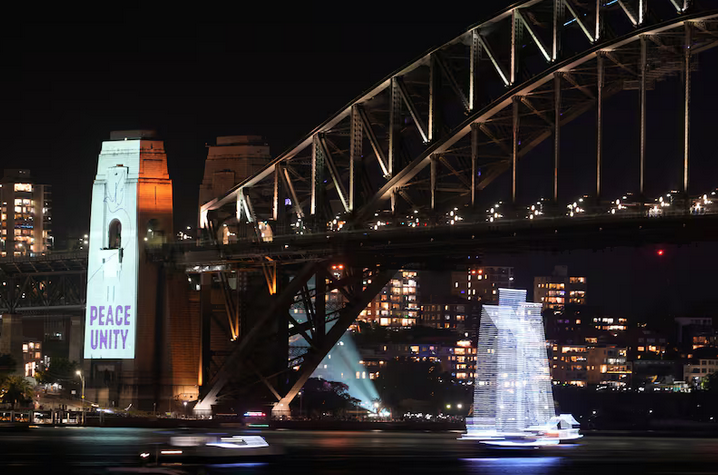
A message of peace and unity is projected on to the Sydney Harbour Bridge, during New Year’s celebrations in Sydney. (Rick Rycroft/The Associated Press)
New South Wales Premier Chris Minns urged Sydney residents not to stay away through fear, saying extremists would interpret smaller crowds at New Year’s Eve festivities as a victory.
“We have to show defiance in the face of this terrible crime and say that we’re not going to be cowered by this kind of terrorism,” he said.
Indonesia and Hong Kong hold subdued events
In Indonesia, one of Australia’s nearest neighbours, cities scaled back festivities as a gesture of solidarity with communities devastated by floods and landslides that struck parts of Sumatra island a month ago, claiming more than 1,100 lives.
The capital, Jakarta, was not ringing in 2026 with its usual fanfare, choosing subdued celebrations with a program focused on prayers for victims, Pramono Anung, the city’s governor, said last week.

Children perform a traditional Balinese dance to release the sun of 2025 and welcome the sun of 2026, during a New Year’s Eve celebration in Denpasar, on Indonesia’s island of Bali. (Sonny Tumbelaka/AFP/Getty Images)
Munafri Arifuddin, the mayor of Makassar, urged residents of one of Indonesia’s largest cities to forgo parties, calling for prayer and reflection. “Empathy and restraint are more meaningful than fireworks and crowds,” he said.
Concerts and fireworks on Indonesia’s tourist island of Bali were cancelled and replaced with a cultural arts event featuring traditional dances.
Death toll from floods in Indonesia, Sri Lanka and Thailand passes 1,000, with hundreds missing
Indonesian man searches for missing wife after devastating floods
Hong Kong, too, was ringing in 2026 without the usual spectacle in the sky over iconic Victoria Harbour, after a massive fire in November killed at least 161 people.
The facades of eight landmarks were turning into giant countdown clocks presenting a three-minute light show at midnight.
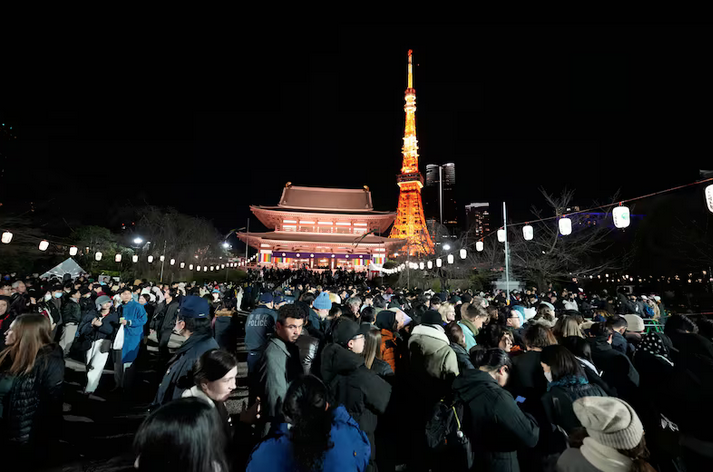
People gather for New Year’s celebrations at the Zojoji Buddhist temple in Tokyo. (Eugene Hoshiko/The Associated Press)
Many parts of Asia welcome the new year by observing age-old traditions.
In Japan, crowds were gathering at a Buddhist temple in Tokyo for a bell striking at midnight. In the South Korean capital, Seoul, a bell-tolling and countdown ceremony were being held at the Bosingak pavilion.

Fireworks explode over skyscrapers during New Year’s celebrations in Manila, the capital of the Philippines. (Ezra Acayan/Getty Images)
Quieter celebrations in Greece and Cyprus
Greece and Cyprus were ringing in 2026 by turning down the volume — replacing traditional fireworks with low-noise pyrotechnics, light shows and drone displays in capital cities. Low-noise fireworks avoid the explosive bursts that generate the loud cracks of traditional displays.
Officials in the countries said the change is intended to make celebrations more welcoming for children and pets, particularly animals sensitive to loud noise.
Additional security in New York City
Police in New York City will have additional anti-terrorism measures at the Times Square ball drop, with “mobile screening teams” in search of suspicious activity. It is not in response to a specific threat, according to NYPD Commissioner Jessica Tisch.
Zohran Mamdani will take office as mayor at the start of 2026. Two swearing-in ceremonies are planned, starting with a private ceremonial event around midnight in an old subway station
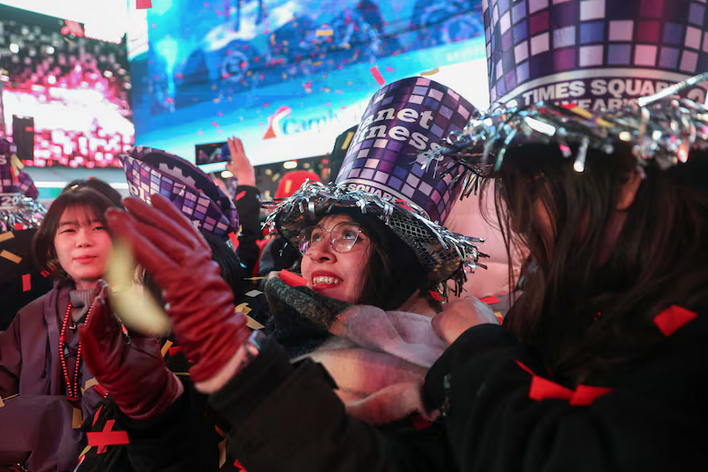
Revellers celebrate in Times Square in New York. (Heather Khalifa/The Associated Press)
Ring in 2026 with CBC’s Live Cross-Canada New Year’s Eve countdown. Join Adrienne Arsenault, Jann Arden, Ian Hanomansing and Andrew Phung as celebrations unfold across all six time zones. Get details on where and when to watch.
With files from CBC News and Reuters
CBC’s Journalistic Standards and Practices·About CBC News
Corrections and clarifications·Submit a news tip·
Related Stories
Tired of sad headlines? Here are some good news highlights from 2025
2025: The sports year in pictures
The post Here’s what New Year’s celebrations look like as the world rings in 2026 appeared first on CANADA VOICE.
]]>The post Israel attacks Beirut suburb two days after Lebanon agreed for talks appeared first on CANADA VOICE.
]]>Israel kills top Hezbollah commander only two days after Lebanon’s president said he was open to negotiations.
aljazeera. / By Justin Salhani
Israel has killed a senior Hezbollah commander in an attack on Beirut’s southern suburbs, which comes only two days after Lebanon’s president announced the country had succumbed to an Israeli pressure campaign and agreed to hold negotiations.
Hezbollah confirmed that its chief of staff, Haytham Ali Tabtabai, was among five people killed and 28 others wounded in the Israeli strike on Beirut’s Haret Hreik neighbourhood on Sunday.
Recommended Stories
list of 4 items
- list 1 of 4Israel kills top Hezbollah commander in attack on Lebanon’s capital
- list 2 of 4Despite ceasefires in Gaza and Lebanon, the war isn’t over for Netanyahu
- list 3 of 4Olive farmers face danger, neglect after Israel’s war in southern Lebanon
- list 4 of 4Israeli attack on Palestinian refugee camp in Lebanon kills at least 13
Israeli officials and media have warned of a renewed escalation against Lebanon in recent weeks, claiming Hezbollah is regrouping and rearming. Meanwhile, Lebanon’s government has come under pressure from Israel via its main benefactor, the United States, as both countries urge it to move faster to disarm Hezbollah and meet with Israelis for direct talks.
Israel has ‘the upper hand’
Lebanon’s leadership had pushed for indirect negotiations with Israel, even though the issue is divisive inside the country. Just two days before Israel’s attack on Beirut’s suburb, Lebanon’s President Joseph Aoun addressed the issue.
“The Lebanese state is ready to negotiate under the UN, US or joint international sponsorship – any agreement that would establish a framework for a permanent end to transborder aggressions,” Aoun announced on Friday from Tyr, a southern city that suffered extensive damage during last year’s war.
Aoun did not say explicitly whether or not the talks would be direct. Analysts, however, told Al Jazeera that Israel’s recent uptick in attacks indicates it is not looking to negotiate.
Israel “has got the upper hand militarily at the moment, and they don’t seem to be interested in negotiating in earnest,” Nicholas Blanford, a nonresident senior fellow with the Atlantic Council, told Al Jazeera.
“They’re quite happy sniping away at Hezbollah on a daily basis … Lebanon is doing what they can under the circumstances, but I don’t think they have a willing interlocutor in the Israelis at this stage.”
Despite an ostensible ceasefire, Israel has intensified attacks in Lebanon’s south and Bekaa Valley in recent days. At least 13 people were killed by an Israeli strike on Lebanon’s largest Palestinian refugee camp last week, in an attack that killed mostly children and marked the highest death toll in a single strike since a ceasefire was agreed in November last year.
Get instant alerts and updates based on your interests. Be the first to know when big stories happen.
Israel has killed more than 300 people in Lebanon since then, including around 127 civilians, according to the United Nations. It also continues to occupy at least five points in south Lebanon, despite the ceasefire stating Israel would withdraw its troops from Lebanese territory.
“The problem is that Israel is not interested in negotiating at the moment. It wants to eliminate Hezbollah or push the Lebanese army into a clash with the party,” Kassem Kassir, a Lebanese journalist close to Hezbollah, told Al Jazeera.
“Every time Aoun or [Prime Minister Nawaf] Salam talk about negotiations, Israel escalates its aggression.”
Israel ‘should demonstrate good faith’
Tabtabai’s killing marks the highest-ranking Hezbollah target killed since the ceasefire. The attack also came a week to the day before Pope Leo XIV’s planned visit to the country and a day after Lebanon mutedly celebrated its 82nd independence day.
US and Israeli officials have warned Lebanon of an intensification should the country not move faster to disarm Hezbollah. In August, Lebanon’s cabinet approved a plan to have the Lebanese Armed Forces (LAF) disarm Hezbollah and bring the group’s weapons under the state’s control. Hezbollah has refused to relinquish its weapons, saying the move serves Israel.
Still, the Lebanese army has been criticised by some US officials for moving too slowly in disarming Hezbollah. Analysts say the Lebanese government has also been criticised for failing to establish a political consensus on the divisive issue.
But Israel’s actions are undermining the Lebanese government’s efforts, according to analysts. After Lebanon’s cabinet approved the plan to disarm Hezbollah, US Special Envoy Tom Barrack visited Israel in an effort to get its military to stop attacks and withdraw troops from the Lebanese territory. He came back empty-handed.
The US recently cancelled a planned trip by Lebanon’s army chief Rodolphe Haykal to Washington, DC after the LAF issued a statement critical of Israel. Haykal had previously proposed suspending LAF operations on disarming Hezbollah until Israel stops its attacks.
“If Israel actively wants to enter and succeed in negotiations, it should demonstrate good faith in entering, and ways for that would be to at least reduce attacks on Lebanese territory or withdraw from some points in the south. They could create a positive dynamic to develop a consensus,” David Wood, the International Crisis Group’s senior analyst for Lebanon, told Al Jazeera.
Choices before Hezbollah
Since last November’s ceasefire, Hezbollah has only responded to Israeli attacks once. Under its new Secretary-General Naim Qassem, the group has largely shown restraint.
Still, there are concerns in Lebanon that the group may decide to soon change tactics.
“There is definitely a mood to strike back against the Israelis, not just from today’s attack but in general,” Blanford said. “But they know very well that if they do, the Israelis will escalate, and no one in Lebanon will thank Hezbollah for doing that.”
Israel’s military superiority and its US backing leave Hezbollah and the Lebanese state with few choices. Currently in Lebanon, the issue of negotiations with Israel and Hezbollah’s disarmament is divisive.
Analysts said many in the country fervently oppose direct negotiations, though the government has expressed a willingness to enter indirect talks, similar to 2022’s maritime agreement between Israel and Lebanon.
Many in Lebanon, including Hezbollah’s supporters, say they would be open to seeing Israel withdraw its troops from southern Lebanon and demarcate the border. Few welcome a renewed aggression, suggesting diplomacy as a likely preference.
But analysts say that would require Israel to respect the agreements it enters into, including the various ceasefire deals it has repeatedly violated.
“What we’ve seen since the ceasefire is that Israel speaks more loudly with actions than words,” Wood said. “Opponents [of negotiations] can point to Israel’s behaviour in Lebanon, Syria and Gaza, and say Israel is not bound by its own agreements.”
The post Israel attacks Beirut suburb two days after Lebanon agreed for talks appeared first on CANADA VOICE.
]]>The post Rare virus that killed Gene Hackman’s wife kills three in small California town appeared first on CANADA VOICE.
]]>Betsy Arakawa was killed by Hantavirus earlier this year, and health experts in California are worried about the number of cases so early in the season
The rare virus that killed Gene Hackman’s wife Betsy Arakawa has killed three people in a small northern Californian town east of San Francisco, health experts confirmed.
Local health officials are concerned after the unusual spike in Hantavirus-related deaths so close together, with all three deaths occurring in the first few months of the year.
The deaths occurred in the town of Mammoth Lakes, which has a population of just over 7,000.
Hantavirus is contracted when people come into contact with infected deer mouse droppings, urine, or saliva.
Dr. Tom Boo, Mono County Public Health Officer, said: “A third case of Hantavirus Pulmonary Syndrome (HPS), each of which has been fatal, is tragic and alarming.”
“The occurrence of three cases in a short period has me worried, especially this early in the year,” Dr. Boo said in a statement.
“Historically, we tend to see Hantavirus cases later in the spring and in the summer. We’ve now gone about a month without any additional suspect cases but remain concerned about the increase in activity.”

Hantavirus is a virus that spreads through the urine, droppings, or saliva of wild rodents, including deer mice, and can cause serious disease in humans (California Department of Public Health)
He said there was no clear picture of how the third person, a young adult, had contracted the virus, as there was no evidence of mice at the person’s home, and while there were some mice at their workplace, it was “not unusual for indoor spaces this time of year in Mammoth Lakes”.
“We haven’t identified any other activities in the weeks before illness that would have increased this person’s exposure to mice or their droppings,” Dr. Boo said.
The public health office believes deer mouse numbers are high in Mammoth Lakes and elsewhere in Eastern Sierra this year, and an increase in indoor mice also increases the risk of exposure to Hantavirus.
“I want to emphasize that as far as we know, none of these deceased individuals engaged in activities typically associated with exposure, such as cleaning out poorly ventilated indoor areas or outbuildings with a lot of mouse waste,” Dr. Boo said.
“Instead, these folks may have been exposed during normal daily activities, either in the home or the workplace.”
Dr. Boo urged Mono County residents to take precautions against the virus, which does not spread between people, including by storing food in rodent-proof containers and sealing all gaps in homes to prevent mice from entering.
“Many of us encounter deer mice in our daily lives, and there is some risk. We should pay attention to the presence of mice and be careful around their waste.”
Hantavirus, which is rare, shot to public attention after a New Mexico medical examiner announced that Gene Hackman’s wife Betsy Arakawa had died after contracting the virus.
The bodies of Arakawa, 65, and actor Hackman, 95, were found in their Santa Fe home in February, sometime after they died.
A medical examiner announced that Gene Hackman’s wife Betsy Arakawa died after contracting hantavirus pulmonary syndrome (AP)
Evidence suggested Arakawa died about two weeks before their bodies were found, while Hackman died about a week later from heart disease.
The Mono County health office said that about one in three people infected with Hantavirus die, adding that prompt diagnosis and treatment can improve outcomes.
The US began recording cases of the virus in 1993, and according to the Centers for Disease Control and Prevention, 864 laboratory-confirmed cases had been recorded across the country by the end of 2022.
The CDC reports that states in the southwest, in particular, have recorded the highest number of cases. California has recorded 78, while New Mexico has recorded 122.
Of the Californian cases, 27 have been recorded in Mono County. The health office said most cases are recorded in late spring or summer, so three cases at this time of year were “strikingly unusual.”
More about Betsy ArakawaGene HackmanCaliforniavirus
The post Rare virus that killed Gene Hackman’s wife kills three in small California town appeared first on CANADA VOICE.
]]>The post Watch in full: Angry exchange between Trump and Zelensky at White House appeared first on CANADA VOICE.
]]>US President Donald Trump and Ukraine’s President Volodymyr Zelensky clashed during an angry meeting at the White House on Friday.
Trump told his Ukrainian counterpart to be “thankful” and accused him of “gambling with World War Three”.
It comes a week after Zelensky said Trump was “living in a disinformation space” created by Russia, and the Trump accused Zelensky of being a “dictator”.
The post Watch in full: Angry exchange between Trump and Zelensky at White House appeared first on CANADA VOICE.
]]>