The post As Hezbollah Nervously Watches Iran, Washington Should Double Down on Disarmament ..by Hanin Ghaddar, appeared first on CANADA VOICE.
]]>
Washingtoninstitute / by Hanin Ghaddar
Hanin Ghaddar is the Friedmann Senior Fellow at The Washington Institute’s Rubin Family Arab Politics Program, where she focuses on Shia politics throughout the Levant.
On January 8, Iranian Foreign Minister Abbas Araghchi landed in Beirut with an economic delegation and, reportedly, four suitcases full of cash for Hezbollah, continuing Tehran’s tradition of sending officials to Lebanon as a show of power every time a crisis emerges. Yet this time feels different—the Islamic Republic’s latest wave of protests and international pressure has seemingly cornered the regime, presenting Beirut with an opportunity to shift the political narrative around Hezbollah and the pace of the disarmament process on the ground.
Lebanese officials appear to sense this change—local media reports indicate that Araghchi was not allowed to bring in the money. Although this was not the first time that airport security had forced Iranian officials to return home with bags of cash, last week’s incident was widely broadcast in the Lebanese media, seemingly sending a signal to Hezbollah. Indeed, both President Joseph Aoun and Prime Minister Nawaf Salam have made strong statements against the group in recent days. During a January 11 interview with Tele Liban, Aoun stated that Hezbollah’s weapons had “outlived their purpose” and become a burden on the Lebanese people, including the group’s Shia constituency. A day later, during a meeting with the ambassadors of the five-nation contact group for Lebanon, Salam stated that the government is still determined to implement the plan for disarming Hezbollah north of the Litani River.
Despite the president’s bolder-than-usual language, there are still no serious indications that the Lebanese Armed Forces (LAF) are prepared to translate these words into action, at least not beyond the country’s southern frontier zone. Yet this week’s developments highlight the new openings being created by Iran’s domestic crisis—openings that Washington and its partners should jump on quickly.
Hezbollah Is Worried, Beirut Is Idle
Sources close to Hezbollah circles have told the author that the group feels very vulnerable at the moment, believing that Israeli military operations may soon target organizational infrastructure in its southern Beirut stronghold of Dahiya. Hezbollah is also facing the potential loss of its top sponsor due to the mass protests throughout Iran and threats of U.S. military action against the regime. Even if Tehran manages to entice Washington into some sort of deal to avoid collapse, Hezbollah fears that its own existence would be part of the price the regime is willing to pay to survive. Sources indicate that this is why the group’s information machine and leadership have been silent about the protests since the crisis broke out.
Whatever happens in Iran, now is a great moment to take aim at the main pillars of Hezbollah’s domestic power, particularly the financial and political infrastructure that fuel the group’s ongoing threats to Lebanon, Israel, and the wider region. Beirut can best weaken Hezbollah’s financial networks by targeting its cash economy, while the international community can target and isolate the group’s political roots in various state institutions, from Speaker of Parliament Nabih Berri to the numerous government appointees and employees who act on behalf of Hezbollah and its partner Amal.
Regrettably, however, the Lebanese government is not taking advantage of Hezbollah’s present fear and confusion by pressing forward with any actions of this sort, let alone the more difficult task of nationwide disarmament. Instead, Beirut is giving itself another month (see below) to assess regional developments before even receiving the LAF’s plan for phase 2 of the disarmament process, which is supposed to extend from the Litani River to the Awali River. This, of course, will also give Hezbollah more time to prepare ways of obstructing the process.
Also regrettable is the LAF’s January 8 statement announcing the successful conclusion of phase 1, which was supposed to focus on disarmament efforts south of the Litani. Somehow, the statement avoided mentioning the words “Hezbollah” or “disarmament” at all. Instead, it spoke of “extending operational control over the territories that have come under its authority in the South Litani Sector, with the exception of lands and sites that remain under Israeli occupation.” The statement then provided two indications of why the disarmament effort has been delayed: first, it blamed “continued Israeli attacks on Lebanese territory and the occupation of several sites within it,” and second, it argued that “the delayed delivery of promised military capabilities to the Army constitutes a significant factor affecting the pace of mission implementation.”
Israel’s Response
In response to this announcement, the Prime Minister’s Office in Israel stated that Beirut and the LAF’s efforts were “an encouraging beginning, but they are far from sufficient, as evidenced by Hezbollah’s efforts to rearm and rebuild its terror infrastructure with Iranian support.” In addition, the Israeli Foreign Ministry posted an interactive map showing the group’s remaining arsenal south of the Litani. No other actor—including the United States or other members of the ceasefire monitoring mechanism—has publicly issued an evaluation of the LAF’s performance in phase 1, so the only details that anyone is getting on this process come from Israeli officials and media.
This is a serious gap that will further complicate internal accountability and political dynamics in Lebanon. Without evidence and evaluation, Hezbollah can still tell its constituency that it is strong and well-armed in the south, while political officials can use the uncertainty to stall subsequent phases.
On January 12, U.S. Ambassador to Lebanon Michel Issa said that defining “a deadline” for completing disarmament north of the Litani “is the most important thing.” And in parliament, the Lebanese Forces party—the legislature’s largest bloc—demanded that the LAF complete phase 2 within three months. But no practical plan for carrying out that phase has even been offered; as noted above, the LAF blamed the delay on Israel, while the government decided to postpone its scheduling decisions and give the LAF until the first week of February to submit a plan.
By waiting even that long, Beirut—and Washington—risk missing the promising but potentially narrow window of opportunity created by the Iran crisis. As discussed below, they also risk imminent military escalation inside Lebanon.
The Military Option
Amid the delays, Israel has been preparing for its own phase 2—namely, a widened air campaign against Hezbollah. Yet airstrikes can only go so far in destroying additional targets, including new weapons factories and depots in Dahiya. Only the LAF can fulfill that mission.
Of course, launching that mission would be a fateful decision for the LAF. Once the army moves north of the Litani, it may find itself in direct confrontation with Hezbollah. Despite the group’s vocal threats, however, armed confrontation is not a certainty, especially given Hezbollah’s many calculations and concerns regarding developments in Lebanon and Iran. One thing is clear: by beginning operations north of the Litani, the LAF would prevent a major Israeli escalation. And even if clashes with Hezbollah do unfold, they would be less damaging to Lebanon—particularly to its Shia community—than another major confrontation with Israel.
Policy Recommendations
With Iran and Hezbollah cornered by the current protest crisis, the group may be more ready to make compromises or, at least, less willing to confront the LAF militarily. Facing the most critical chapter in its history, Hezbollah is mainly focused on just surviving right now. Hence, there is no credible reason to postpone disarmament for another month; rather, this delay could cost Lebanon a golden opportunity to establish a national monopoly on weapons even sooner than originally hoped. Instead of letting Beirut waste time and hitch its planning to the still-uncertain outcome of the Iran protests, Washington should apply pressure via the following steps:
- Release a formal U.S. assessment of the LAF’s performance in phase 1, which would give Lebanese officials and citizens a reference other than the Israeli assessment.
- Ask Beirut and the LAF to submit the plan for phase 2 before the next meeting of the ceasefire mechanism.
- Urge Lebanon to set a realistic deadline for completing phase 2, with clear deliverables.
- Urge the LAF to launch initial operations north of the Litani River as soon as the plan is submitted. This would weaken Hezbollah’s narrative and potentially shift voter attitudes toward the group ahead of the parliamentary election scheduled for this May.
- Urge Beirut to start targeting Hezbollah’s domestic financial infrastructure, including cash networks, crypto systems, online gambling networks, and exchange companies.
- Process and deliver U.S. assistance to the LAF as soon as possible (assuming the LAF statement was correct in noting that promised assistance has been delayed). This would remove any credible excuse for continuing to postpone phase 2. Relatedly, France has announced that it will hold a donor conference on March 5 to support the LAF, but U.S. officials should make clear that this is no reason to delay initial action on the ground.
- Guarantee that the LAF will receive additional U.S. assistance once disarmament moves forward north of the Litani, with an eye toward the possibility that Hezbollah resistance could make phase 2 more difficult. Benchmarks could be established for sending specified assistance if certain steps are achieved by certain dates.
In addition to these immediate steps, President Trump could offer to host President Aoun in Washington once Beirut successfully implements phase 2. Conversely, if Lebanese military units do not expand their activities north of the Litani soon, Washington should be prepared to suspend aspects of its security assistance to the LAF, and signal that continued stalling would put the entire assistance package in danger of cancellation.
Hanin Ghaddar is the Friedmann Senior Fellow at The Washington Institute and coauthor of its recent report “A Roadmap for Israel-Lebanon Peace.”
The post As Hezbollah Nervously Watches Iran, Washington Should Double Down on Disarmament ..by Hanin Ghaddar, appeared first on CANADA VOICE.
]]>The post Recognizing Somaliland: Israel’s Return to the Red Sea..by Ehud Yaari appeared first on CANADA VOICE.
]]>
Washingtoninstitute / by Ehud Yaari
Ehud Yaari is the Lafer International Fellow at The Washington Institute.
The surprise announcement on December 26 that Israel will be the first country to grant Somaliland full recognition has ignited new dynamics in the Red Sea Basin. As part of the agreement, Israel will establish a diplomatic presence and possible security presence in the area for the first time since relations with Eritrea broke down in 2020. Israeli relations had been further degraded by the suspension of normalization with Sudan since civil war broke out there in April 2023. The Somaliland breakthrough gives Jerusalem an opportunity to move past those setbacks and could spur other governments to recognize the republic as well.
Why Normalize with Somaliland?
A former British colony, Somaliland gained independence in June 1960 and five days later united with Somalia, which had been an Italian colony. In 1991, however—following the brutal dictatorship of Gen. Muhammad Siad Barre, the collapse of the Somali state, and the country’s defeat in the Ogaden War with Ethiopia—Somaliland’s clans “restored sovereignty” and declared full independence with Hargeisa as their capital. In the thirty-five years since then, the Republic of Somaliland has maintained a democratic system with free elections and avoided the terrorist threats prevalent in Somalia.
Normalization of relations with Israel may open opportunities for bilateral cooperation in many spheres, including intelligence sharing and access to naval and air bases. (Notably, Somaliland has allocated only a minimal budget to its small military throughout its existence.) An ambitious program for Israeli civilian aid in water management, agricultural modernization, and information technologies is also being planned, and a large delegation from Hargeisa is expected in Israel soon.
Jerusalem was forced to seek allies with access to the Gulf of Aden, the Bab al-Mandab Strait, and the Red Sea after the Yemeni Houthis began a concerted attack campaign on October 19, 2023, targeting ships bound for Israel and launching missile and drone strikes on Israeli soil. Theoretically, Somaliland’s 850 kilometers of coastline across from Yemen could offer certain advantages to the Israel Defense Forces, who have mounted a series of massive airstrikes and occasional naval strikes against the Houthis. Although the IDF does not want a base in Somaliland, it does seek access rights when needed, as well as intelligence facilities to monitor the Houthis. (Relatedly, Arab states claimed for years that Israel had established an intelligence-gathering facility on top of a mountain range in Eritrea and a naval base in the Dahlak Islands. Yet according to various sources consulted by the author, there were no permanent IDF bases, just occasional Israeli use of Eritrean facilities.) Israeli planners assume that confrontations with the Houthis will resume if fighting erupts with Iran or Hamas. Importantly, the port of Eilat—Israel’s only outlet to the Red Sea—has all but ceased operations, and Jerusalem will not tolerate this state of affairs indefinitely.
Initial discussions about establishing relations between Israel and Somaliland began four years ago—well before the Houthi crisis—and intensified after former president Muse Bihi Abdi visited Washington in March 2022. The objective at that time was to exchange trade offices and/or diplomatic missions, not full recognition. Eager to reach an agreement, authorities in Somaliland quietly sent high-level envoys to Jerusalem (hosted by the author). Successive Israeli governments were reluctant to strike a deal, but by April 2025, the pace of negotiations with Somaliland’s new democratically elected president, Abdirahman Mohamed Abdilahi (aka Irro), was accelerating, eventually leading to the current breakthrough.
Other Potential Partners (and Complications)
Ethiopia—Somaliland’s closest neighbor, which governed the area during different periods in the more distant past—has long been weighing recognition but continues to postpone a decision. In January 2025, the two governments signed a memorandum of understanding that would give Addis Ababa access to the port of Berbera in return for recognition of Somaliland, thereby replacing the port of Djibouti as Ethiopia’s main trading route while meeting Prime Minister Abiy Ahmed’s top strategic goal of securing maritime access for his landlocked country. This idea was hotly debated because it would mean Ethiopia backing down from the “One Somalia” policy and flouting Mogadishu’s argument that Berbera is still part of its territory. In any case, implementation has stalled, and the prospects for reviving the deal are not clear.
Similarly, Taiwan has cultivated very close economic cooperation with Somaliland and helped develop the republic’s coast guard, but it, too, is hesitant to go further. Although it has exchanged trade and diplomatic representatives with Hargeisa, it has not granted formal recognition, mainly because China has been pressuring Somaliland not to recognize Taiwan.
The United Arab Emirates maintains close relations with Somaliland as well, running the republic’s ports and serving as its main export destination. Moreover, the UAE was one of the few Arab League members that did not join the chorus denouncing Israel’s recognition. Nevertheless, Abu Dhabi has avoided granting recognition—though this did not stop Somalia’s government from retaliating against the UAE after Israel’s recognition, announcing that it would terminate all Emirati port security deals and annul all defense agreements. Notably, however, two of the three ports covered by these canceled deals—Berbera and Bosaso—are not actually under Mogadishu’s control. Somaliland controls Berbera, while Bosaso lies in Somalia’s semiautonomous Puntland region, which cooperates closely with the UAE under President Said Abdullahi Deni and may eventually decide to secede from Somalia if the circumstances are favorable. (Both ports are also significant to U.S. military operations, as discussed in the next section.)
Most Arab states, particularly Saudi Arabia, seem to view Israel’s recognition of Somaliland as part of its wider cooperation with the UAE. Riyadh publicly denounced the move, describing it as an attempt to establish “parallel entities” in Somalia, though it ignored Mogadishu’s request to bomb Somaliland. Meanwhile, many Arab media outlets argue that Israel’s recognition announcement is connected to the recent UAE-sponsored offensive in eastern Yemen, in which the Southern Transitional Council captured large swaths of territory only to be turned back by a Saudi-led counteroffensive. They point out that STC leader Aidarous al-Zubaidi—who seeks the secession of “South Yemen” and peace with Israel—fled to the UAE through Somaliland after his offensive was defeated.
In Jerusalem, some officials felt that revealing Israel’s secret contacts with Somalia would be more beneficial than recognizing Somaliland. Yet the decision to favor Hargeisa instead was greatly influenced by Mogadishu’s lack of progress toward joining the Abraham Accords. Somali President Hassan Sheikh Mohamud met with Israeli Prime Minister Binyamin Netanyahu in Nairobi in 2016, and six years later, his spokesmen made public statements about the government’s desire for normalization with Israel. Yet Somalia’s deteriorating security situation—largely a product of intensifying offensives by the terrorist group al-Shabab—led Mohamud to rely on Turkish and Qatari military support, and the dialogue with Israel was suspended.
Next Steps and U.S. Interests
President Irro is hoping that the breakthrough with Israel will spur other countries—mainly the United States but also the United Kingdom and India—to review their stand on recognition, publicly declaring that “many” governments will follow Israel’s lead. For his part, Netanyahu would no doubt like the United States to recognize Somaliland, though it is unknown if he has spoken with Washington about this. He has urged India to recognize the republic, and Foreign Minister Gideon Saar has been consulting with Ethiopia and Kenya on this issue as well.
As for the future scope of cooperation with Israel, Hargeisa has consistently denied that it will provide Jerusalem with military bases. In a series of X/Twitter posts on January 1, Somaliland’s Foreign Ministry issued a strong statement on the matter: “The Government of the Republic of Somaliland firmly rejects false claims made by the President of Somalia alleging the resettlement of Palestinians or the establishment of military bases in Somaliland. Somaliland’s engagement with the State of Israel is purely diplomatic, conducted in full respect of international law and the mutual sovereign interests of both countries.” This statement may not reflect the longer-term intentions of both parties, however, and predicting how the emerging alliance will advance is premature at the moment.
Ultimately, much will depend on how the U.S. position evolves, and whether Washington wishes to build on its military operations from facilities in the strategically located port of Berbera. Notably, the Puntland-controlled port of Bosaso offers similar advantages on the Gulf of Aden and has repeatedly hosted U.S. operations against local al-Shabab mountain hideouts.
If the Trump administration decides to accept the fait accompli of Somaliland’s independence and recognize the republic, this may encourage more countries to adopt a different approach to the chronic crisis in the Horn of Africa. To be sure, this decision would carry the risk (or, in some eyes, the benefit) of fracturing Washington’s troubled relations with Somalia. Yet when it comes to staving off al-Shabab and other security threats, Mogadishu has no alternative to the counterterrorism assistance provided by U.S. Africa Command (AFRICOM), so it may not be willing to sever this relationship regardless of what happens with Somaliland.
Ehud Yaari is The Washington Institute’s Lafer International Fellow and a Middle East commentator for Israel’s Channel 12 television.
The post Recognizing Somaliland: Israel’s Return to the Red Sea..by Ehud Yaari appeared first on CANADA VOICE.
]]>The post Iran Is Teetering. The West Isn’t Prepared… by Holly Dagres appeared first on CANADA VOICE.
]]>washingtoninstitute / by Holly Dagres
Holly Dagres is the Libitzky Family Senior Fellow in The Washington Institute’s Viterbi Program on Iran and U.S. Policy.
Also published in New York Times
To avoid being caught flat-footed, Western governments must begin policy planning for the destabilizing waves that could accompany regime collapse while urgently restoring support for programs focused on internet freedom, human rights, and similar areas.
A lone man crouched in the middle of a Tehran street, a black jacket pulled over his head, blocking advancing Iranian security forces. The video went viral among Iranians, quickly drawing comparisons to the famous “Tank Man” in China’s Tiananmen Square in 1989. Similarly courageous actions have occurred across Iran: young protesters—sometimes alone, sometimes in pairs or more—standing or kneeling peacefully before their repressors. The protests are the largest since the Woman, Life, Freedom uprising that began in 2022 and are taking place despite what the United Nations has called crimes against humanity committed by the authorities during that period. The trigger this time was the collapse of the Iranian rial against the dollar. However, the protesters’ core grievances remain constant—government mismanagement, corruption, and repression—and they include an explicit demand for the ouster of the Islamic Republic…
Read the full article on the New York Times website.
The post Iran Is Teetering. The West Isn’t Prepared… by Holly Dagres appeared first on CANADA VOICE.
]]>The post Iran 1978: Hindsight Is a Wonderful Thing .. by Simon Henderson appeared first on CANADA VOICE.
]]>
Firsthand recollections of how the Islamic Revolution progressed on the ground raise questions about the current protest movement’s prospects for success.
Trying to predict what will happen in Iran is challenging, perhaps impossible. Believe me, I know. I have been here before.
In December 1978, three months after joining the Financial Times in London and despite never having been to Iran, I was sent to Tehran to cover the revolution. For the next two years, the revolution, the US embassy hostage crisis, and the start of the 1980-88 Iran-Iraq war dominated my life.
In late 1978 the country was already in crisis. In August of that year a cinema in the southern city of Abadan had been deliberately set ablaze, trapping around 400 people. The next month, soldiers fired on demonstrators in Jaleh Square, Tehran, killing scores. But, when I first went, the only thing I knew about Iran was that it was ruled with American and British support by the shah, who was kept in power by the feared Savak intelligence agency.
Within a few days of arriving I had the “splash,” the front-page lead of the FT: “Million join in peaceful protest march in Tehran.” In the next day’s edition my story was “More deaths as anti-shah protests grow.”
But the FT’s main interest was oil, so I headed to Ahwaz in the oil-rich southwest of the country, where I interviewed an American oil executive who told me he had had a death threat left on his desk: “Hell, I’ve been in this business too long—that sort of thing doesn’t scare me.” A week later I reported his assassination.
Economically, the country was in a deepening mess. Oil workers were on strike, reducing production to “near zero.” Gasoline was rationed, despite the country’s huge oil reserves, among the world’s largest. The lack of fuel for power stations meant electricity was cut off every evening, being reconnected only in the early hours of the following morning.
Those who could afford it were fleeing the country, even if it meant leaving assets like property behind. The main opposition was already identifiably “Islamic.” Mosques in Tehran and the surrounding area organised buses to bring demonstrators into the city. The women all wore chador cloaks or at least head scarves, and grouped separately from men. The historical opposition to the shah’s rule had been the communist Tudeh party, but its members did not seem to be a major force any longer.
Danger was always close. On December 28 I was caught on the wrong side of a demonstration when army rangers opened fire at a crowd of several thousand. Fortunately it was mostly into the air but, yes, it was very scary. A month later, a thug in the crowd waved a knife at my throat, earning me a reporting mention in The Washington Post.
The challenge of day-to-day reporting is firstly to find out and judge the significance of what is going on, and secondly to look for trends. In retrospect, the course of the 1979 revolution is clear: demonstrations; loss of government control; exit of the shah, Mohammad Reza Pahlavi (who, it turned out, had cancer); return of Ayatollah Khomeini from exile in France; resignation of interim prime minister Shahpour Bakhtiar (later murdered in France by Iranian agents); then finally, a few days of anarchy until pro-Khomeini forces overcame resistance.
But at the time this chronology was anything but clear. Remember, this was before the internet, with only short-wave radio reception from the BBC, and only intermittent overseas telephone and telex communications.
So far, this time, we are notionally much better informed. Despite challenges, especially in the last few days, news is still getting through. We have had demonstrations and multiple deaths—at least 500—but not yet loss of government control. Also, the protesters lack any obvious leadership and coordination.
Despite rumours of Supreme Leader Ali Khamenei planning to go into exile, he seems still to be in the country. In 1979 the armed forces turned out to be reluctant to shoot demonstrators. The revolutionary guards and the guys in black on motorbikes are yet to show similar scruples this time.
So we are left thinking, is this another revolution or just another round of discontent of the kind which has erupted every few years and then petered out, as in the “women, life, freedom” protests of 2022? Could the Islamic Republic remodel itself, less Khamenei (and mullahs), more Masoud Pezeshkian, the suited but tieless president elected in 2024, who is regarded within the establishment as a reformist? And what about Israel, still worried about Iran’s damaged but not destroyed nuclear programme, and itself very vulnerable to Iran’s high-precision missiles?
The wild card, at least this week, is the late shah’s son, Reza Pahlavi, who seems to be taking on a leadership role for which he has previously shown neither enthusiasm nor particular ability. Yet the 65-year-old, who lives in a Washington suburb, appears to be a unifying character in contrast to his father’s divisiveness.
So far, this Pahlavi’s main challenge is that he lacks any sign of support from US President Donald Trump, who is expected to be briefed on his options. Meanwhile, Tehran is seeking talks with Washington, an old time-wasting gambit. It looks like being a busy next few days.
Simon Henderson is the Baker Senior Fellow at The Washington Institute and director of its Bernstein Program on Gulf and Energy Policy. This article was originally published on the Arabian Gulf Business Insight website.
The post Iran 1978: Hindsight Is a Wonderful Thing .. by Simon Henderson appeared first on CANADA VOICE.
]]>The post Iran at a Watershed Moment? The Case for Meaningful U.S. Action appeared first on CANADA VOICE.
]]>
Farzin Nadimi / Farzin Nadimi, a Senior Fellow with The Washington Institute, is a Washington-based analyst specializing in the security and defense affairs of Iran and the Persian Gulf region.
Patrick Clawson / Patrick Clawson is the Morningstar Senior Fellow and Research Counselor at The Washington Institute.
Acting now offers the best chance to halt atrocities and shape a peaceful transition, while waiting would only ensure that the next phase of the crisis is bloodier for Iranians, more dangerous for the region, and more difficult to influence.
Iran is entering a decisive moment in which long-accumulating economic and political failures, chronic corruption, and a vulnerable internal security posture are converging with sustained public unrest and demand for drastic change. This convergence is not cyclical or temporary; it reflects a structural crisis that exposes the limits of repression as a governing strategy. The Islamic Republic now faces a narrowing set of options, all of them costly, and none likely capable of restoring durable stability.
For the United States, the issue is no longer whether Iran is unstable; it is whether the Trump administration will act in time to steer that instability away from mass killing and toward a peaceful political transition aligned with U.S. interests, regional security, and basic human dignity. Washington has both a strategic interest and the operational tools to act now, particularly in the realms of military deterrence, compellence, information access, and conditional engagement.
Not Just Bad Economics: A Perfect Storm of Mismanagement
The currency collapse that preceded the protests was merely the straw that broke the camel’s back. Iranians have suffered such extensive economic blows over the past year that their anger will likely continue generating periodic protests even if the current round is squelched:
- Last November, President Masoud Pezeshkian warned that the entire capital might have to be evacuated due to acute water shortages. After years of excessive consumption and dam construction, the country was thrown into crisis when the latest cycle of periodic droughts hit.
- For months now, electricity has been cut off for hours at a time, sometimes with no warning.
- Natural gas shortages—a major problem for electricity generation—have forced authorities to close industrial plants powered by gas and cut the wages of factory workers. With power stations burning heavy fuel oil in place of gas, urban pollution has become so bad that many schools have been forced to close for more than fifty days a year.
Although international sanctions and confrontations with the United States and Israel have weakened the regime in various ways over the years, last year’s uptick in external pressure was not the proximal trigger for the above domestic problems or the protests they have spurred. Put another way, as long as Iran’s regime-dominated business environment remains deeply corrupt and foreigners remain subject to arbitrary arrest, external measures alone—such as lifting sanctions—will never convince outside investors to provide the funds needed for fixing the electricity, water, and gas sectors.
The fiscal 2026/27 budget that Pezeshkian proposed last month only rubbed salt into the public’s wounds. After three years of limited salary increases, it called for adjustments that, by March 2027, would leave most workers’ incomes at less than half what they were in real terms in March 2023—and this came after the measure was modified to lessen the blow. Similarly, fears of renewed protests led the president to change the price of unrationed gasoline again, but it still costs less than 5 percent of the prices seen in neighboring countries—a practice that has led to so much smuggling and overconsumption that Iran now spends $6 billion per year on gasoline imports. Obviously, that money could do much to improve the dire electricity and water situations instead. Likewise, the government’s proposals for exchange rate reform are no more credible than past initiatives, all of which retained special rates benefiting the politically well-connected while shortchanging the fund that was supposed to compensate ordinary Iranians for the higher cost of essential goods.
It is no wonder, then, that the current wave of protests center on ousting the entire governing system rather than individual issues like fixing the exchange rate. A regime unable to provide water, power, clean air, fuel, or credible wages cannot plausibly claim competence, much less legitimacy. When subsistence collapses, coercion becomes the regime’s primary remaining instrument. Yet Iran’s leaders now face a reality they had long sought to defer: repression no longer appears capable of restoring stability. This problem will persist even if the current protests are contained.
A Military and Internal Security Watershed?
The internal security system—anchored in the Islamic Revolutionary Guard Corps (IRGC), Basij units, the six-brigade Special Guard Unit (part of the Police Command of the Islamic Republic of Iran, or FARAJA), and, when necessary, regime-backed Hashd al-Shabi militias from neighboring Iraq—remains powerful, but it is overstretched, politically exposed, and increasingly deployed against a society that no longer fears incremental escalation. So far, major cracks have not been evident within the coercive apparatus—higher-tier IRGC and Basij operatives showed no hesitation in shooting to kill after Supreme Leader Ali Khamenei ordered a swift crackdown last week.
Yet the severity of the crackdown itself may be an indicator of vulnerability. At one point, at least, the escalating protests seemed close enough to overwhelming the system that the regime felt compelled to use mass-casualty tactics, whose death toll is still being assessed but may be in the thousands already. It also activated a simultaneous nationwide telecommunications shutdown for the first time in its history, and the blackout more or less continues as of this writing, targeting internet service, cell phones, and even landline phones. Smaller-scale use of such techniques enabled the regime to survive previous crises, and the tactic may prove effective again today. Yet each instance has deepened the public’s alienation from and anger toward the leadership.
Indeed, authoritarian systems historically reach moments when violence ceases to function as a tool of control and instead becomes an accelerant of decay. Iran appears to be heading toward that threshold. The degree to which the regime is relying on mass blackouts, mass arrests, and lethal force against unarmed demonstrators reflects not strength and confidence but strategic anxiety. (Notably, the counter-demonstration that the regime recently organized in Tehran shows it is still trying to win the narrative battle)
Iran’s “external” military capabilities—e.g., missiles, drones, and proxy forces—do not offset this internal fragility. Whatever value they may have in deterring actors like the United States and Israel, they cannot restore domestic legitimacy or reverse economic collapse. Nor do they protect the regime from elite fragmentation or social exhaustion. Unfortunately, the regime seems to be finding uses for some of these capabilities (e.g., surveillance drones) as tools of domestic repression, and it could put more innocent lives at risk by employing them in lethal ways (e.g., attacking civilians with explosive drones and foreign militia forces).
Why Acting Now Serves Core U.S. Interests
For the United States, passivity carries growing costs. An economically failing regime and morally bankrupt leadership that survive through massacring their own citizens could emerge more vengeful and radicalized on the international scene, more dependent on coercion, and more inclined toward external aggression as a substitute for legitimacy. Conversely, early, meaningful, and measured U.S. signaling or other actions could constrain regime behavior, limit further bloodshed and persecution, and empower Iranian society to determine its own political future.
In the immediate term, Washington should take the following steps in coordination with its partners:
- Disrupt the regime’s domestic suppression network by aggressively employing cyber and electronic warfare to degrade regime command, control, communications, and surveillance assets used for repression. Much of this apparatus has become operationally centralized and dependent on data networks that are inherently vulnerable to disruption.
- Restore unfettered internet access for Iranians as a humanitarian priority, since reliable information access is central to preventing atrocities, documenting abuses, and sustaining nonviolent grassroots movements. This effort could be carried out on two fronts: (1) working in coordination with the American tech industry to provide and enable alternative connectivity and circumvention tools, and (2) using coercive electronic and cyber measures to compel the regime to lift its blackouts. At the same time, given that the regime has not blocked satellite television transmissions from abroad, Washington should help U.S.-funded broadcasters access whatever facilities would help them get information to the Iranian people.
- Establish a credible coercive airpower threat and prepare contingency options to prevent further atrocities. This should include reestablishing air supremacy and maintaining constant mid- to low-altitude intelligence, surveillance, and reconnaissance (ISR) over parts of Iran where mass killings continue, as well as over the western border to prevent Iraqi Shia militias from entering Iran and assisting the IRGC with crackdowns. Localized no-fly zones and even no-drive zones could help prevent the regime from moving assets or committing atrocities. They could also be tailored to prevent similar use of civilian aircraft, while more extreme measures could be considered if the regime persists in ignoring warnings (e.g., cratering relevant runways and roads or otherwise incapacitating airports). Whatever tactics are employed, the credible prospect of air supremacy over all or part of Iran—used selectively, conditionally, and with explicit links to civilian protection objectives—can serve as a powerful instrument of compellence without resort to ground conflict.
- Rapidly surge U.S. and allied air, missile defense, and strike assets into the region for deterrence purposes. This would signal readiness to protect U.S. forces and allies if the regime grows more aggressive in the region; it would also show Tehran that further atrocities against the Iranian people will carry immediate costs to the military and security establishment.
- Tie any U.S. diplomatic engagement with Tehran to verifiable cessation of mass violence, persecution of protesters, and other breaches of international law. If the situation escalates and regime collapse seems imminent, Washington should demand that Tehran commit to a peaceful political transition with the goal of establishing a true democracy in which Iranians can choose their own future. Engagement without such conditions would allow the regime to easily reverse any agreement when it feels strong enough.
- Warn Iran that the United States will maintain escalation dominance for the duration of the crisis if President Trump decides to intervene militarily. That is, if Iran retaliates against American strikes by, for example, attacking Israel, then U.S. and Israeli assets will respond even more heavily, coordinating their intelligence and operations to destroy additional regime targets like security headquarters and surveillance centers.
- Embark on stricter actions against entities that buy Iranian oil or do business with Iran. The 25 percent tariff that President Trump announced on January 12 is a good example if it can be implemented effectively. At a time when oil prices are likely to remain low, this could make life more difficult for the regime.
Farzin Nadimi is a senior fellow at The Washington Institute, specializing in the security and defense affairs of Iran and the Persian Gulf region. Patrick Clawson is the Institute’s Morningstar Senior Fellow and director of its Viterbi Program on Iran and U.S. Policy.
The post Iran at a Watershed Moment? The Case for Meaningful U.S. Action appeared first on CANADA VOICE.
]]>The post How the Middle East Became an Arena for Putin’s Power Struggle with the US appeared first on CANADA VOICE.
]]>Russia’s arms sales, military relationships, and paramilitary activity across the region remain central to expanding its local influence and boosting its anti-Western strategic interests.

washingtoninstitute / by Anna Borshchevskaya
- Anna Borshchevskaya is a senior fellow at The Washington Institute, focusing on Russia’s policy toward the Middle East.
Also published in Al Majalla
Conflict across the Middle East continues to spiral, and the future US position in the region remains at the forefront of foreign policy discussions. However, this discussion would be incomplete without looking at Russia’s role in the region—specifically, how Moscow uses defence relationships to enable long-term competition with the West in the Middle East.
In the backdrop of the ongoing escalation between Iran and its proxies with the United States and Israel stands the question of long-term competition between great powers in the region. Russian President Vladimir Putin, for his part, believes he is fighting an existential battle with the United States, and the Middle East is an arena where he believes Russia can shape this competition.
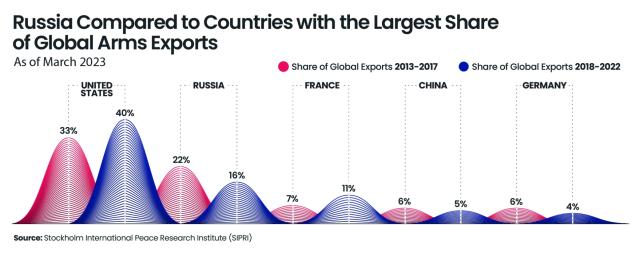
Before the full-scale invasion of Ukraine in February 2022, the Middle East and North Africa had emerged as Russia’s second most important arms market. Russia itself had re-emerged as one of the world’s top arms exporters, second only to the United States.
However, with Moscow’s fixation on Ukraine, foreign policymakers must monitor the state of Russia’s arms trade and how its defence relationships in the Middle East are propelling its influence and larger strategic interests. Russian defence presence in the Middle East stands on three pillars: arms sales (along with joint military exercises), access to military bases, and use of paramilitary forces, chiefly the Wagner group, recently renamed the Afrika Korps.
Arms Deals with the Middle East
Available data from the Stockholm International Peace Research Institute (SIPRI) shows that Russia’s share of global arms exports fell before the invasion of Ukraine. However, the primary reason for this trend is that India, the top purchaser of Russian weaponry, significantly reduced its imports of these weapons (though most recently, India significantly increased its imports of Russian oil).
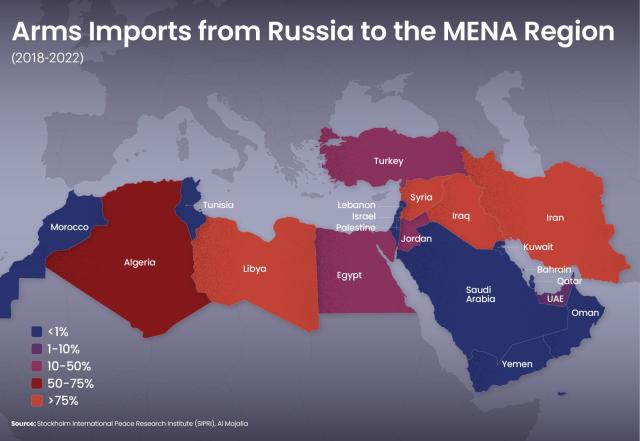
Russia has continued to focus on Middle East arms sales, which compete with traditionally dominant sales from the West. In February 2021, Russia’s Federal Service for Military-Technical Cooperation stated that military exports to the Middle East had hovered around $6bn per year over the previous five years, or between 40-50% of total military exports. Russia also emerged as Algeria’s largest weapons supplier by 2021—in particular, supplying some of its most advanced systems, such as fighter aircraft, including the Sukhoi 57.
Following the invasion of Ukraine, reports citing US government officials stated that Russian supplies of weaponry became constrained by sanctions, export controls, Russia’s prohibition from using the SWIFT payment system, and its own shift in focus towards supporting its forces in Ukraine. Indeed, in private, Middle East officials expressed concern at the start of the invasion of Ukraine that Russia would be unable to deliver on existing contracts. Two years on, these concerns have been validated as the Russian military has received a drubbing at the hands of the Ukrainians, forcing Russia’s armament industry to turn its full attention to maintaining and reconstituting its own forces in Ukraine.
As the invasion progressed, some wondered if Russia’s poor military performance would reduce interest in Russian arms in the region. This poor performance has not gone unnoticed, but there has not been a corresponding drop in interest as experienced after the US-led coalition destruction of the Soviet-trained and equipped Iraqi military in 1991.
One reason for this current reality is likely to be the types of weapons Russia exports, primarily aircraft, aircraft engines, and missiles. The weaponry that has performed poorly in Ukraine, such as tanks and armoured fighting vehicles (AFV), is not a primary export.
Nor have Russian air defence systems shown themselves to be a failure. Thus, interest in Russian aircraft, missiles, and air defence systems is likely to continue. On the contrary, Iran’s use of aerial drones against the Saudi oil terminals at Abqaiq in September 2019 and the Houthi use of these drones and ballistic missiles keep Russian air defence weapons a relevant and desired commodity among countries like Saudi Arabia and the United Arab Emirates.
Indeed, in recent months, some regional officials have privately observed that Western sanctions prevent additional purchases of Russian weapons, implying that their own interest in Russian weaponry has not declined. In May 2023, several sanctioned Russian weapons manufacturing companies with direct ties to the Russian military, including companies that produce helicopters deployed to fight in Ukraine, came to Saudi Arabia to participate in a trade event.
At the end of the year, Putin personally visited both Saudi Arabia and the UAE, where he declared the UAE as Russia’s main trading partner in the Arab world. Reportedly, topics of discussion during these meetings included trade in advanced technology. Algeria, for its part, held a military dialogue with Russia at the end of 2023.
To be sure, there are tell-tale signs that things are not good with Rosoboronexport, Russia’s state armaments manufacturer. Russia sought to retrieve parts of the defence systems it exported to countries to replenish its own weapons stocks being expended in Ukraine.
One of those countries was in the Middle East, specifically Egypt. The Wall Street Journal reported in November 2023 that Egyptian President Abdel Fattah el-Sisi agreed to deliver approximately 150 engines. This report came after reports in April of another Russia-Egypt deal to send Russia 40,000 rockets, a deal that ended following US pressure on Egypt.
This overall picture suggests that while Russia’s ability to export weapons to the Middle East may become limited in the long term, Moscow remains attentive to the region, which sees it as an important player in balancing the great power competition engulfing it. Arms sales are and will likely continue to be at the tip of Moscow’s foreign policy spear in this competition.
Closer Military Ties with Iran
The invasion of Ukraine accelerated strategic cooperation between Russia and Iran, including in the military sphere. This trend is likely to continue.
Multiple reports following the invasion hinted at a broader high-tech and defence partnership, and US officials began publically expressing concern. US National Security Council official John Kirby noted in late 2022, “Russia is offering Iran an unprecedented level of military and technical support that is transforming their relationship.”
Iran’s provision of Shaheed attack drones for use in Ukraine has received much attention and, to be sure, is important, as no country other than Iran has willingly helped Russia kill Ukrainians. But what Russia is providing to Iran deserves at least as much attention. At the end of 2023, Iran’s deputy defence minister told the Tasnim news agency that Iran had finalised arrangements to deliver Russian-made Sukhoi Su-35 fighter jets and helicopters.
The Russians have yet to confirm the deal, but what is confirmed is the export to Iran of training aircraft, which would enable Iranian pilots to make the leap to the much more advanced Su-35. If this deal goes through, it would significantly increase Tehran’s ability to conduct offensive air operations by replacing its antiquated 1970s inventory of US aircraft, which the Shah purchased before the Islamic Revolution.
Iran remains a primary threat to the Gulf states, and the provision of Su-35s to Iran would shift the military balance within the region in Iran’s favour, causing the Gulf states to change their security planning. But even if the deal does not go through, a trend of strategic cooperation has already emerged, including through bilateral Russian-Iranian and multilateral Russian, Chinese and Iranian exercises, a pattern that goes back at least five years.
In late 2019, when Russia, China and Iran conducted their first trilateral military drills, Second Rear Admiral Gholamreza Tahani told Iran’s state-run Press TV that the drills were a signal that relations between these three countries had reached a “meaningful level,” and that it was the first time Iran held joint drills with two world naval powers on such a scale.
This trend has continued ever since. At the end of 2023, Russian Foreign Minister Sergey Lavrov announced progress on the Russian-Iranian treaty on a “comprehensive strategic partnership.” At the beginning of the year, Russia’s state-run TASS reported that the document is being finalised and is set to confirm bilateral respect for each state’s sovereignty.
With the increased frequency and intensity of diplomatic and military relations, as well as the associated information narratives, it is no wonder Iran is among the newest members of BRICS. The UAE has joined, while Saudi Arabia remains invited but has not formally accepted accession to the group. With Russia assuming the chairmanship on 1 January this year, it will be important to watch if Russia attempts to court many in the Middle East and Africa by dangling defence contracts.
Expanded Military Presence and Wagner
A chief Western strategic objective is to keep Russia out of the Mediterranean. This position allows Russia to exert diplomatic and economic pressure on the European Union and project military power into the Middle East and Africa while posturing on NATO’s southern flank.
Russia’s Black Sea Fleet has suffered debilitating losses. Still, the Russian Navy remains largely intact and can strike NATO targets with Kalibr land attack missiles across the Mediterranean.
If Russia were to enhance its position on the Mediterranean further, it would impact its ability to conduct its war on Ukraine, but as the West waffles in aiding Ukraine, the Russians may see even greater opportunity in North Africa and the Middle East. Thus, Moscow understands the strategic importance of this region and continues to vie for influence there.
Not only does Russia maintain its permanent bases in Syria, chiefly in Tartus and Khmeimim, but it continues to look for access to a naval base in Libya, which has been another focal point of Russia’s Middle East activities for approximately the last five years. Reports in late 2023 suggested that Russia is moving ahead with plans for gaining docking rights in a naval base in Eastern Libya, most likely in Tobruk, after Putin’s meeting on September 28 with eastern military commander Khalifa Haftar.
These plans do not appear to have been finalised, but Moscow is clearly working towards expanding its military influence in Libya. Tobruk is a deep-water port that would add to Russia’s logistical capabilities, especially with the shallow-water port of Tartus. Russia also continues to seek access to a naval base in Sudan on the Red Sea, with an eye towards permanent access to the Suez Canal, the Indian Ocean and the Arabian Peninsula.
Many of Russia’s efforts to expand its military influence have either been spearheaded by or maintained with the help of its so-called private military companies (PMC), such as the Wagner Group. This group has been an instrumental tool for the Kremlin. It has officially been rebranded in the aftermath of Putin ally Yevgeny Prigozhin leading a failed mutiny and subsequently dying in a plane crash in August.
Subsequently, the Russian defence ministry has taken over many of Wagner’s security, oil, and gold mining contracts and the group’s relationships with African leaders. In Africa, Wagner has been most recently rebranded as Afrika Korps; the takeaway is that the Kremlin needs a paramilitary force to continue carrying out foreign policy objectives, whether as Wagner or by any other name.
Taking the Long View of Russia
Some might look at Russia’s declining arms trade and sanctions on the Russian military-industrial complex that, if kept in place, portend the decline of Russia’s military capabilities and losses in Ukraine and conclude there is no need to worry about Russia’s influence in the Middle East. But this view is both myopic and misleading.
Russia continues to vie for influence in the region through cementing access to strategic ports and using paramilitary groups and proxies, all of which Russia can afford absent Western pressure to cease these activities. Its defence contracts are foundational to these efforts.
Within Russia itself, the war in Ukraine is not only a chief military and foreign policy priority but also the main driver of economic growth. Russia’s 2024 budget shows that for the first time in decades, military and defence spending is higher than social spending.
Indeed, the war has militarised Russian society. In the aftermath of the Ukraine conflict, if it needs to release pressure incurred by an excess of combat veterans, it may employ them abroad, especially through the use of paramilitary groups such as Wagner.
This will be far easier to accomplish now that the Defense Ministry fully controls the group. Thus, when it comes to Russia’s defence relationships in the Middle East, Western policymakers need to take a long view that accounts for both Putin’s strategic objectives and the implications of the Ukraine war, regardless of its outcome.
More to the point, if the US Congress continues to dither and delay aid to Ukraine, Russia may soon tip the scales decisively in its favour. If this happens, America’s standing in the world will be diminished, and its adversaries will grow emboldened.
Anna Borshchevskaya is a senior fellow in The Washington Institute’s Diane and Guilford Glazer Foundation Program on Great Power Competition and the Middle East. This article was originally published on Al Majalla’s website.
The post How the Middle East Became an Arena for Putin’s Power Struggle with the US appeared first on CANADA VOICE.
]]>