The post Are Trump officials driving Alberta’s separatist movement in Canada appeared first on CANADA VOICE.
]]>Alberta separatists seek funding from the Trump administration after three reported meetings.

ALJAZEERA By Elizabeth Melimopoulos
Published On 30 Jan 202630 Jan 2026
Canada’s Prime Minister Mark Carney has said that he expects the United States to respect the country’s sovereignty after reports that Alberta separatists have met several times with officials of the Donald Trump administration.
The Financial Times reported that US State Department officials held meetings with the Alberta Prosperity Project (APP), a group calling for a referendum on whether the energy-rich western province should leave Canada.
Recommended Stories
Canada’s Carney hails new trade deals, ‘expects’ US to respect sovereignty
Speaking in Ottawa on Thursday, Carney said he has been clear with US President Donald Trump on the issue.
“I expect the US administration to respect Canadian sovereignty,” he said, adding that after raising the issue, he wanted the two sides to focus on areas where they can work together.
Carney is himself an Albertan, raised in Edmonton, the provincial capital. The province has had an independence movement for decades.
Trump has repeatedly threatened to make Canada the “51st state” of the American Union.
Here is what we know:
What have the reports said about US contacts with Alberta separatists?
Leaders of the APP have reportedly met with US State Department officials in Washington at least three times since last April. Trump entered office for a second time in January.
These meetings have prompted concern in Ottawa regarding potential US interference in Canadian domestic politics.
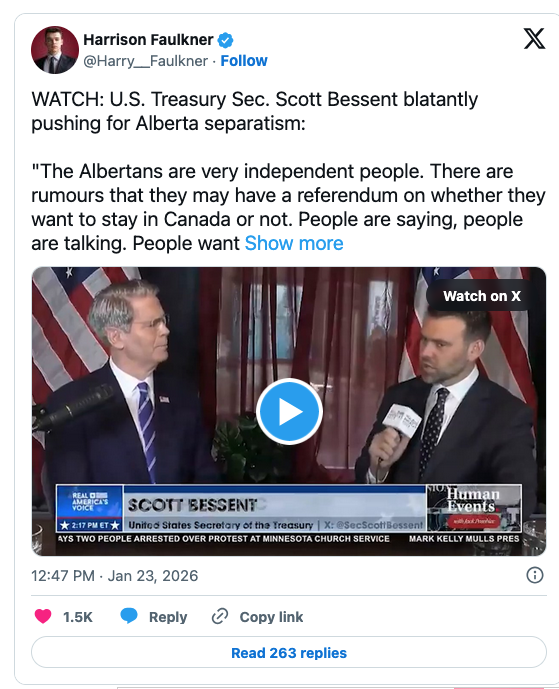
This follows comments by US Treasury Secretary Scott Bessent last week, who described Alberta as “a natural partner for the US” and praised the province’s resource wealth and “independent” character during an interview with the right-wing broadcaster Real America’s Voice.
“Alberta has a wealth of natural resources, but they [the Canadian government] won’t let them build a pipeline to the Pacific,” he said. “I think we should let them come down into the US,” Bessent said during an interview with the right-wing broadcaster.
“There’s a rumour they may have a referendum on whether they want to stay in Canada or not.”
Asked if he knew something about the separation effort, Bessent said, “People are talking. People want sovereignty. They want what the US has got.”
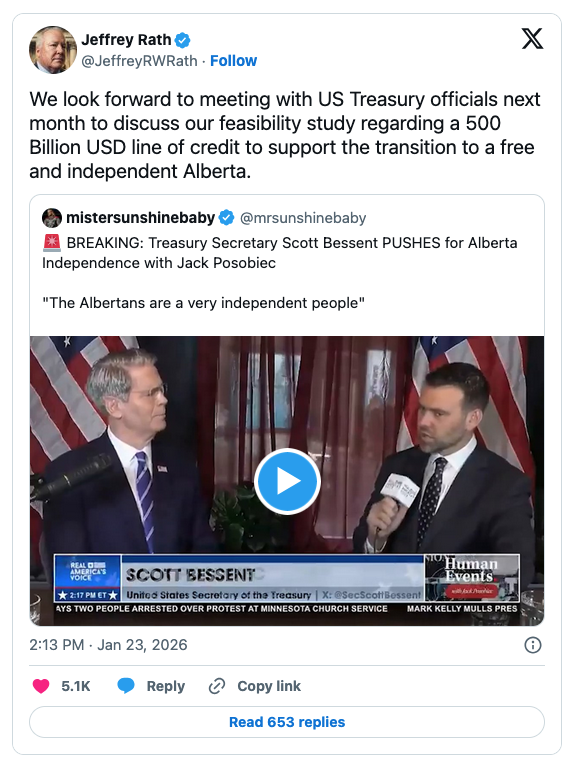
After Bessent’s comments, Jeffrey Rath, a leader of the APP, said that the group was seeking another meeting with US officials next month, where they are expected to ask about a possible $500bn credit line to support Alberta if a future independence referendum – which has not yet been called – were to be held.
The developments come at a sensitive moment in US-Canada relations, with trade tensions still simmering and after a recent speech at the World Economic Forum in Davos where Carney warned that Washington was contributing to a “rupture” in the global order.
Trump has repeatedly threatened to make Canada part of the American Union. His expansionist ambitions have been further underscored by his recent push to acquire Greenland from Denmark, which, like Canada, is a NATO ally. At the start of the year, the US military also abducted Venezuelan President Nicolas Maduro, and has since attempted to take control of the South American nation’s massive oil industry.
How have Canadian leaders reacted to the reports?
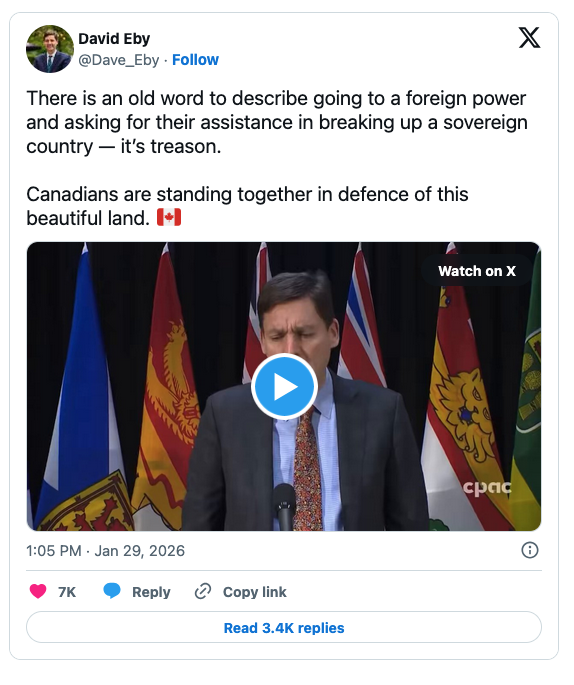
Speaking on Thursday, British Columbia Premier David Eby described the reported behind-the-scenes meetings as “treason”.
“To go to a foreign country and to ask for assistance in breaking up Canada, there’s an old-fashioned word for that – and that word is treason,” Eby told reporters.
“It is completely inappropriate to seek to weaken Canada, to go and ask for assistance, to break up this country from a foreign power and – with respect – a president who has not been particularly respectful of Canada’s sovereignty.”
Ontario Premier Doug Ford appealed for Canadian unity on Thursday morning.
“You know, we have a referendum going on out in Alberta. The separatists in Quebec say they’re gonna call a referendum if they get elected. Like, folks, we need to stick together. It’s Team Canada. It’s nothing else,” he said.
Alberta Premier Danielle Smith, however, said she won’t demonise the Albertans who are open to separation because of “legitimate grievances” with Ottawa and said she did not want to “demonise or marginalise a million of my fellow citizens”.
Smith has long been pro-Trump and visited the US president’s Mar-a-Lago estate in January 2025, at a time when most other Canadian leaders were joining hands to criticise his demand that the country become a part of the United States.
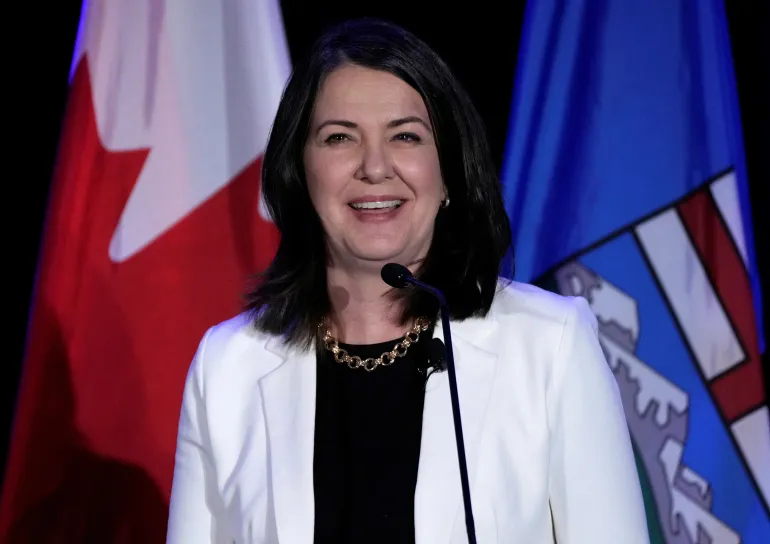
Alberta Premier Danielle Smith [FILE: Todd Korol/Reuters]
What do we know about a potential referendum in Alberta?
Anger towards Ottawa has been building in Alberta for decades, rooted largely in disputes over how the federal government manages the province’s vast oil and gas resources.
Many Albertans feel federal policies – particularly environmental regulations, carbon pricing and pipeline approvals – limit Alberta’s ability to develop and export its energy.
As a landlocked province, Alberta depends on pipelines and cooperation with other provinces to access global markets, making those federal decisions especially contentious.
Many Albertans believe the province generates significant wealth while having limited influence over national decision-making. In 2024-25, for instance, it contributed 15 percent of Canada’s gross domestic product (GDP), despite being home to only 12 percent of the population.
Alberta consistently produces more than 80 percent of Canada’s oil and 60 percent of the country’s natural gas.
Yet, many Albertans say that the federal government does not give the province its fair share from taxes collected. Canada has a system of equalisation payments, under which the federal government pays poorer provinces extra funds to ensure that they can maintain social services. While Quebec and Manitoba receive the highest payments, Alberta – as well as British Columbia and Saskatchewan – at the moment receive no equalisation payments.
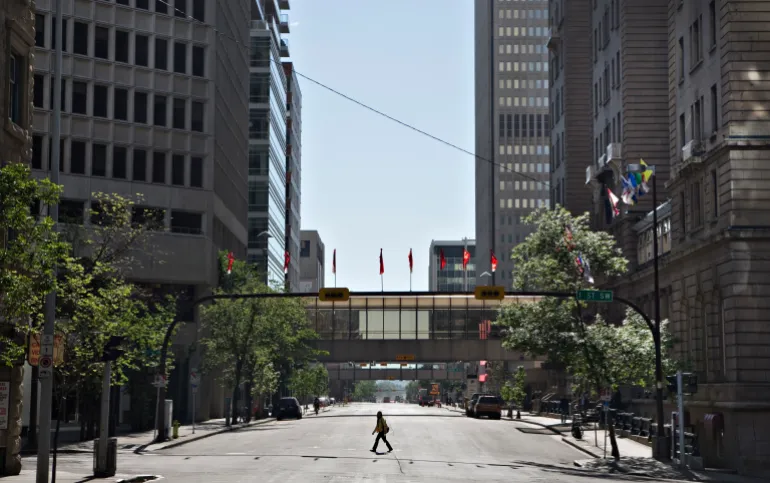
A woman crosses an empty downtown street in Calgary, Alberta [FILE: Andy Clark/Reuters]
Carney recently signed an agreement with Alberta, opening the door for an oil pipeline to the Pacific, though it is opposed by Eby and faces significant hurdles.
Recent Ipsos polling suggests that about three in 10 Albertans would support starting the process of leaving Canada.
But the survey also found that roughly one in five of those supporters viewed a vote to leave as largely symbolic – a way to signal political dissatisfaction rather than a firm desire for independence.
A referendum on Alberta independence could happen later this year if a group of residents can collect the nearly 178,000 signatures required to force a vote on the issue. But even if the referendum passes, Alberta would not be immediately independent.
Under the Clarity Act, the federal government would first have to determine whether the referendum question was clear and whether the result represented a clear majority. Only then would negotiations begin, covering issues such as the division of assets and debt, borders and Indigenous rights.
What is the Alberta Prosperity Project and what does it want?
The APP is a pro-independence group that is campaigning for a referendum on Alberta leaving Canada.
It argues that the province would be better off controlling its own resources, taxes and policies, and has been working to gather signatures under Alberta’s citizen-initiative rules to trigger a vote.
While it describes itself as an educational, non-partisan project, the group has drawn controversy over its claims about the economic viability of an independent Alberta.
On its website, the APP says, “Alberta sovereignty, in the context of its relationship with Canada, refers to the aspiration for Alberta to gain greater autonomy and control over provincial areas of responsibility.”
“However, a combination of economic, political, cultural and human rights factors … has resulted in many Albertans defining ‘Alberta sovereignty’ to mean Alberta becoming an independent country and taking control of all matters that fall within the jurisdiction of an independent nation,” it adds.

What else has Washington said?
White House and State Department officials told the FT that administration officials regularly meet with civil society groups and that no support or commitments were conveyed.
A report published by Canada’s public broadcaster CBC earlier this year quoted US national security analyst Brandon Weichert as saying that Trump’s talk of Canada becoming the “51st state” was, in reality, aimed at Alberta.
Appearing on a show hosted by former Trump chief strategist Steve Bannon, Weichert suggested that a vote for independence in Alberta would prompt the US to recognise the province and guide it towards becoming a US state.
Has the Trump administration tried this elsewhere?
Yes, in Greenland.
As with Canada, Trump has repeatedly called for Greenland to be incorporated into the US. His threats to annex Greenland have prompted strong opposition from the government of the Arctic island, Denmark — which governs Greenland — and Europe.
But as with Alberta, Trump’s administration has also attempted to test separatist sentiment. In August 2025, the Danish government summoned the top US diplomat in Copenhagen after Denmark’s national broadcaster reported that three Trump allies had begun pulling together a list of Greenlanders supportive of the US president’s efforts to get it to join the United States.
The post Are Trump officials driving Alberta’s separatist movement in Canada appeared first on CANADA VOICE.
]]>The post Business insider: Maple Leaf Makeover / By Emily Stewart appeared first on CANADA VOICE.
]]>
Business insider / By Emily Stewart – Senior Correspondent
It’s a best-of-times, worst-of-times scenario for Canada on the global stage.
To get the bad out of the way, its most important ally — the United States — has grown increasingly antagonistic, with renewed tariff threats and talk of annexation coming from the White House. On the upside, Canada is signaling it can stand more firmly on its own. Canadian Prime Minister Mark Carney has identified a “rupture” in North American integration and is moving his country in a more self-sufficient direction — both economically and politically. There’s a recognition that Canada and the US will always be deeply intertwined — Americans aren’t suddenly going to stop watching “Heated Rivalry” or “Schitt’s Creek,” and the Toronto Maple Leafs aren’t going to stop traveling south of the border — but some level of unwinding may now be unavoidable.
“Every country has to take care of itself,” says Tony Stillo, director of Canada Economics at Oxford Economics, “and Canada’s putting Canada first.”
In a speech at the World Economic Forum in Davos in January, Carney struck a determined, defiant tone toward the US and a decades-old rules-based international order that, in his view, is now falling apart. “Canadians know that our old comfortable assumptions that our geography and alliance memberships automatically conferred prosperity and security — that assumption is no longer valid,” he said. In turn, he’s made the choice to take on “the world as it is, not wait around for a world we wish it to be.”
The pope himself, I think, would struggle to find the patience to deal with the US administration right now.
Carney is walking a fine line. He is right that the US is no longer as reliable a partner as it once was in the economy, security, and trade. And as much as President Donald Trump has turned the divide into a chasm, the fracture has been forming for years, as both Democratic and Republican administrations in the US have taken a more protectionist stance.
At the same time, Canada can’t just walk away. Exports account for a third of Canada’s GDP, and more than 75% of its exports go to the US. By comparison, exports are about one-tenth of the US’s GDP, and around 16% of its exports go to Canada. Many of the two countries’ biggest industrial sectors, including automotives and energy, are almost irreversibly interwoven. The uncertainty emanating from the US has a big impact on Canada’s economy — as the saying goes, when the US catches a cold, Canada gets the flu.
There is also a short-term impetus to keep relations amicable. The US-Mexico-Canada trade deal (formerly known as NAFTA) is up for review mid-year, and the US, thanks to its sheer size, has more leverage.
“The prime minister’s in an impossible situation. It is incredibly challenging for any Canadian on the international side right now to both vigorously defend our economy and to do that without escalating an already volatile relationship,” says Dan Kelly, the president of the Canadian Federation of Independent Business. “The pope himself, I think, would struggle to find the patience to deal with the US administration right now.”
Canada is trying to reduce its reliance on the US through a series of policies aimed at growing and integrating its domestic economy. The federal government removed internal trade barriers that prevented goods and even workers from flowing between provinces. The IMF estimates that fully eliminating them would boost real Canadian GDP by 7%. Many Canadian consumers are opting to buy Canadian products where possible. Under Carney, the country established the Major Projects Office as part of a push to advance nation-building ventures and streamline regulatory approvals for ambitious programs in mining, energy, ports, and rail.
“The government isn’t trying to just invest, they’re trying to catalyze and incentivize private money to come in,” Stillo says.
These are steps in the right direction, but the major projects will take years to build. This is a long-term undertaking.
“We have high-talent workers. We’re the most educated in the OECD. We have real innovation in areas like AI and quantum computing, and we have natural resources — critical minerals, LNG, oil and gas — most countries would absolutely love to have,” says Matthew Holmes, the chief of public policy at the Canadian Chamber of Commerce. “We have all the preconditions to be an energy superpower and a major player economically, but we need to get our domestic economy fundamentals.”
Kelly tells me about a third of CFIB’s members, which are small- and medium-sized businesses, have started to do more business internationally in countries beyond the US, and a third are doing more internal trade. A recent business survey from the Bank of Canada found that sentiment remains “subdued,” though firms’ overall outlook has improved slightly.
We’re just looking to take a couple of eggs out of this basket and spread them around the world.
Part of the problem Canada faces is that any move it makes to cultivate ties elsewhere may elicit an outsize reaction from its neighbors to the south. Just look at its recent trade negotiations with China. Carney visited China in January and subsequently announced that Canada would allow 49,000 Chinese electric vehicles into the Canadian market at a 6.1% tariff rate, while China agreed to lower tariffs on Canadian canola seed. When Trump caught wind of it, he threatened to put 100% tariffs on Canadian goods coming into the US. Canada has tried to calm the situation, emphasizing that it’s not entering a free trade agreement with China, it’s just settling some preexisting disputes. The tit-for-tat also comes as Canadian oil sales in China surge, as it pushes into Asia.
“We’re not running into the arms of China,” says Julian Karaguesian, a course lecturer in McGill University’s economics department. “We’re just looking to take a couple of eggs out of this basket and spread them around the world. And China’s the largest economy in the world after the United States.”
Canada has trade opportunities outside the US and has set a goal to double non-US exports over the next decade. It already has a robust set of free trade agreements and is the only G7 nation to have them with all other G7 members. It’s also likely looking toward India and MERCOSUR, a trade bloc in South America.
Commerce Secretary Howard Lutnick has downplayed the ongoing spat, calling it “political noise” coming out of the prime minister. He said Canada has the “second-best deal in the world” with the US, behind Mexico. Lutnick also indicated that getting too close to China could hurt Canada amid the USMCA talks set for the summer and create a “road map” for overhauling the entire deal. Given the constantly changing nature of the US and Canada’s relationship as of late — and Trump’s ever-shifting focus on a variety of issues — the possible scenarios for USMCA negotiations run the gamut, from minor adjustments to a total breakdown in talks.
“With USMCA, the gloves are going to be off,” Karaguesian says.
— — — —
None of this is to say that Canada is in sterling shape. Its economy is growing at a lackluster pace, and its labor market is doing OK, but not great. Productivity has been lagging for years. It would surely prefer the US were not so adversarial. At the same time, the country and its leaders are clear-eyed about what’s happened and are laying out a plan for what’s next, internationally and domestically. Holmes, from the Chamber of Commerce, says Canada has had a sort of “it’s the economy, stupid” moment under Carney.
Peter Morrow, an economist at the University of Toronto, says that Canada is doing better than was feared a year ago. “There were a lot of concerns about dramatic levels of protectionism in the United States and all but complete collapses of manufacturing in Canada,” he says. “The realized tariffs have not been as dramatic as they might have been otherwise,” he says. The effective tariff rate on Canadian goods coming into the US is still under 10%. Carney has a “very good relationship with reality,” Morrow says, and as much as economic nightmare scenarios haven’t come to pass, the geopolitical outlook is worse than expected, given the instability of the NATO alliance and the deterioration of the global rules-based system that’s been in place since World War II.
Most of the economists and business people I spoke to for this story agreed that Canada coming into its own was a long time in the making. From Bush’s “you’re with us or against us” mentality post-9/11 to Obama’s “Buy America” push to Biden’s industrial policy, America has been acting like a less friendly friend for a while. Trump has taken it to an extreme, often failing to differentiate between international friend and foe. If it nudges Canada further out of America’s shadow, the thinking goes, so be it. Carney’s declaration that the global economy’s middle powers need to band together and his suggestion that the US cannot be trusted is a sentiment he’s not alone in — he’s just saying it out loud.
“Carney is saying things that obviously encapsulate well how many, many countries, companies, and leaders are feeling, including many parts in many parts of the United States,” Kelly says, adding that Carney’s economic background and focus are also a plus. “For a decade, anything economic was kind of issue number 500 on the Trudeau government’s list of priorities. And now it seems very much like ensuring our economy is in high gear is the top job for the prime minister.”
One of the main pieces of certainty Canada can have, at least in the immediate future, is that there’s going to be a lot of uncertainty coming from the US. In many ways, America has become a threat actor and cause of decline. This has fostered a novel level of pro-Canadian sentiment within the country’s borders and also boosted Carney’s profile on the international and domestic stage — his approval rating jumped to 60% in a recent poll.
This is also landing at what’s culturally a bright moment for Canada. Canada’s men’s hockey team is favored to win gold at the coming Winter Olympics, following up its victory in 2025’s Four Nations tournament. Its women’s team will likely be in contention for a medal as well. The gay hockey romance “Heated Rivalry,” out of Ontario, is everywhere. Tourists are turning up in Hamilton, Ontario, where the show is partially filmed, to check out some of the spots featured. The town is inviting them in.
“All these kinds of things to brand Canada’s reputation as a welcoming place to everyone is not unhelpful,” Kelly says. Especially as the US is moving in a different and much more unwelcoming direction.
Emily Stewart is a senior correspondent at Business Insider, writing about business and the economy.
Business Insider’s Discourse stories provide perspectives on the day’s most pressing issues, informed by analysis, reporting, and expertise.
The post Business insider: Maple Leaf Makeover / By Emily Stewart appeared first on CANADA VOICE.
]]>The post Man is shot and killed during Minneapolis immigration crackdown, National Guard activated appeared first on CANADA VOICE.
]]>MINNEAPOLIS (AP) — A federal immigration officer shot and killed a man Saturday in Minneapolis, drawing hundreds of protesters onto the frigid streets and ratcheting up tensions in a city already shaken by another fatal shooting weeks earlier.
Family members identified the man who was killed as Alex Pretti, a 37-year-old intensive care unit nurse who had protested President Donald Trump’s immigration crackdown in his city. After the shooting, an angry crowd gathered and protesters clashed with federal immigration officers, who wielded batons and deployed flash bangs.
The Minnesota National Guard was assisting local police at the direction of Gov. Tim Walz, officials said. Guard troops were sent to both the shooting site and to a federal building where officials have squared off with protesters daily.
Information about what led up to the shooting was limited, Minneapolis Police Chief Brian O’Hara said.
Department of Homeland Security spokesperson Tricia McLaughlin said in a statement that federal officers were conducting an operation and fired “defensive shots” after a man with a handgun approached them and “violently resisted” when officers tried to disarm him.
In bystander videos of the shooting that emerged soon after, Pretti is seen with a phone in his hand but none appears to show him with a visible weapon.
O’Hara said police believe the man was a “lawful gun owner with a permit to carry.”
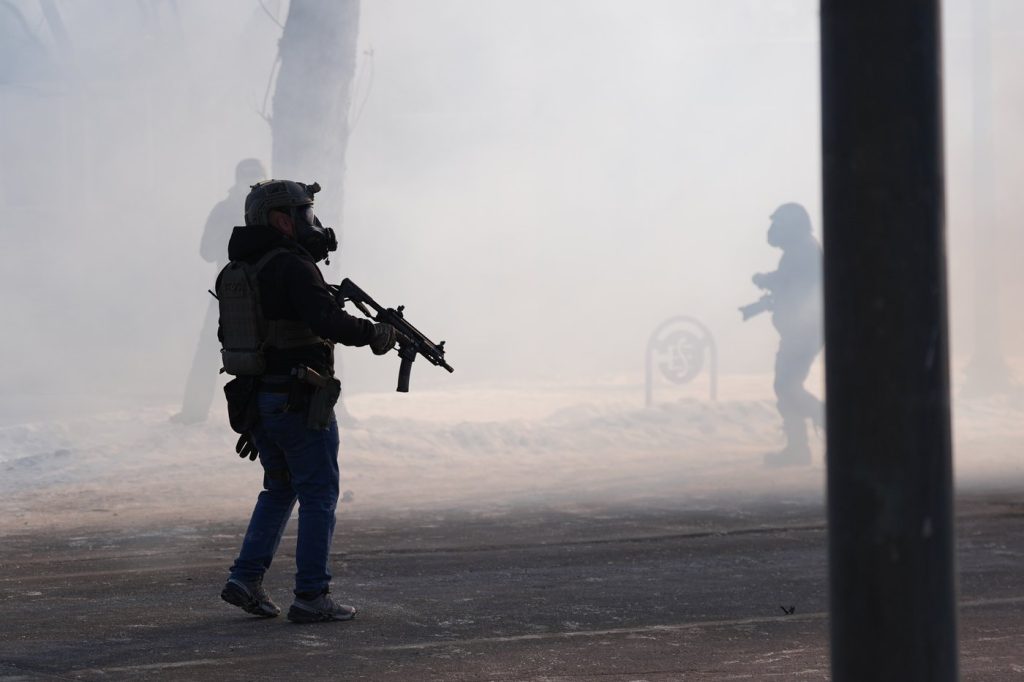
Federal immigration officers deploy tear gas after a shooting in Minneapolis, on Saturday, Jan. 24, 2026. (AP Photo_Abbie Parr) Copyright 2026 The Associated Press. All rights reserved
DHS Secretary Kristi Noem said during a news conference that Pretti had shown up to “impede a law enforcement operation.” She questioned why he was armed but did not offer detail about whether Pretti drew the weapon or brandished it at officers.
The officer who shot the man is an eight-year Border Patrol veteran, federal officials said.
Trump weighed in on social media by lashing out at Walz and the Minneapolis mayor.
Trump shared images of the gun that immigration officials said was recovered and said: “What is that all about? Where are the local Police? Why weren’t they allowed to protect ICE Officers?”
Trump, a Republican, said the Democratic governor and mayor are “are inciting Insurrection, with their pompous, dangerous, and arrogant rhetoric.”
Pretti was shot just over a mile from where an Immigration and Customs Enforcement officer shot and killed 37-year-old Renee Good on Jan. 7, sparking widespread protests.
Pretti’s family released a statement Saturday evening saying they are “heartbroken but also very angry,” and calling him a kindhearted soul who wanted to make a difference in the world through his work as a nurse.
“The sickening lies told about our son by the administration are reprehensible and disgusting. Alex is clearly not holding a gun when attacked by Trump’s murdering and cowardly ICE thugs. He has his phone in his right hand and his empty left hand is raised above his head while trying to protect the woman ICE just pushed down all while being pepper sprayed,” the family statement said. “Please get the truth out about our son. He was a good man.”
Video shows officers, man who was shot
In a bystander video of Saturday’s shooting obtained by The Associated Press, protesters can be heard blowing whistles and shouting profanities at federal officers on Nicollet Avenue.
The video shows an officer shoving a person who is wearing a brown jacket, skirt and black tights and carrying a water bottle. That person reaches out for a man and the two link up, embracing. The man, wearing a brown jacket and black hat, seems to be holding his phone up toward the officer.
The same officer shoves the man in his chest and the two, still embracing, fall back.
The video then shifts to a different part of the street and then comes back to the two individuals unlinking from each other. The video shifts focus again and then shows three officers surrounding the man.
Soon at least seven officers surround the man. One is on the man’s back and another who appears to have a canister in his hand strikes a blow to the man’s chest. Several officers try to bring the man’s arms behind his back as he appears to resist. As they pull his arms, his face is briefly visible on camera. The officer with the canister strikes the man near his head several times.
A shot rings out, but with officers surrounding the man, it’s not clear from where the shot came. Multiple officers back off the man after the shot. More shots are heard. Officers back away and the man lies motionless on the street.
The police chief appealed for calm, both from the public and from federal law enforcement.
“Our demand today is for those federal agencies that are operating in our city to do so with the same discipline, humanity and integrity that effective law enforcement in this country demands,” the chief said. “We urge everyone to remain peaceful.”
Gregory Bovino of U.S. Border Patrol, who has commanded the Trump administration’s big-city immigration campaign, said the officer who shot the man had extensive training as a range safety officer and in using less-lethal force.
“This is only the latest attack on law enforcement. Across the country, the men and women of DHS have been attacked, shot at,” he said.
Walz said he had no confidence in federal officials and that the state would lead the investigation into the latest fatal shooting.
But Drew Evans, superintendent of the Minnesota Bureau of Criminal Apprehension, said during a news conference that federal officers blocked his agency from the shooting scene even after it obtained a signed judicial warrant.
Amid the unrest, Senate Democratic Leader Chuck Schumer said Democrats will not vote for a spending package that includes money for DHS. Schumer’s statement increases the possibility that the government could partially shut down on Jan. 30 when funding runs out.
Protests continue in Minneapolis
Protesters converged at the scene of the shooting despite dangerously cold weather.
At midday Saturday, the worst of an extreme cold wave was over, but the temperature was still -6 degrees (-21 Celsius).
After the shooting, an angry crowd gathered and screamed profanities at federal officers, calling them “cowards” and telling them to go home. One officer responded mockingly as he walked away, telling them: “Boo hoo.” Agents elsewhere shoved a yelling protester into a car. Protesters dragged garbage dumpsters from alleyways to block the streets, and people who gathered chanted, “ICE out now” and “Observing ICE is not a crime.”
As dark fell, hundreds of people gathered quietly by a growing memorial at the site of the shooting. Some carried signs saying “Justice for Alex Pretti.” Others chanted Pretti’s and Good’s names. A doughnut shop and a clothing store nearby stayed open, offering protesters a warm place as well as water, coffee and snacks.
Caleb Spike said he came from a nearby suburb to show his support and his frustration. “It feels like every day something crazier happens,” he said. “What’s happening in our community is wrong, it’s sickening, it’s disgusting.”
___
The age of the man who was shot has been corrected to 37, per information from the police chief. The AP previously reported his age as 51 based on a hospital record.
___
Santana reported from Washington. Associated Press writers Giovanna Dell’Orto, Tim Sullivan and Sarah Raza in Minnesota, Jim Mustian in New York, Michael Catalini in New Jersey and Christopher Weber in Los Angeles also contributed.
Jack Brook, Steve Karnowski And Rebecca Santana, The Associated Press
The post Man is shot and killed during Minneapolis immigration crackdown, National Guard activated appeared first on CANADA VOICE.
]]>The post Trump says he’s withdrawing invitation for Carney to join his Gaza ‘Board of Peace’ appeared first on CANADA VOICE.
]]>Trump launched the new initiative at the World Economic Forum earlier this week

Darren Major · CBC News ·
U.S. President Donald Trump said late Thursday that he is withdrawing an invitation for Prime Minister Mark Carney to join his “Board of Peace” initiative for Gaza.
Trump launched the new initiative Thursday at the World Economic Forum, in Davos, Switzerland. Its stated aim is to rebuild the war-ravaged territory during a governance-transition period.
Some 35 countries have signed up to join the board, but Carney had not yet said if Canada would accept Trump’s invitation. The prime minister was not at the official launch in Davos and instead was attending the first day of a cabinet retreat in Quebec City.
In a post on his Truth Social website, Trump said Carney had been uninvited from joining the initiative.
Here are the countries joining Trump’s ‘Board of Peace’ so far
“Dear Prime Minister Carney: Please let this Letter serve to represent that the Board of Peace is withdrawing its invitation to you regarding Canada’s joining, what will be, the most prestigious Board of Leaders ever assembled, at any time,” Trump wrote in his post.
CBC News has reached out to the Prime Minister’s Office for comment.
Traditional U.S. allies reject invitation
Some key Middle East powers such as Israel, Turkey, Egypt, Saudi Arabia and Qatar have joined Trump’s initiative.
But traditional European allies like the U.K. and France have rejected the invitation — with France raising concerns that some of the initiative’s elements were contrary to the UN charter.
Many rights experts and advocates have previously raised concerns about Trump overseeing a board to supervise a foreign territory’s governance.
Trump threatens 200% tariffs on French wines to get Macron on ‘Board of Peace’
Putin says he’s considering ‘Board of Peace’ invite Trump claims was already accepted
Trump also extended an invitation to Russian President Vladimir Putin, a pariah in most international circles following the full-scale invasion of Ukraine. Putin has said he is considering joining the initiative.
To secure a permanent seat on the board, countries are expected to fork over $1 billion US.
Finance Minister François-Philippe Champagne said earlier this week that Ottawa does not plan to pay the hefty fee for a permanent spot.
“There [are] a lot of details to be worked out, but one thing which is clear is that Canada is not going to pay if we were to join the Board of Peace,” Champagne said.
Withdrawal of invite follows Davos speeches
Trump’s post uninviting Carney from his Gaza initiative comes after the two leaders both delivered speeches at the event in Davos.
In his Tuesday speech, Carney offered a stark assessment of the current state of global affairs, which has garnered international attention.
The prime minister argued that the “great powers” — like the U.S. — are using economic integration as “weapons,” and argued that negotiating with those countries bilaterally puts middle powers like Canada at disadvantage
‘The old order is not coming back,’ Carney says in provocative speech at Davos
Read Mark Carney’s full speech on middle powers navigating a rapidly changing world
Carney proposed that like-minded middle powers band together to push their priorities on the world stage, even if it’s issue by issue.
In his own World Economic Forum address, Trump complained that Canada should be “grateful” for the U.S.
“I watched your prime minister yesterday. He wasn’t so grateful — they should be grateful to the U.S., Canada. Canada lives because of the United States,” Trump said Wednesday.
“Remember that, Mark, the next time you make your statements,” Trump said in reference to Carney’s speech — though the prime minister had left Davos at that point.
‘Canada doesn’t live because of the United States,’ Carney says:
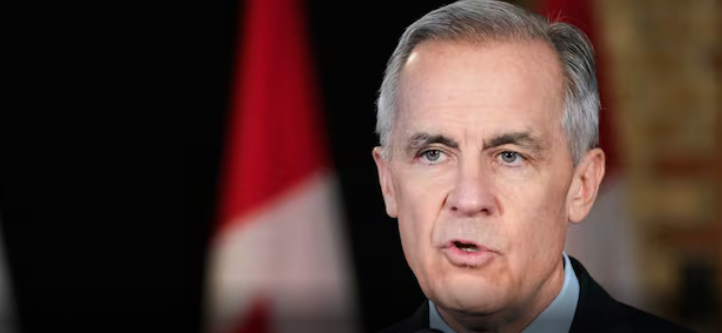
In a speech in Quebec City ahead of the federal cabinet retreat, Prime Minister Mark Carney issued a direct response to U.S. President Donald Trump, saying, ‘Canada thrives because we are Canadian.’ On Wednesday, Trump told the World Economic Forum that ‘Canada lives because of the United States.’
‘Canada thrives because we are Canadian’
Carney fired back at the president Thursday afternoon, in an address at his government’s cabinet retreat.
“Canada and the United States have built a remarkable partnership. In the economy, in security and in rich cultural exchange. But Canada doesn’t live because of the United States,” he said.
“Canada thrives because we are Canadian.”
The rhetorical spat between the two leaders comes as Canada, the U.S. and Mexico prepare to review the trilateral trade deal, known in Canada as the Canada-United States-Mexico Agreement (CUSMA), later this year.
ABOUT THE AUTHOR
Darren Major Senior writer
Darren Major is a senior writer for CBC’s parliamentary bureau in Ottawa. He previously worked as a digital reporter for CBC Ottawa and a producer for CBC’s Power & Politics. He holds a master’s degree in journalism and a bachelor’s degree in public affairs and policy management, both from Carleton University. He also holds master’s degree in arts from Queen’s University. He can be reached at darren.major@cbc.ca.
CBC’s Journalistic Standards and Practices·About CBC News
U.S. President Donald Trump unveiled his ‘Board for Peace’ in Davos, Switzerland, but so far, few Western allies have joined. Originally endorsed by the United Nations as part of a Gaza peace plan, its charter makes no mention of Gaza at all. Some critics are now accusing Trump of trying to set up his own rival UN.
The post Trump says he’s withdrawing invitation for Carney to join his Gaza ‘Board of Peace’ appeared first on CANADA VOICE.
]]>The post As Hezbollah Nervously Watches Iran, Washington Should Double Down on Disarmament ..by Hanin Ghaddar, appeared first on CANADA VOICE.
]]>
Washingtoninstitute / by Hanin Ghaddar
Hanin Ghaddar is the Friedmann Senior Fellow at The Washington Institute’s Rubin Family Arab Politics Program, where she focuses on Shia politics throughout the Levant.
On January 8, Iranian Foreign Minister Abbas Araghchi landed in Beirut with an economic delegation and, reportedly, four suitcases full of cash for Hezbollah, continuing Tehran’s tradition of sending officials to Lebanon as a show of power every time a crisis emerges. Yet this time feels different—the Islamic Republic’s latest wave of protests and international pressure has seemingly cornered the regime, presenting Beirut with an opportunity to shift the political narrative around Hezbollah and the pace of the disarmament process on the ground.
Lebanese officials appear to sense this change—local media reports indicate that Araghchi was not allowed to bring in the money. Although this was not the first time that airport security had forced Iranian officials to return home with bags of cash, last week’s incident was widely broadcast in the Lebanese media, seemingly sending a signal to Hezbollah. Indeed, both President Joseph Aoun and Prime Minister Nawaf Salam have made strong statements against the group in recent days. During a January 11 interview with Tele Liban, Aoun stated that Hezbollah’s weapons had “outlived their purpose” and become a burden on the Lebanese people, including the group’s Shia constituency. A day later, during a meeting with the ambassadors of the five-nation contact group for Lebanon, Salam stated that the government is still determined to implement the plan for disarming Hezbollah north of the Litani River.
Despite the president’s bolder-than-usual language, there are still no serious indications that the Lebanese Armed Forces (LAF) are prepared to translate these words into action, at least not beyond the country’s southern frontier zone. Yet this week’s developments highlight the new openings being created by Iran’s domestic crisis—openings that Washington and its partners should jump on quickly.
Hezbollah Is Worried, Beirut Is Idle
Sources close to Hezbollah circles have told the author that the group feels very vulnerable at the moment, believing that Israeli military operations may soon target organizational infrastructure in its southern Beirut stronghold of Dahiya. Hezbollah is also facing the potential loss of its top sponsor due to the mass protests throughout Iran and threats of U.S. military action against the regime. Even if Tehran manages to entice Washington into some sort of deal to avoid collapse, Hezbollah fears that its own existence would be part of the price the regime is willing to pay to survive. Sources indicate that this is why the group’s information machine and leadership have been silent about the protests since the crisis broke out.
Whatever happens in Iran, now is a great moment to take aim at the main pillars of Hezbollah’s domestic power, particularly the financial and political infrastructure that fuel the group’s ongoing threats to Lebanon, Israel, and the wider region. Beirut can best weaken Hezbollah’s financial networks by targeting its cash economy, while the international community can target and isolate the group’s political roots in various state institutions, from Speaker of Parliament Nabih Berri to the numerous government appointees and employees who act on behalf of Hezbollah and its partner Amal.
Regrettably, however, the Lebanese government is not taking advantage of Hezbollah’s present fear and confusion by pressing forward with any actions of this sort, let alone the more difficult task of nationwide disarmament. Instead, Beirut is giving itself another month (see below) to assess regional developments before even receiving the LAF’s plan for phase 2 of the disarmament process, which is supposed to extend from the Litani River to the Awali River. This, of course, will also give Hezbollah more time to prepare ways of obstructing the process.
Also regrettable is the LAF’s January 8 statement announcing the successful conclusion of phase 1, which was supposed to focus on disarmament efforts south of the Litani. Somehow, the statement avoided mentioning the words “Hezbollah” or “disarmament” at all. Instead, it spoke of “extending operational control over the territories that have come under its authority in the South Litani Sector, with the exception of lands and sites that remain under Israeli occupation.” The statement then provided two indications of why the disarmament effort has been delayed: first, it blamed “continued Israeli attacks on Lebanese territory and the occupation of several sites within it,” and second, it argued that “the delayed delivery of promised military capabilities to the Army constitutes a significant factor affecting the pace of mission implementation.”
Israel’s Response
In response to this announcement, the Prime Minister’s Office in Israel stated that Beirut and the LAF’s efforts were “an encouraging beginning, but they are far from sufficient, as evidenced by Hezbollah’s efforts to rearm and rebuild its terror infrastructure with Iranian support.” In addition, the Israeli Foreign Ministry posted an interactive map showing the group’s remaining arsenal south of the Litani. No other actor—including the United States or other members of the ceasefire monitoring mechanism—has publicly issued an evaluation of the LAF’s performance in phase 1, so the only details that anyone is getting on this process come from Israeli officials and media.
This is a serious gap that will further complicate internal accountability and political dynamics in Lebanon. Without evidence and evaluation, Hezbollah can still tell its constituency that it is strong and well-armed in the south, while political officials can use the uncertainty to stall subsequent phases.
On January 12, U.S. Ambassador to Lebanon Michel Issa said that defining “a deadline” for completing disarmament north of the Litani “is the most important thing.” And in parliament, the Lebanese Forces party—the legislature’s largest bloc—demanded that the LAF complete phase 2 within three months. But no practical plan for carrying out that phase has even been offered; as noted above, the LAF blamed the delay on Israel, while the government decided to postpone its scheduling decisions and give the LAF until the first week of February to submit a plan.
By waiting even that long, Beirut—and Washington—risk missing the promising but potentially narrow window of opportunity created by the Iran crisis. As discussed below, they also risk imminent military escalation inside Lebanon.
The Military Option
Amid the delays, Israel has been preparing for its own phase 2—namely, a widened air campaign against Hezbollah. Yet airstrikes can only go so far in destroying additional targets, including new weapons factories and depots in Dahiya. Only the LAF can fulfill that mission.
Of course, launching that mission would be a fateful decision for the LAF. Once the army moves north of the Litani, it may find itself in direct confrontation with Hezbollah. Despite the group’s vocal threats, however, armed confrontation is not a certainty, especially given Hezbollah’s many calculations and concerns regarding developments in Lebanon and Iran. One thing is clear: by beginning operations north of the Litani, the LAF would prevent a major Israeli escalation. And even if clashes with Hezbollah do unfold, they would be less damaging to Lebanon—particularly to its Shia community—than another major confrontation with Israel.
Policy Recommendations
With Iran and Hezbollah cornered by the current protest crisis, the group may be more ready to make compromises or, at least, less willing to confront the LAF militarily. Facing the most critical chapter in its history, Hezbollah is mainly focused on just surviving right now. Hence, there is no credible reason to postpone disarmament for another month; rather, this delay could cost Lebanon a golden opportunity to establish a national monopoly on weapons even sooner than originally hoped. Instead of letting Beirut waste time and hitch its planning to the still-uncertain outcome of the Iran protests, Washington should apply pressure via the following steps:
- Release a formal U.S. assessment of the LAF’s performance in phase 1, which would give Lebanese officials and citizens a reference other than the Israeli assessment.
- Ask Beirut and the LAF to submit the plan for phase 2 before the next meeting of the ceasefire mechanism.
- Urge Lebanon to set a realistic deadline for completing phase 2, with clear deliverables.
- Urge the LAF to launch initial operations north of the Litani River as soon as the plan is submitted. This would weaken Hezbollah’s narrative and potentially shift voter attitudes toward the group ahead of the parliamentary election scheduled for this May.
- Urge Beirut to start targeting Hezbollah’s domestic financial infrastructure, including cash networks, crypto systems, online gambling networks, and exchange companies.
- Process and deliver U.S. assistance to the LAF as soon as possible (assuming the LAF statement was correct in noting that promised assistance has been delayed). This would remove any credible excuse for continuing to postpone phase 2. Relatedly, France has announced that it will hold a donor conference on March 5 to support the LAF, but U.S. officials should make clear that this is no reason to delay initial action on the ground.
- Guarantee that the LAF will receive additional U.S. assistance once disarmament moves forward north of the Litani, with an eye toward the possibility that Hezbollah resistance could make phase 2 more difficult. Benchmarks could be established for sending specified assistance if certain steps are achieved by certain dates.
In addition to these immediate steps, President Trump could offer to host President Aoun in Washington once Beirut successfully implements phase 2. Conversely, if Lebanese military units do not expand their activities north of the Litani soon, Washington should be prepared to suspend aspects of its security assistance to the LAF, and signal that continued stalling would put the entire assistance package in danger of cancellation.
Hanin Ghaddar is the Friedmann Senior Fellow at The Washington Institute and coauthor of its recent report “A Roadmap for Israel-Lebanon Peace.”
The post As Hezbollah Nervously Watches Iran, Washington Should Double Down on Disarmament ..by Hanin Ghaddar, appeared first on CANADA VOICE.
]]>The post Recognizing Somaliland: Israel’s Return to the Red Sea..by Ehud Yaari appeared first on CANADA VOICE.
]]>
Washingtoninstitute / by Ehud Yaari
Ehud Yaari is the Lafer International Fellow at The Washington Institute.
The surprise announcement on December 26 that Israel will be the first country to grant Somaliland full recognition has ignited new dynamics in the Red Sea Basin. As part of the agreement, Israel will establish a diplomatic presence and possible security presence in the area for the first time since relations with Eritrea broke down in 2020. Israeli relations had been further degraded by the suspension of normalization with Sudan since civil war broke out there in April 2023. The Somaliland breakthrough gives Jerusalem an opportunity to move past those setbacks and could spur other governments to recognize the republic as well.
Why Normalize with Somaliland?
A former British colony, Somaliland gained independence in June 1960 and five days later united with Somalia, which had been an Italian colony. In 1991, however—following the brutal dictatorship of Gen. Muhammad Siad Barre, the collapse of the Somali state, and the country’s defeat in the Ogaden War with Ethiopia—Somaliland’s clans “restored sovereignty” and declared full independence with Hargeisa as their capital. In the thirty-five years since then, the Republic of Somaliland has maintained a democratic system with free elections and avoided the terrorist threats prevalent in Somalia.
Normalization of relations with Israel may open opportunities for bilateral cooperation in many spheres, including intelligence sharing and access to naval and air bases. (Notably, Somaliland has allocated only a minimal budget to its small military throughout its existence.) An ambitious program for Israeli civilian aid in water management, agricultural modernization, and information technologies is also being planned, and a large delegation from Hargeisa is expected in Israel soon.
Jerusalem was forced to seek allies with access to the Gulf of Aden, the Bab al-Mandab Strait, and the Red Sea after the Yemeni Houthis began a concerted attack campaign on October 19, 2023, targeting ships bound for Israel and launching missile and drone strikes on Israeli soil. Theoretically, Somaliland’s 850 kilometers of coastline across from Yemen could offer certain advantages to the Israel Defense Forces, who have mounted a series of massive airstrikes and occasional naval strikes against the Houthis. Although the IDF does not want a base in Somaliland, it does seek access rights when needed, as well as intelligence facilities to monitor the Houthis. (Relatedly, Arab states claimed for years that Israel had established an intelligence-gathering facility on top of a mountain range in Eritrea and a naval base in the Dahlak Islands. Yet according to various sources consulted by the author, there were no permanent IDF bases, just occasional Israeli use of Eritrean facilities.) Israeli planners assume that confrontations with the Houthis will resume if fighting erupts with Iran or Hamas. Importantly, the port of Eilat—Israel’s only outlet to the Red Sea—has all but ceased operations, and Jerusalem will not tolerate this state of affairs indefinitely.
Initial discussions about establishing relations between Israel and Somaliland began four years ago—well before the Houthi crisis—and intensified after former president Muse Bihi Abdi visited Washington in March 2022. The objective at that time was to exchange trade offices and/or diplomatic missions, not full recognition. Eager to reach an agreement, authorities in Somaliland quietly sent high-level envoys to Jerusalem (hosted by the author). Successive Israeli governments were reluctant to strike a deal, but by April 2025, the pace of negotiations with Somaliland’s new democratically elected president, Abdirahman Mohamed Abdilahi (aka Irro), was accelerating, eventually leading to the current breakthrough.
Other Potential Partners (and Complications)
Ethiopia—Somaliland’s closest neighbor, which governed the area during different periods in the more distant past—has long been weighing recognition but continues to postpone a decision. In January 2025, the two governments signed a memorandum of understanding that would give Addis Ababa access to the port of Berbera in return for recognition of Somaliland, thereby replacing the port of Djibouti as Ethiopia’s main trading route while meeting Prime Minister Abiy Ahmed’s top strategic goal of securing maritime access for his landlocked country. This idea was hotly debated because it would mean Ethiopia backing down from the “One Somalia” policy and flouting Mogadishu’s argument that Berbera is still part of its territory. In any case, implementation has stalled, and the prospects for reviving the deal are not clear.
Similarly, Taiwan has cultivated very close economic cooperation with Somaliland and helped develop the republic’s coast guard, but it, too, is hesitant to go further. Although it has exchanged trade and diplomatic representatives with Hargeisa, it has not granted formal recognition, mainly because China has been pressuring Somaliland not to recognize Taiwan.
The United Arab Emirates maintains close relations with Somaliland as well, running the republic’s ports and serving as its main export destination. Moreover, the UAE was one of the few Arab League members that did not join the chorus denouncing Israel’s recognition. Nevertheless, Abu Dhabi has avoided granting recognition—though this did not stop Somalia’s government from retaliating against the UAE after Israel’s recognition, announcing that it would terminate all Emirati port security deals and annul all defense agreements. Notably, however, two of the three ports covered by these canceled deals—Berbera and Bosaso—are not actually under Mogadishu’s control. Somaliland controls Berbera, while Bosaso lies in Somalia’s semiautonomous Puntland region, which cooperates closely with the UAE under President Said Abdullahi Deni and may eventually decide to secede from Somalia if the circumstances are favorable. (Both ports are also significant to U.S. military operations, as discussed in the next section.)
Most Arab states, particularly Saudi Arabia, seem to view Israel’s recognition of Somaliland as part of its wider cooperation with the UAE. Riyadh publicly denounced the move, describing it as an attempt to establish “parallel entities” in Somalia, though it ignored Mogadishu’s request to bomb Somaliland. Meanwhile, many Arab media outlets argue that Israel’s recognition announcement is connected to the recent UAE-sponsored offensive in eastern Yemen, in which the Southern Transitional Council captured large swaths of territory only to be turned back by a Saudi-led counteroffensive. They point out that STC leader Aidarous al-Zubaidi—who seeks the secession of “South Yemen” and peace with Israel—fled to the UAE through Somaliland after his offensive was defeated.
In Jerusalem, some officials felt that revealing Israel’s secret contacts with Somalia would be more beneficial than recognizing Somaliland. Yet the decision to favor Hargeisa instead was greatly influenced by Mogadishu’s lack of progress toward joining the Abraham Accords. Somali President Hassan Sheikh Mohamud met with Israeli Prime Minister Binyamin Netanyahu in Nairobi in 2016, and six years later, his spokesmen made public statements about the government’s desire for normalization with Israel. Yet Somalia’s deteriorating security situation—largely a product of intensifying offensives by the terrorist group al-Shabab—led Mohamud to rely on Turkish and Qatari military support, and the dialogue with Israel was suspended.
Next Steps and U.S. Interests
President Irro is hoping that the breakthrough with Israel will spur other countries—mainly the United States but also the United Kingdom and India—to review their stand on recognition, publicly declaring that “many” governments will follow Israel’s lead. For his part, Netanyahu would no doubt like the United States to recognize Somaliland, though it is unknown if he has spoken with Washington about this. He has urged India to recognize the republic, and Foreign Minister Gideon Saar has been consulting with Ethiopia and Kenya on this issue as well.
As for the future scope of cooperation with Israel, Hargeisa has consistently denied that it will provide Jerusalem with military bases. In a series of X/Twitter posts on January 1, Somaliland’s Foreign Ministry issued a strong statement on the matter: “The Government of the Republic of Somaliland firmly rejects false claims made by the President of Somalia alleging the resettlement of Palestinians or the establishment of military bases in Somaliland. Somaliland’s engagement with the State of Israel is purely diplomatic, conducted in full respect of international law and the mutual sovereign interests of both countries.” This statement may not reflect the longer-term intentions of both parties, however, and predicting how the emerging alliance will advance is premature at the moment.
Ultimately, much will depend on how the U.S. position evolves, and whether Washington wishes to build on its military operations from facilities in the strategically located port of Berbera. Notably, the Puntland-controlled port of Bosaso offers similar advantages on the Gulf of Aden and has repeatedly hosted U.S. operations against local al-Shabab mountain hideouts.
If the Trump administration decides to accept the fait accompli of Somaliland’s independence and recognize the republic, this may encourage more countries to adopt a different approach to the chronic crisis in the Horn of Africa. To be sure, this decision would carry the risk (or, in some eyes, the benefit) of fracturing Washington’s troubled relations with Somalia. Yet when it comes to staving off al-Shabab and other security threats, Mogadishu has no alternative to the counterterrorism assistance provided by U.S. Africa Command (AFRICOM), so it may not be willing to sever this relationship regardless of what happens with Somaliland.
Ehud Yaari is The Washington Institute’s Lafer International Fellow and a Middle East commentator for Israel’s Channel 12 television.
The post Recognizing Somaliland: Israel’s Return to the Red Sea..by Ehud Yaari appeared first on CANADA VOICE.
]]>The post Video shows woman dragged from car by ICE agents in Minneapolis as she tells them she’s autistic appeared first on CANADA VOICE.
]]>The woman can be heard saying she is an ‘autistic disabled person’ trying to get to her doctor

Mark Gollom · CBC News ·
As violent clashes between ICE agents and protesters escalate in Minneapolis, video is now circulating of a woman who is dragged from her car and hauled away by masked agents as she says she is a disabled autistic person trying to get to the doctor.
The confrontation with the woman occurred on Tuesday, reportedly just a couple of blocks away from where Renee Nicole Good was shot to death by an ICE agent last week.
In the Tuesday video, which has been posted to YouTube by Freedom News TV, the woman is shown sitting behind the wheel of her vehicle, which is stopped on the street with the driver’s side window rolled down.
As violent clashes between ICE agents and protesters escalate in Minneapolis, video is now circulating of a woman who is dragged from her car and hauled away by masked agents as she says she is a disabled autistic person trying to get to the doctor.
The confrontation with the woman occurred on Tuesday, reportedly just a couple of blocks away from where Renee Nicole Good was shot to death by an ICE agent last week.
In the Tuesday video, which has been posted to YouTube by Freedom News TV, the woman is shown sitting behind the wheel of her vehicle, which is stopped on the street with the driver’s side window rolled down.
Multiple masked ICE agents approach her car and tell her to move it, as another agent points in the direction he wants her to go. She responds, but it’s not clear what she says or who she’s speaking to.
That same agent then pulls on the driver’s side door handle, but is unable to open it. The woman then drives slightly forward and stops. Agents again approach the car, demanding she move.
At that point, another agent, located on the passenger side of the vehicle, breaks the window in the passenger door. Throughout the altercation, protesters and ice agents can be heard yelling at each other and at the woman. Some people who appear to be protesters, tell her to drive away.
WATCH | Video of woman pulled from car, arrested by ICE:
The vehicle is then approached by several agents, and one opens the back door on the driver’s side, while two others try to get into the driver’s side front door.
Eventually, one agent grabs the woman, pulls her from the car and forces her to the pavement. Two agents then pull her to her feet and she grips the window with one hand and yells: “I’ve been beat up by police before. I’m disabled, trying to go to the doctor up there, that’s why I couldn’t move.”
Another agent then comes to the driver’s side of the vehicle and uses a knife to cut away the woman’s seatbelt that was wrapped around her.
Minneapolis, Portland shootings spur protests over ICE crackdowns as outcry grows
The woman again states that she’s an “autistic disabled person” and is trying to go to the doctor
At that point, a masked agent grabs her, turns her so she is facing the car, and two other agents join him to help force her arms behind her back. They handcuff her and carry her away as protesters continue to blow their whistles and yell at the agents.
Tear gas, flash bang grenades and pepper balls were also fired toward the protesters during the stand-off, according to multiple media reports.
CBC News requested comment from ICE about the incident, but did not hear back from the agency before publication.
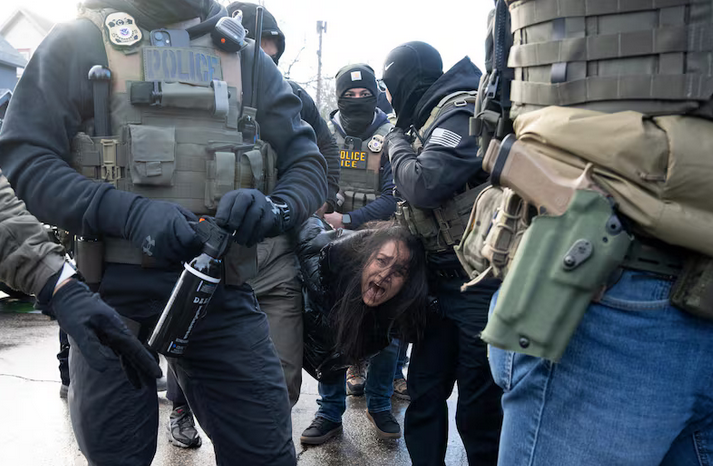
Federal agents carry a woman after they pulled her from her vehicle in Minneapolis, Minn., on Tuesday, Jan. 13, 2026. (Tim Evans/Reuters)
A spokesperson for the Department of Homeland Security told The Independent that ICE officers had been in the area to execute an arrest warrant for a 20-year-old man, originally from Ecuador, who they said had entered the U.S. illegally near El Paso, Texas, in 2019.
“As officers carried out their law enforcement duties, significant crowd surrounded them and began impeding law enforcement operations — a federal crime,” the spokesperson told the newspaper.
“One agitator ignored multiple commands by an officer to move her vehicle away from the scene, she was arrested for obstruction. Another agitator assaulted an officer by jumping on his back. Six of these agitators were taken into custody for assaulting law enforcement.”
In Minneapolis, ICE clashes with Minnesotans who want them out
As the federal law enforcement agency continues its crackdowns in Minneapolis, it’s become common for people to boo, taunt and blow whistles when they spot heavily armed immigration agents passing through in unmarked vehicles or walking the streets.
It’s all part of a grassroots effort to warn neighbours about ICE, confront agents over their actions and remind the government that residents are observing the agents as they execute warrants.
Homeland Security says it has made more than 2,000 arrests in the state since early December.
ABOUT THE AUTHOR
Mark Gollom – Senior Reporter
Mark Gollom is a Toronto-based reporter with CBC News. He covers Canadian and U.S. politics and current affairs.
With files from The Associated Press
CBC’s Journalistic Standards and Practices·About CBC News
Corrections and clarifications·Submit a news tip·
The post Video shows woman dragged from car by ICE agents in Minneapolis as she tells them she’s autistic appeared first on CANADA VOICE.
]]>The post As Iranians bury their dead, many are waiting for Trump’s next move appeared first on CANADA VOICE.
]]>
Briar Stewart · CBC News
While airing video on Wednesday of large funeral processions for some of the people killed during the protests that have recently gripped the country, Iran’s state broadcaster blamed the U.S. for whipping up and leading the “terrorist actions.”
That’s the clerical regime’s official narrative, which it has been amplifying while ruthlessly trying to silence all other accounts of what’s happening.
This wave of demonstrations began on Dec. 28, when merchants at Tehran’s Grand Bazaar protested the country’s deepening economic crisis and the further drop of the currency, the rial, to a record low.
The unrest quickly spread across the country, as people fed up with years of repression and restrictions took to the streets.
The U.S. and Canada are urging their citizens to leave Iran immediately as Iranians send urgent pleas for help and describe the violence inflicted by security forces. Meanwhile, the number of those killed during ongoing protests has surpassed 2,000, according to human rights groups.
For nearly a week, most of Iran’s 90 million citizens have been cut off from the internet and prevented in many cases from connecting with family and friends both inside and outside Iran.
“The signals were cut as the protests began and citizens were suddenly paralyzed,” wrote a 22-year-old man in a message to CBC News. “Communication is still extremely difficult. SMS (messaging) is down.”
CBC is not identifying the man because, like others, he is concerned about potentially severe repercussions from the Iranian regime.
Over the past two days, with the help of an Iranian journalist living in Europe, CBC has been able to connect with three individuals in Iran on the social messaging platform Telegram.
All three answered questions about the protests and the level of violence, as well as U.S. President Donald Trump’s threats to intervene because of the brutal crackdown on protesters.
The U.S.-based human rights group HRANA says it has verified more than 2,500 deaths.
“I personally witnessed gunfire and attacks … tear gas, sound bombs or flares, live ammunition and pellet guns,” said the 22-year-old, who is in the southern Iranian city of Bandar Abbas, which lies on the Strait of Hormuz.
“I witnessed the confirmed death of at least one person right next to me. The body was taken away by the repression forces.”
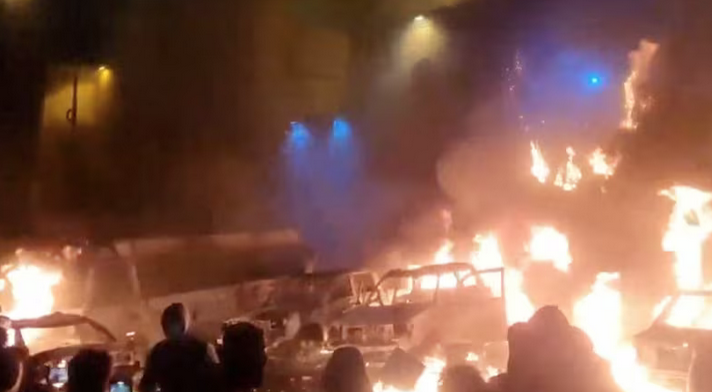
In this screen grab obtained from a social media video released on Jan. 9, protesters gather as vehicles burn in the Iranian capital, Tehran. (Reuters)
Thousands killed, even more arrested
In addition to those who have been killed, human rights groups estimate that thousands have been arrested during the protests. Iran’s judicial chief has vowed swift justice.
The 22-year-old said that security forces used motorcycles, armoured vehicles and water cannons to try to push demonstrators back.
He said one of his friends was hit by several pellets at a protest and that he knew of numerous people who were injured in the eyes and face by projectiles.
The man described the protests as unprecedented, even compared to previous uprisings, such as the 2022 demonstrations sparked by the death of 22-year-old Mahsa Amini in police custody.
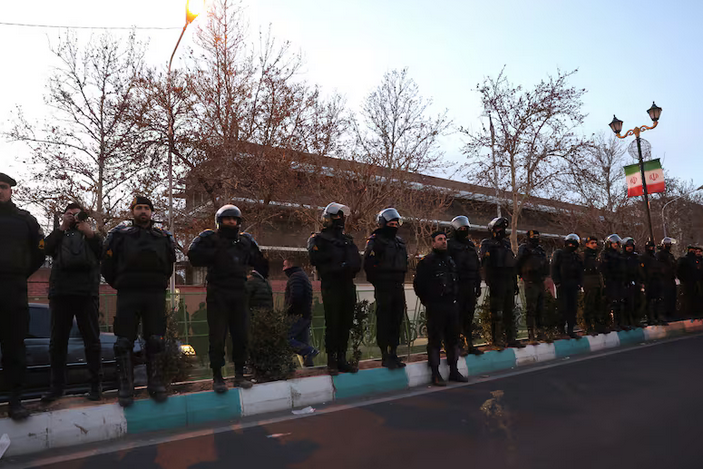
Members of the Iranian police stand guard in front of the British embassy following anti-government protests in Tehran on Jan. 14. (Majid Asgaripour/West Asia News Agency/Reuters)
That’s because several “different segments of society” have taken to the streets and banks and government facilities were burned. A CCTV video verified by Reuters and posted on social media last week showed footage of a mosque in Tehran being vandalized.
In the central Iranian city of Isfahan, a man told CBC the situation was so tense, even grocery stores didn’t “dare to open.”
He said after an office belonging to a subsidiary of Iran’s state broadcaster was set on fire on Jan. 9, pickup trucks arrived mounted with heavy machine guns. The guns were fired into the air to disperse the crowd.
“There were fatalities, but the numbers are very unclear,” he said of that particular incident.
Starlink banned
Iranians told CBC that it has been impossible to talk to people outside of the country unless you have access to a Starlink satellite internet system, which was formally banned in June, after the 12-day war between Israel and Iran.
Earlier this week, President Trump mused about sending Iran more of the systems. On Wednesday, Iran’s intelligence services said they confiscated a large shipment of Starlink kits in one of the country’s border areas.
Human rights groups reported that security forces had started seizing satellite dishes, in what is seen as an attempt to restrict access to foreign TV channels.
Awyar Shekhi, who is with the Norway-based Iranian Kurdish rights group Hengaw, said over the past two days, some people inside Iran were able to call out, but that calls into the country wouldn’t connect.
When she spoke with CBC by Zoom around 8 a.m. ET on Wednesday, she said Hengaw had not yet been able to connect with any of his sources on the ground that day.
Trump threats
In a defiant address delivered on Jan. 9, Iran’s Supreme Leader Ayatollah Ali Khamenei called the protesters troublemakers who were trying to please the U.S. president.
Trump has threatened to punish the long-ruling regime for using violence against demonstrators. He told Iranians to keep protesting, saying that “help is on the way,” without specifying what kind of response he is considering.
“Some think Trump won’t do anything. Some are upset with him, asking why he spoke if he didn’t intend to act,” wrote the 22-year-old from Bandar Abbas.
“People hope that the repressors, commanders and key figures of the Islamic regime will be targeted by drones and missiles.”
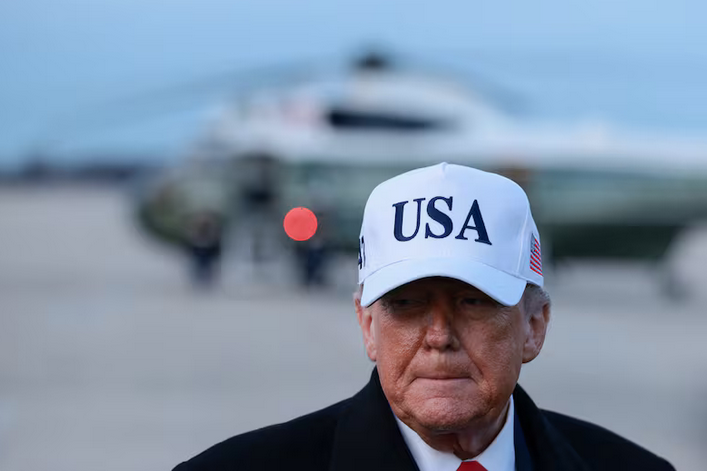
U.S. President Donald Trump is seen at Joint Base Andrews, Maryland, on Jan. 13, 2026. (Evelyn Hockstein/Reuters)
He hopes mounting international pressure leads to the regime’s demise, but others feel it is nowhere close to collapsing.
“These people are not going to disappear so easily,” said a 47-year-old living in Tehran in a voice message sent through Telegram. “This system is far more brutal, more complex and far more professional.”
He said security forces, including those in plain clothes, are on the streets, and public fear is pervasive. He notes that when he and others talk on the phone within Iran, they choose to temper their language, in case someone is listening.
There is widespread anxiety and anticipation about what could come next. He said people are hoping an outside power, potentially Trump, can help force a revolution.
“It is as if people are waiting for a saviour,” the man said.
In the northern part of the capital where he lives, he said people are still taking to the streets nightly, but are now mostly chanting broader slogans about change.
“I think people have pulled back for now because of the killings,” he said. “They are absorbing the shock, regrouping and then they will strike again.”
ABOUT THE AUTHOR
Briar Stewart – Foreign Correspondent
Briar Stewart is a CBC correspondent, based in London. During her nearly two decades with CBC, she has reported across Canada and internationally. She can be reached at briar.stewart@cbc.ca or on X @briarstewart.
With files from Mahtab Qolizadeh
CBC’s Journalistic Standards and Practices·About CBC News
Corrections and clarifications·Submit a news tip·
The post As Iranians bury their dead, many are waiting for Trump’s next move appeared first on CANADA VOICE.
]]>The post Iran Is Teetering. The West Isn’t Prepared… by Holly Dagres appeared first on CANADA VOICE.
]]>washingtoninstitute / by Holly Dagres
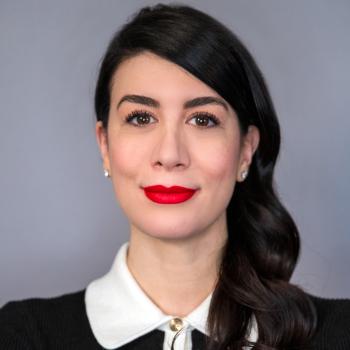
Holly Dagres is the Libitzky Family Senior Fellow in The Washington Institute’s Viterbi Program on Iran and U.S. Policy.
Also published in New York Times
To avoid being caught flat-footed, Western governments must begin policy planning for the destabilizing waves that could accompany regime collapse while urgently restoring support for programs focused on internet freedom, human rights, and similar areas.
A lone man crouched in the middle of a Tehran street, a black jacket pulled over his head, blocking advancing Iranian security forces. The video went viral among Iranians, quickly drawing comparisons to the famous “Tank Man” in China’s Tiananmen Square in 1989. Similarly courageous actions have occurred across Iran: young protesters—sometimes alone, sometimes in pairs or more—standing or kneeling peacefully before their repressors. The protests are the largest since the Woman, Life, Freedom uprising that began in 2022 and are taking place despite what the United Nations has called crimes against humanity committed by the authorities during that period. The trigger this time was the collapse of the Iranian rial against the dollar. However, the protesters’ core grievances remain constant—government mismanagement, corruption, and repression—and they include an explicit demand for the ouster of the Islamic Republic…
Read the full article on the New York Times website.
The post Iran Is Teetering. The West Isn’t Prepared… by Holly Dagres appeared first on CANADA VOICE.
]]>The post Iran 1978: Hindsight Is a Wonderful Thing .. by Simon Henderson appeared first on CANADA VOICE.
]]>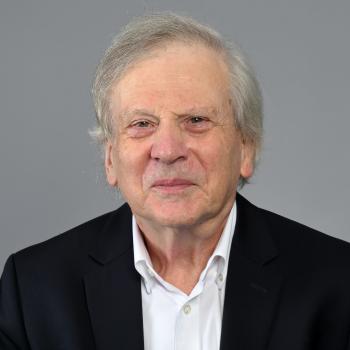
Firsthand recollections of how the Islamic Revolution progressed on the ground raise questions about the current protest movement’s prospects for success.
Trying to predict what will happen in Iran is challenging, perhaps impossible. Believe me, I know. I have been here before.
In December 1978, three months after joining the Financial Times in London and despite never having been to Iran, I was sent to Tehran to cover the revolution. For the next two years, the revolution, the US embassy hostage crisis, and the start of the 1980-88 Iran-Iraq war dominated my life.
In late 1978 the country was already in crisis. In August of that year a cinema in the southern city of Abadan had been deliberately set ablaze, trapping around 400 people. The next month, soldiers fired on demonstrators in Jaleh Square, Tehran, killing scores. But, when I first went, the only thing I knew about Iran was that it was ruled with American and British support by the shah, who was kept in power by the feared Savak intelligence agency.
Within a few days of arriving I had the “splash,” the front-page lead of the FT: “Million join in peaceful protest march in Tehran.” In the next day’s edition my story was “More deaths as anti-shah protests grow.”
But the FT’s main interest was oil, so I headed to Ahwaz in the oil-rich southwest of the country, where I interviewed an American oil executive who told me he had had a death threat left on his desk: “Hell, I’ve been in this business too long—that sort of thing doesn’t scare me.” A week later I reported his assassination.
Economically, the country was in a deepening mess. Oil workers were on strike, reducing production to “near zero.” Gasoline was rationed, despite the country’s huge oil reserves, among the world’s largest. The lack of fuel for power stations meant electricity was cut off every evening, being reconnected only in the early hours of the following morning.
Those who could afford it were fleeing the country, even if it meant leaving assets like property behind. The main opposition was already identifiably “Islamic.” Mosques in Tehran and the surrounding area organised buses to bring demonstrators into the city. The women all wore chador cloaks or at least head scarves, and grouped separately from men. The historical opposition to the shah’s rule had been the communist Tudeh party, but its members did not seem to be a major force any longer.
Danger was always close. On December 28 I was caught on the wrong side of a demonstration when army rangers opened fire at a crowd of several thousand. Fortunately it was mostly into the air but, yes, it was very scary. A month later, a thug in the crowd waved a knife at my throat, earning me a reporting mention in The Washington Post.
The challenge of day-to-day reporting is firstly to find out and judge the significance of what is going on, and secondly to look for trends. In retrospect, the course of the 1979 revolution is clear: demonstrations; loss of government control; exit of the shah, Mohammad Reza Pahlavi (who, it turned out, had cancer); return of Ayatollah Khomeini from exile in France; resignation of interim prime minister Shahpour Bakhtiar (later murdered in France by Iranian agents); then finally, a few days of anarchy until pro-Khomeini forces overcame resistance.
But at the time this chronology was anything but clear. Remember, this was before the internet, with only short-wave radio reception from the BBC, and only intermittent overseas telephone and telex communications.
So far, this time, we are notionally much better informed. Despite challenges, especially in the last few days, news is still getting through. We have had demonstrations and multiple deaths—at least 500—but not yet loss of government control. Also, the protesters lack any obvious leadership and coordination.
Despite rumours of Supreme Leader Ali Khamenei planning to go into exile, he seems still to be in the country. In 1979 the armed forces turned out to be reluctant to shoot demonstrators. The revolutionary guards and the guys in black on motorbikes are yet to show similar scruples this time.
So we are left thinking, is this another revolution or just another round of discontent of the kind which has erupted every few years and then petered out, as in the “women, life, freedom” protests of 2022? Could the Islamic Republic remodel itself, less Khamenei (and mullahs), more Masoud Pezeshkian, the suited but tieless president elected in 2024, who is regarded within the establishment as a reformist? And what about Israel, still worried about Iran’s damaged but not destroyed nuclear programme, and itself very vulnerable to Iran’s high-precision missiles?
The wild card, at least this week, is the late shah’s son, Reza Pahlavi, who seems to be taking on a leadership role for which he has previously shown neither enthusiasm nor particular ability. Yet the 65-year-old, who lives in a Washington suburb, appears to be a unifying character in contrast to his father’s divisiveness.
So far, this Pahlavi’s main challenge is that he lacks any sign of support from US President Donald Trump, who is expected to be briefed on his options. Meanwhile, Tehran is seeking talks with Washington, an old time-wasting gambit. It looks like being a busy next few days.
Simon Henderson is the Baker Senior Fellow at The Washington Institute and director of its Bernstein Program on Gulf and Energy Policy. This article was originally published on the Arabian Gulf Business Insight website.
The post Iran 1978: Hindsight Is a Wonderful Thing .. by Simon Henderson appeared first on CANADA VOICE.
]]>