The post What France’s crackdown on Shein and Temu means for global ultra-fast fashion appeared first on CANADA VOICE.
]]>BBC / By Emily St. Martin,Features correspondent
France’s fast fashion bill takes aim at retail behemoths lawmakers argue damage the environment, hurt the economy and feed impulse buyers.
France’s lower house of parliament unanimously approved a “kill bill” on 14 March that targets fast fashion and ultra-fast fashion sold by online retail giants such as Shein and Temu. The measure is a move to offset the fast fashion industry’s environmental impact by banning the advertising of certain ultra-fast-fashion companies – and penalising them with annually increasing increments of up to 10 euros (£8.54 or $10.92) per article of clothing by 2030. The bill would also mandate that fast fashion retailers include an item’s reuse, repair, recycling and environmental impact near the product’s price.
What is fast fashion?
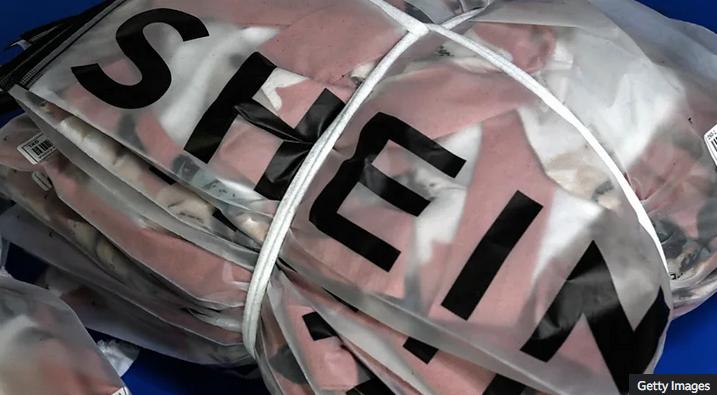
Fast fashion is widely considered low-quality apparel. It is produced rapidly to follow current trends in the industry and sold at rock-bottom prices. Fast fashion allows cost-conscious consumers to regularly update and expand their wardrobes with knockoff en vogue styles, and although the monetary cost is low, experts say both textile factory workers and the earth’s environment are paying the – hefty – price.
“It’s important when the price conversation comes up for people to realize that the price of fast fashion is being kept artificially low,” said Emily Stochl, the vice president of advocacy and community engagement at Remake, a sustainable fashion nonprofit organisation.
Getty Images / (Credit: Getty Images)
“It’s essentially being subsidized by the fact that these companies are not paying their workers adequately. So this idea that [fast fashion pricing] is the bar for clothing that consumers have come to expect – it’s an artificial construction.”
Stochl points to previous advertising bans such as cigarette advertisements in the US in the 1970s and the UK in the early aughts, likening the addictive nature of tobacco to the impact fast fashion has had on consumers. France’s new bill uses similar language, stating, “This evolution of the apparel sector towards ephemeral fashion, combining increased volumes and low prices, is influencing consumer buying habits by creating buying impulses and a constant need for renewal, which is not without environmental, social and economic consequences.”
Shein, Temu and the impact of new policies
Shein, a fast fashion behemoth founded in China and headquartered in Singapore, argued in a statement to the BBC that the bill’s impact will “worsen the purchasing power of French consumers, at a time when they are already feeling the impact of the cost-of-living crisis.”
Kathleen Talbot, chief sustainability officer and vice president of operations at Reformation, an eco-friendly brand favored by the likes of Taylor Swift, Monica Lewinsky and Sydney Sweeney, says that ultra-fast fashion brands represent the “insane excess” the fashion industry is seeing in terms of speed and volume. Talbot adds that using regulation as a vehicle to drive change may be the only option, as slowing overconsumption seems unlikely in a market with a piping-hot demand that isn’t simmering down.
How do we start to create incentives for good actors – or on the flip side, tax bad actors – to force brands to pay for negative externalities?
– Kathleen Talbot
“What’s interesting about the proposed French bill and regulations like the New York Fashion Act is they do have similar aims,” says Talbot. “We’re asking these big questions around how we account for the negative impacts of fashion on people and the planet. How do we start to create incentives for good actors – or on the flip side, tax bad actors – to force brands to pay for negative externalities? I wish it was easier to do that. What we’re seeing are these really location-specific, siloed efforts.”
“But I think it’s a start”, Talbot adds. “Hopefully, [it] helps become a model or move other regulatory bodies to consider these issues and consider what the role of regulation is in addressing the challenges we’re seeing in the industry.”
When approaching lasting change through policy reform, Stochl points out that vital workers in the garment-maker and textile waste management communities are most harshly impacted by fast fashion – and they are centered in the development of the proposed legislation.
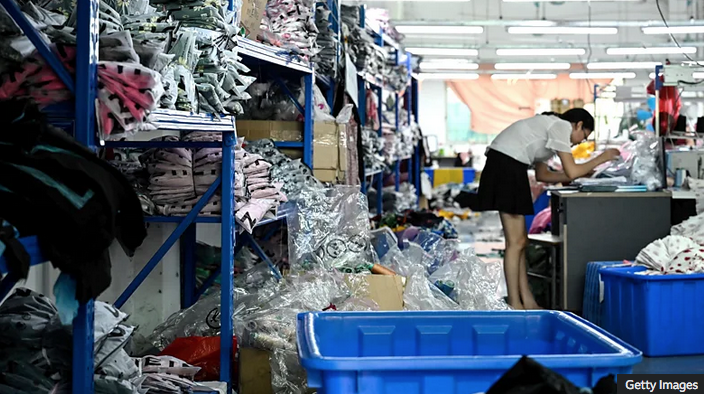
Getty Images / Textile workers bear the brunt of ultra-fast fashion brands’ cost-cutting measures (Credit: Getty Images)
“Lawmakers should ensure that the funds collected via these penalties flow in the direction of where that environmental impact is occurring,” Stochl continued. “For example, the frontline communities facing the most environmental impact because of fast fashion are often communities in the global south… So as penalties are collected to address environmental impact, how are those funds distributed to the frontline communities most impacted? As far as I can tell, the policy doesn’t address those things.”
Temu, a Chinese-owned e-commerce company, has been widely criticised by politicians in the UK and US alike – and in 2023, a US government investigation warned of an “extremely high risk that Temu’s supply chains are contaminated with forced labor.”
Temu says it “strictly prohibits” the use of forced, penal, or child labour by any of its merchants.
In 2021, a report by Swiss advocacy group Public Eye, found that a number of Shein employees across six sites in Guangzhou were found to be working 75-hour weeks. And in 2023, a group of US lawmakers called for Shein to be investigated over claims that forced labour of the Uyghur people – a Turkic ethnic group within China – is used to manufacture some of the clothes the brand sells. Shein told the BBC that it has “zero tolerance” for forced labour.
A spokesperson for Temu told the BBC that the brand “acknowledges the important environmental concerns addressed by the proposed French legislation,” and argued that they do not operate as a fast fashion company because they are a marketplace and do not manufacture their own products.
Both Temu and Shein separately tell the BBC that their on-demand business models reduce waste compared with traditional business models.
—
If you liked this story, sign up for The Essential List newsletter – a handpicked selection of features, videos and can’t-miss news delivered to your inbox every Friday.
The post What France’s crackdown on Shein and Temu means for global ultra-fast fashion appeared first on CANADA VOICE.
]]>The post London Fashion Week: Celebrating 40 years of catwalks appeared first on CANADA VOICE.
]]>Stars are striking a pose to celebrate the 40th anniversary of London Fashion Week (LFW).
The bi-annual event, originally the brainchild of PR guru Lynne Franks – and now a staple of the global fashion calendar – launched in 1984.
The youngest of the big five fashion weeks, this year’s event brings glitz and glamour to London until Tuesday.
But British Fashion Council chair David Pemsel has said economic challenges are putting pressure on the industry.
Speaking to BBC Breakfast, Mr Pemsel said the cost-of-living crisis, interest rates and Brexit were all creating difficulties for designers and fashion houses.
He insisted, however, that the industry remained “resilient”.
“[Our] quality is really respected in the industry: we’ve got phenomenal designers doing amazing things,” he said.
The anniversary edition of LFW will host 67 designers across 46 catwalks and 36 events, say organisers – with collections by many more up-and-coming designers expected to make an appearance off-grid.
Star attractions include Preen, Richard Quinn, Simone Rocha, Harris Reed, 16Arlington and Emilia Wickstead.
Harry Lambert, the man behind Harry Styles’ makeover and Emma Corrin’s wardrobe, is also set to cause a stir.
Continuing tradition, Burberry is slated to close the official programme on Monday, with Daniel Lee’s collection.
Striking a (lasting) pose
On Thursday night, some of London’s best-known landmarks, including Covent Garden, the London Eye and the Royal Opera House, were lit up in green to mark the start of the LFW anniversary celebrations.
Throughout the decades, LFW has showcased established, and emerging, British talent – from supermodels Naomi Campbell and Kate Moss, to iconic designers including Matthew Williamson, Stella McCartney and the late Alexander McQueen.
Lynne Franks, who provided the inspiration for Absolutely Fabulous character Edina Monsoon, says she pushed for a fashion week in London out of frustration – intent on giving the city a dedicated floorspace to promote its prowess, in keeping with other fashion capitals such as New York, Milan, Paris and Tokyo.
“We were not on the international calendar at all,” she told the Evening Standard. “I thought, if they can do it, why can’t we?”
Although smaller than its peers in Milan, Paris and New York – which routinely boast international fashion giants – London continues to be known for its unique style and daring.
“It’s much more innovative,” Betty Jackson, a designer at the first LFW, told the BBC. “I do think we have the best ideas, really. And we’re fearless.
“A lot of of inspiration, I think, comes from young people wearing stuff on the street, and wearing things in a different way,” she said.
The British Fashion Council’s NewGen initiative continues to support the next generation of designers, while Friday’s Central Saint Martins MA show provides a platform for the London art school’s brightest young stars.
Memorable moments from London Fashion Week
Shalom Harlow’s spray-paint dress (1999)

Victor Virgile
In one of the most visually arresting moments amid McQueen’s myriad runway shows, two robots spray-painted a dress worn by the model Shalom Harlow.
Speaking to the Metropolitan Museum of Art about the experience, Harlow said she did not directly discuss the set piece with the designer ahead of show.
“I like to think that he wanted to interfere as little as possible and allow me to have the most genuine, spontaneous experience as possible,” the model told the Met.
Queen Elizabeth II joins Wintour in front row (2018)

Getty Images
Fashion royalty met the real thing, when Queen Elizabeth II joined Anna Wintour at British designer Richard Quinn’s runway show in 2018.
The late queen, then 91, appeared, all smiles, dressed in a turquoise blazer.
Writing a tribute piece for Vogue following Elizabeth II’s death in 2022, Wintour said the late queen was “so delighted to be there, telling me how she had appeared in a fashion show long before she became Queen”.
She continued: “She said it with joy and humour that bounded around the room, lighting it up: An everyday occurrence for Her Majesty, an unforgettable one for the rest of us.”
Alexander McQueen dances down the catwalk (1997)

Alexis Duclos
The late fashion designer lit up LFW countless times with his creativity, but in 1997 enjoyed his own rare moment on the catwalk.
Dressed in a casual polo shirt and jeans – a counterpoint to his dramatic fashion creations – the beloved British designer danced down the runway at the end of his show to the rapturous applause of his models and audience.
Hussein Chalayan’s coffee table dress (2000)

Reuters
Hussein Chalayan is famous for his experimental designs, but none have captured the global imagination quite like his coffee table dress.
As models strode around a living room, one stood atop the coffee table that, in an eye-popping moment of industrial design, transformed into a wooden hooped skirt when she lifted it up.
Despite its theatrical edge, the show held a serious underlying message. Inspired by refugees of war, the interplay between furniture and clothing drew parallels with those forced to flee their homes, carrying their worldly possessions on their backs.
Prince struts his stuff (2007)

Getty Images
Singer Prince made a career out of flamboyance – in his music and his fashion choices – so, in some ways, his surprise appearance at LFW makes perfect sense. Not that anybody expected it.
The star, who was in the capital to play at the 02 Arena, snuck in virtually unnoticed ahead of Matthew Williamson’s 2007 show – only to start singing from the front row, before jumping on stage to perform his track Chelsea Rodgers. According to The Telegraph, there was method to his madness: the song was dedicated to his namesake girlfriend at the time… a model who just so happened to be a fan of Williamson.
Fashion show, gig, immersive love letter – or a mixture of the three? Either way, very Prince.
London Fashion Week contributes £21bn to the UK economy, and employs more than 900,000 people, according to the British Fashion Council’s latest industry report.
Last year, sales of womenswear were valued at an estimated £30.9bn, with menswear sales estimated at £15bn, Mintel figures show.
Prime Minister Rishi Sunak praised the sector this week for its contribution, reiterating its value to the UK economy. “It generates a huge amount for the coffers, and has global resonance in terms of creativity and reputation in this country,” he told the Evening Standard.
“It’s an opportunity to reach into new markets – to remind everyone of the power of fashion week and the power of businesses that participate,” he added.
However, McKinsey’s State of Fashion report warns of “strong economic headwinds” for the year ahead, with fashion houses facing “subdued economic growth, persistent inflation and weak consumer confidence”.
Mr Sunak frustrated fashion industry leaders by scrapping tax-free shopping when he was chancellor in 2021.
He has retained the policy as prime minister, despite repeated calls from the British Fashion Council, bosses of several large fashion brands and retailers to re-instate the tax break.
The post London Fashion Week: Celebrating 40 years of catwalks appeared first on CANADA VOICE.
]]>The post Irish designer captivates at Paris Couture Week appeared first on CANADA VOICE.
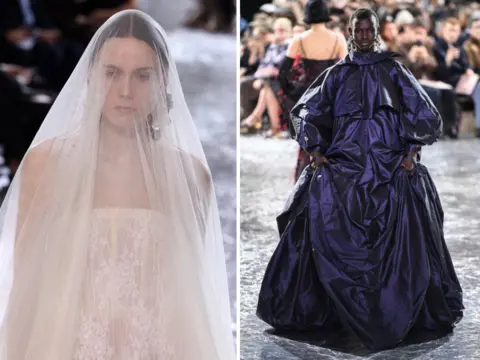
]]>Irish fashion designer Simone Rocha has presented an haute couture collection in Paris.
The Dublin-born creative exhibited her work as a guest couturier for Jean Paul Gaultier on Wednesday.
Gaultier launched the initiative upon his retirement in January 2020 with Rocha becoming the sixth person invited to guest design couture – the most elite branch of the fashion industry.
“I was really humbled, excited and enthusiastic when I got the call,” Rocha told BBC News NI ahead of the show.
“I think it’s a real gift that he has done this way of working. It feels really generous… to be so open to interpretation.”
 Estrop
 Swan Gallet/WWD
As part of the process, the ‘enfant terrible’ gives his guests free reign to interpret the Gaultier brand as they see fit.
“He wants to wait to see it in the show, because it’s designer to designer – that’s the best process,” Rocha said.
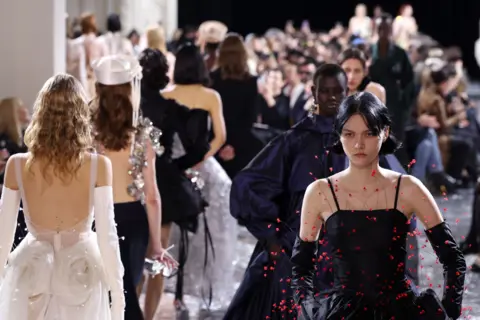
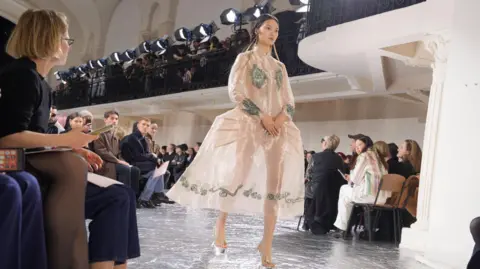
When the show was announced, fashion commentators speculated on how Rocha’s hyper-feminine, whimsical signatures would translate to the Jean Paul Gaultier brand.
“I love that,” Simone said.
“When I was asked to do it, straight away I could see it being very feminine but also very provocative and playful, all these iconic Gaultier troupes.”
 Estrop, Dominique Maitre/WWD
Rocha described the opportunity as an “invited challenge” and she relished in exploring Gaultier’s archives.
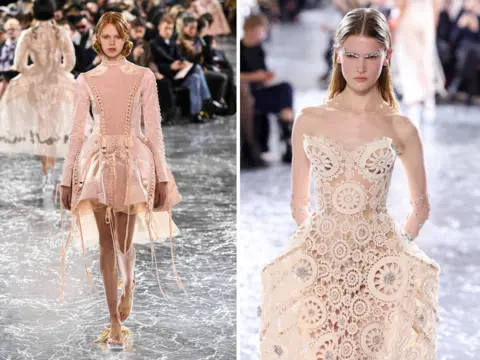
“Some were quite preserved, all in tissue in these wooden boxes, which are actually called coffins – which I also loved – some pieces were so old they were almost starting to disintegrate, so you couldn’t even try them on,” she said.
 Dominique Maitre/WWD, Estrop
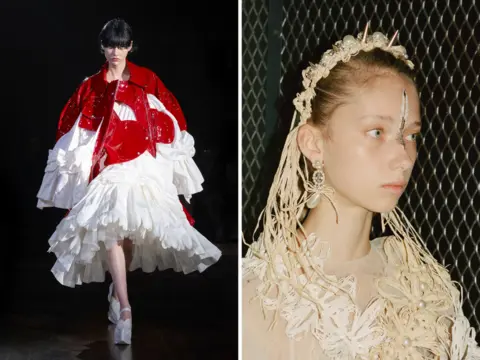
Hand-crochet and manipulated Irish lace feature in the collection, which includes “a nice mix of techniques that feel very close to home”.
However, Simone also embraced newer design methods “that feel almost a bit alien, but amazing”.
“It’s quite a labour intensive process, but at the same time I think we’ve been using restraint in some areas and then [been] excessive in others,” she explained.
 Victor VIRGILE/Gamma-Rapho
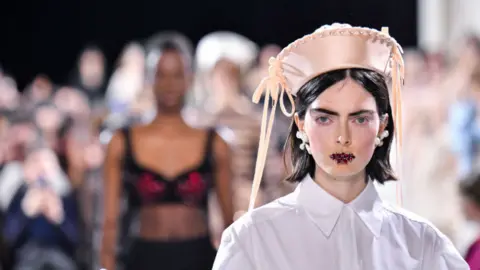
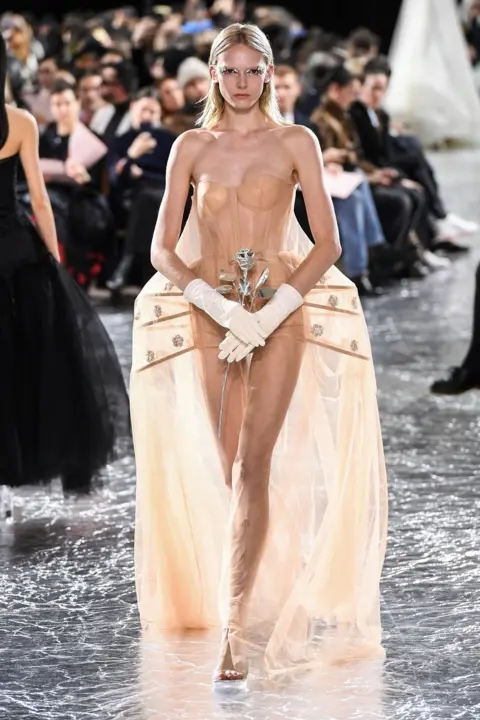
Rocha appears to have struck the balance, according to early reviews from the fashion press who have praised her reimagining of Gaultier’s conical bras, corsets and sailor hats.
The collection marked “a new high point in the Irish designer’s career”, according to The Irish Times, which claimed each item was “outstanding in its own way”.
“It’s that rare collection where every single look warrants conversation,” added Fashionista, while Harper’s Bazaar has deemed the show “a resounding success” full of “exquisite tulle creations”.
Elle magazine labeled the partnership “a meeting of minds and beauty”, and, as for the main man, Jean Paul told The Guardian that the collection “went beyond what [he] expected”.
 Dominique Maitre/WWD
Since graduating Central Saint Martins in 2010, Rocha has established herself as one of the world’s leading fashion designers, receiving numerous accolades for her work.
These include Harper’s Bazaar Designer of the Year Award and Fashion Awards for Emerging Talent, The New Establishment Award and British Womenswear Designer.
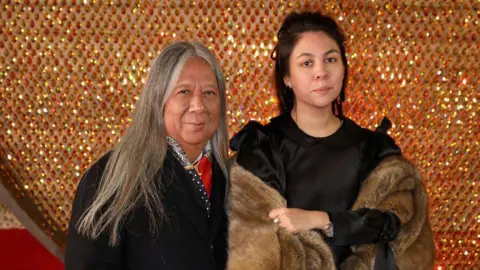
As the daughter of esteemed designer John Rocha, she has carried the family name to further prominence with stores in London, New York, Taipei and Hong Kong, and notable collaborations with Moncler, H&M and J Brand.
Born in Dublin in 1989, Rocha has spoken of a colourful childhood filled with music and laughter.
She began assisting her father from a young age, immediately feeling at ease in the studio but unsure of her future creative practice.
“They used to have really good parties in the house I grew up in. Shane MacGowan, Van the Man… it was really fun. Wild. All the kids just ran around and what was really nice is that we were always very much a family,” she previously told The Telegraph.
It is those strong family ties that took the designer across the world from a young age, regularly visiting relations in Hong Kong.
 Getty
Getty“I’m really proud of being half Irish and half Chinese,” Rocha told BBC News NI.
“I grew up in Ireland and I really enjoyed it. I was really fortunate to go to art college in Dublin [National College of Art] before I went to do my masters in London.
“There’s such a natural heritage of storytelling, writing, music, film [in Ireland]. And it has completely been a part of the work that I make… the duality and contrast of being from two different places.
“A lot of the [Irish] landscape has really influenced my textiles and fabrication and then, contrasting that with this idea of the man-made, the practical side of life and living, has been a big part of my process.”
 DH-PR / Jacob Lilis
The Children of Lir, wren boys, mummers and John Millington Synge’s Riders to the Sea have influenced Rocha’s designs in recent seasons.
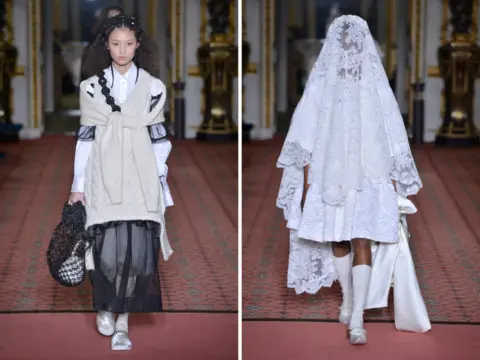
“I’d read the body of text [Riders to the Sea] and I was also thinking about the traditional mourners in the Aran Islands and how the women used to dye their petticoats and wear them as veils,” she said.
Envisioning men lost at sea, she was inspired to create lifejacket-inspired Aran stitch knitwear.
 DH-PR
DH-PRWhen Rocha decided to show menswear and womenswear together for winter 2023, she initially explored traditional Irish relationship rituals.
“Folklore, things like a snail leaving tracks of an [initial] in flour… throwing an apple on the floor to foretell the name of your loved one,” she explained.
 Getty
Getty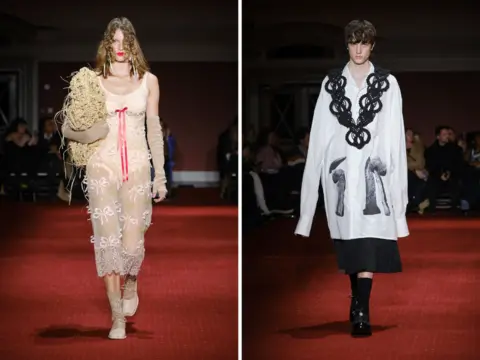 DH-PR
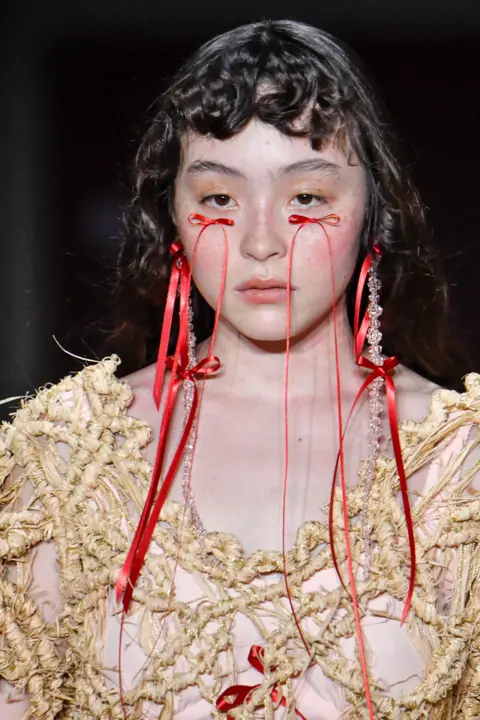
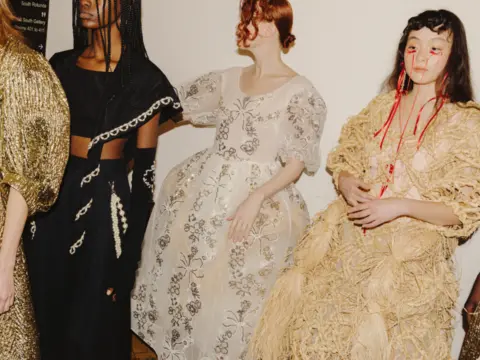
DH-PRAs her research deepened, Rocha looked to Lughnasadh – an Irish autumn festival with pagan origins.
What followed was elaborate, macramé garments paired with red ribbon ‘tears’, which she said represented the blood traditionally daubed on children’s foreheads to protect them from harm.
 Jacob Lilis
The collection was the beginning of an “all encompassing” triptych, exploring preservation and historical dress, with Wednesday’s couture show a second offering.
Her winter 2024 collection, due to be presented next month in London, has seen the designer explore an alternative archive.
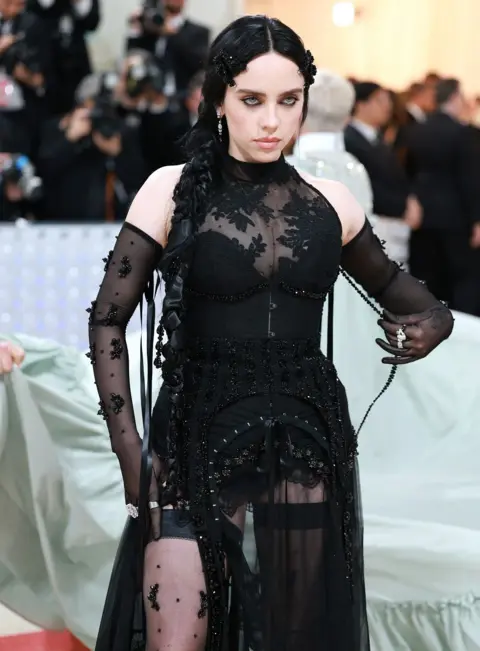
“I was privy to all of Queen Victoria’s mourning clothes… it’s been amazing, I’ve been exploring this idea of preserved clothes and mourning, and that’s going to influence the collection in February.”
 Getty
GettyRocha explained that her work has always “felt like an extension of [herself]” and it is a “huge compliment” to have it embraced by a growing fanbase.
Reflecting on her earliest shows and the supports available, Rocha admitted the industry has changed significantly over the last decade, partly because of the Covid pandemic.
“There was a huge appetite, suddenly even if you were showing in London you felt totally international, and I do feel like that’s still the case,” she said.
“I think the industry itself, post pandemic, retail has all had a shift.
“Everyone – especially if you’re independent – had to step back and look at your business, your identity, what you want to say and think of the steps to go forward.
“That comes with experience… for young designers the whole landscape is harder to navigate.”
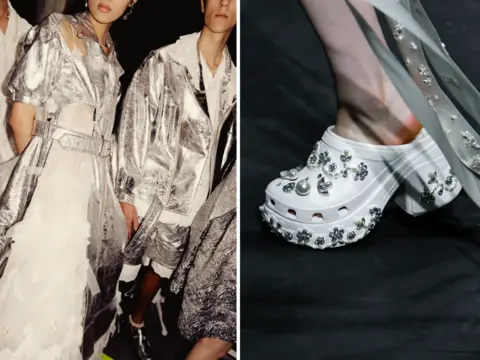 Jacob Lilis / Getty
Having said that, opportunity is aplenty, Rocha explained, with designers no longer fixed to the traditional fashion colleges and capitals.
“If you make the right work, you can share it now with social media, you don’t have to be at the fashion week, people are producing at different times, it’s so less regimented… people can see it in all different ways,” she said.
“If you do something that you really believe in and you do it really well, it’ll find the space and people will find you.”
What is haute couture?
Haute couture is considered the ultra-elite of fashion design.
The clothes are often made from the finest of materials and are extremely expensive with starting prices in the tens of thousands.
The ‘haute couture’ (high dressmaking) denomination is legally protected and its requirements are defined by the French chamber of commerce.
Participating fashion houses must design custom, fitted pieces for private clients and maintain a Paris atelier (workshop) with a minimum of 15 full-time staff.
Additionally, they must employ 20 full-time technical workers and showcase a collection of at least 50 original designs per year.
Jean Paul Gaultier is one of 16 members of the Chambre Syndicale de la Haute Couture regulatory body, although guest houses have occasionally been invited to showcase their designs at couture week.
The post Irish designer captivates at Paris Couture Week appeared first on CANADA VOICE.
]]>The post Fashion 2024: Knitwear, ribbons and other trends for the year ahead appeared first on CANADA VOICE.
]]>It’s hard to look fashionable in a Christmas jumper covered in mince pie crumbs and spatters of mulled wine, so we’re not here to make anybody feel bad this festive season.
But come spring, many of us will be spending way too much money on the hottest looks, in an inevitably fruitless attempt to look as good as the models on our Instagram feed.
Here are eight of the biggest fashion trends set to dominate 2024.
1. Polka dots
 Getty Images
We counted every single polka dot at every fashion show this year, and can tell you that the total came to 12,487,396. The runways, in other words, were packed full of them.
The pattern is often popular in summer, but really the prints are a timeless and versatile trend which you’re likely to see a lot of throughout the next year.
“Polka dots can be relied upon for elegance and impact,” said the Telegraph. “Spots are playful; they don’t take themselves too seriously. Even the name, polka, suggests joie de vivre.
“This time around, we are making them our own. They’re big and bold, they’re imperceptibly small, they’re punchy, they’re muted… This is a print for everybody: it’s genderless, classless, ageless and timeless. It’s time to join the dots.”
2. Cherry red
 Getty Images
With the exception of the annoying stone you have to spit out at the end, we love everything about cherries – and this season they provided the runways with a distinctive, vibrant and confident colour.
Some fashion houses put forward designs which were cherry red from head to toe, while others kept it limited to a skirt or jacket and combined it with other colours to make an ensemble.
“Fashion’s obsession with bright red has been impossible to ignore in recent seasons, seen on the runway but also the red carpet,” said Vogue’s Alex Kessler.
“Spring/summer 2024 [collections] brought a noticeable shift towards deeper and more opulent versions of the shade.”
3. Metallics
 Getty Images
Several designers took inspiration from the pipes under their kitchen sink for this next trend – a variety of outfits and dresses with a metallic sheen.
One of our favourite Met Gala themes of the last decade was 2016’s Man vs. Machine, which saw A-list guests dress in silver, futuristic colours with robot-inspired accessories. Metallics became prominent once again in 2023 as fans dressed up for Beyonce’s Renaissance tour.
The trend looks set to continue into next year and dominated during Paris fashion week, with Net-A-Porter noting: “Swathes of shimmering metallics glistened across the SS24 runways.”
But if you’re opting for gold, careful not to overload. “Metallic gold can have a gladiator look,” pointed out StyleCaster. “If you want to tone it down, pair metallic gold with alternate materials like denim or leather.”
4. Knitwear
 Getty Images
Let’s get down to the knitty gritty: In the UK, the weather is so appalling that frankly a nice cardigan or jumper never goes out of fashion.
According to Who What Wear, the SS24 collections acknowledged that “knitwear is a year-round staple, but one that should be no less fabulous than the rest of the items you wear”.
“Erdem’s embroidered cardigans were some of the most beautiful pieces we saw,” they added.
Elsewhere, W magazine suggested: “Cardigans and fair isle knits were the most prominent knitwear trend this season.”
5. Snowflake patterns
 Getty Images
We admit these beautiful and intricate designs are a bit more sophisticated than the snowflakes we made in school with some paper and a pair of scissors.
“Designers got crafty this season,” noted Drapers, “and the Paris runways were aflutter with super-size lace and broderie anglaise designs for SS24”.
(Don’t worry, we’ve already Googled it, broderie anglaise refers to patterns with small round or oval holes cut out of the fabric, providing the snowflake look.)
Several of the outfits on display during fashion weeks saw the snowflake design put front and centre, while others displayed them through an outer layer of sheer.
6. Bows and ribbons
 Getty Images
If you’re reading this in a room surrounded by discarded giftwrap, make sure you scoop up those bows and ribbons before they reach the rubbish bin.
Giant bows showed up in the collections of several major designers during the various fashion weeks, so we could be seeing them adorn a variety of dresses next year.
“Oversized and opulent bows, spotted at shows like Sixdo and Aknvas, added a touch of whimsy to looks that were otherwise simple or unadorned,” according to InStyle.
But not all fashion houses went for large and conspicuous designs – others opted for much smaller bows and ribbons to decorate, accessorise or tie together outfits.
“The dainty accessory creates a soft, romantic look no matter how it’s worn, acting as garment detailing for a slew of different silhouettes,” suggested Nylon.
7. Short shorts
 Getty Images
If you already feel overloaded by the number of tabloid headlines which use the phrase “leggy display”, then you may want to skip this one.
This summer will likely see an explosion in popularity for short shorts in a variety of colours, styles and fabrics.
“Those leg days at the gym are about to pay off,” said Net-A-Porter, “because if the recent runways told us anything, it’s that seriously short shorts are set to be the ultimate power-dressing move come summer ’24.”
8. Upcycled, pre-loved or sustainable materials
 Getty Images
Arguably the most important fashion trend we could all adopt in the coming year is green. But not the colour.
Sustainability has long been a concern in relation to the highly-polluting fashion industry. A huge number of consumers buy something cheap, wear it a few times, and then chuck it out.
Tiny steps are being taken to address the industry’s carbon footprint, such as the increasing popularity of websites which specialise in “pre-loved fashion”, but many feel a great deal more needs to be done.
So we applaud the designers who are putting sustainability in the spotlight – either by changing their working practices, or by incorporating used materials into their designs.
Examples highlighted by British Vogue include Stella McCartney’s use of Kelsun, a seaweed-based fibre that is said to have a significantly lower carbon footprint than conventional fibres.
Eckhaus Latta, meanwhile, showed a series of trousers that were 3D woven from yarn, cutting out the fabric-making process and reducing the amount of excess stock by making the manufacturing process more agile.
“Waste materials and deadstock are given a second life as new garments,” said Fashion United. “Materials destined for landfill are rescued and reworked. Pieced, patched, and layered together with imperfections and signs of wear and tear celebrated rather than hidden.”
As consumers’ awareness of their carbon footprint increases, perhaps the items many will choose to wear the most in the coming year are the clothes already in their wardrobe.
The post Fashion 2024: Knitwear, ribbons and other trends for the year ahead appeared first on CANADA VOICE.
]]>The post Hair raising! The return of the perm appeared first on CANADA VOICE.
]]>
The Guardian Leah Harper – @theharpsbizarre
The trend responsible for some of the 80s’ most ‘memorable’ barnets is back. But fear not – the modern look is less Deirdre Barlow, more a tumble of soft waves
It is a truth universally acknowledged that everybody wants the opposite of the hair they have. Those with bountiful curls are wont to straighten them to a crisp, while the rest of us crimp and twist, chasing waves via diffusers, tongs, curl creams and, lately, perms.
That’s right, the trend responsible for some of the 80s most memorable ’dos is making a return – to the terror of many who are still scarred by their own perm-disasters. But fear not: the perm, which for many still conjures images of Neighbours-era Kylie Minogue, or Coronation Street’s Deirdre Barlow, has had an update. Long gone are the tight, brittle waves, as seen on peak-perm Barbra Streisand; the modern perm – or the new-wave perm, as it has been dubbed – is an altogether gentler look.

The Argentinian model Mica Argañaraz , the new face of Zara. Photograph- Étienne Laurent:EPA-EFE
It’s definitely more than “beachy” waves, but not quite corkscrew, and it has captured fashion’s collective imagination. On the catwalk, Gucci and Celine had a number of curly-haired models walking in their spring/summer 2019 shows, while the current face of Zara – ever a yardstick – is the curly queen Mica Argañaraz. Emma Stone kickstarted the trend for celebrity perms last year when her makeup artist posted mid-perm pictures to Instagram, quickly followed by fellow actors Jaime King and Olivia Munn. On TV, lawyer Marcia Clark’s perm became a subplot in The People v OJ Simpson: American Crime Story, before Daisy Haggard sported loose waves in the BBC’s Back to Life and Natasha Lyonne’s curl-tastic hair was named as “the real star of Russian Doll”. In the past week, Charlotte Gainsbourg, Priyanka Chopra and the model Taylor Hill all wore waves on the Cannes red carpet. Men, too, are getting in on the act, with Game of Thrones fans citing the “Jon Snow effect” as the reason behind renewed male interest in curls.
Early iterations of the perm date back as far as 1872, although it was not until 1938 that Arnold F Willatt developed the “cold wave perm”, which avoids heat, and uses ammonium thioglycolate – a fact Legally Blonde fans will remember as the chemical compound referenced by Elle Woods during the case-solving court scene – to break down the hair’s protein structures and create curls.

Natasha Lyonne’s hair was named as ‘the real star of Russian Doll’. Photograph- Netflix
Modern perm techniques vary, and today many chemical perms have switched to using sodium thioglycolate, but the technology has not, in fact, moved on a great deal, according to Luke Hersheson, creative directive of Hersheson salons, which offers the new-wave perm (from £150).
“The perception of perms was very much related to the haircut they were teamed with,” he says. “In the 70s and 80s, it was graphic cuts, quite short, extreme shapes and bubble perms. Nowadays, perms are for longer hair, so it’s less about the hair standing away from the head, and more about using people such as Julia Roberts as a reference. We’re not using old-school perm rods, either, but foam rollers, which are bigger and softer.”
At Karine Jackson Hair & Beauty in London, hair stylists now do around four perms a day, up from just four a year of the “Think Curl” perm (from £100), which is ammonia- and thioglycolate-free.
“In the 80s, when perms went wrong they often weren’t wound properly, which resulted in ‘fish-hook [sharply bent] ends’; now, Curlformers [a kind of curler that creates various types of curl] do the work, so it can’t happen with them,” says the salon’s founder and director, Karine, who has permed Neve Campbell’s hair.

A perm by the Nicky Oliver salon in Manchester. Prices available on request. Photograph- Vince Broderick
Social attitudes towards curls are also changing. Historically, curly, frizzy or even wavy hair has been associated with scruffiness or unprofessionalism – a belief that often comes with racist connotations. Over recent years, however, black men and women have embraced natural, afro hair textures.
“We have seen an increase in the perm market for afro hair,” says Nicky Oliver, the founder and director of Nicky Oliver salon in Manchester, and an authority on styling for African-Caribbean and Asian hair. “People have been wearing theirs relaxed for years, then they wanted to wear their hair natural – but many still want it to be manageable. They have been used to blowdrying their hair. By doing a very tight perm, they can still have their curls but they will be easier to manage.”

‘It’s about using people such as Julia Roberts as a reference’- Roberts in Pretty Woman, 1990. Photograph- Allstar:Touchstone Pictures
Jackson stresses that there is no longer a “one size fits all” approach; today, pre-perm consultations can include questions on everything from how often clients tie their hair up and go to the gym, to what medication they are taking, alongside a hair-strength test – all of which can affect how a perm takes to the hair and how long it will last (anywhere from two to 12 months).
Jack Howard, hair colourist at Paul Edmonds, agrees: “Individuality is everything: with highlights, we used to do a sea of perfectly placed foils; now, that stripy uniform look is really dated. It’s the same with the perm,” he says. “It’s all about creating a bespoke look for the individual client that suits their hair texture, condition and style.”
Howard has created a new technique, which he called “permage” (from £275) that combines perming and face framing highlights, and also uses Curlformers to create his curls.
“The lived-in hair trend is really hot right now,” he says. “Modern perming isn’t about getting a tight curl and then growing or blow-drying it out, it’s about leaving hair in a more natural state and adding volume.”
The “digital perm”, a Japanese method that has been growing in popularity the UK, follows the same vein. The process uses infrared heat, digitally monitored by a machine, as well as the application of chemicals to create the finished effect.
“The digital perm gives you more choice as to whether you want it curly, straight or wavy,” says Christian Toth, hair shaping specialist at One2One Hair in Mayfair, London, who was the first to launch the digital perm in the UK (currently costing £390). It tends to appeal to clients who have “lifeless hair and those who are more open to experimenting with different looks”, he says. In other words, it’s perfect for supposedly non-committal millennials keen to give curls a try.
If the current crop of perm-adopters are those who are accustomed to a life of transience – be it via the job or housing market, or romantic relationships – it makes sense that they would be wary of long-term hair-styling choices. Hersheson agrees that part of the appeal could be down to the fact that perms are now less, well, permanent.
“Because the curls are softer, they drop out quicker, but you don’t get such a definitive regrowth,” he says. The 90s were also synonymous with super-straight hair – see Kate Moss, Gwyneth Paltrow and Clueless’s Cher Horowitz – and those who grew up during this era may now be looking to switch allegiance.

A model on the Gucci catwalk, SS19, Paris fashion week. Photograph- Rex:Shutterstock
“I think we’ve been through years of hair that looks tonged, but it has come to have Real Housewives connotations. So there’s a rebellion against that [with hair that has] wave and movement, without looking like you’ve worked at it too hard. There’s something more soulful about hair that’s got movement to it. It has more ‘warmth’ to it than poker-straight hair.”
Although organic perms are less common, they do now exist, offering perms free from harsh chemical ingredients that might also appeal to younger generations, given their propensity for organic foods. That said, Oliver maintains that it is hard to find any perming products that would be considered environmentally friendly. “We’re dealing with chemicals at the end of the day,” he says.
The number of readily available styling products for curly and natural hair type has also risen considerably. Superdrug, for example, reports increased customer interest in enhancing natural curls; its own-brand curly range, Black Castor & Shea, is now a bestseller, with sales almost trebling over the past year. This may well have translated into curls becoming fashionable again. The laid-back, relaxed look achieved by updated perming techniques means that fringes, too, are getting the curl treatment. And if the thought of getting a perm makes nothing curl except your toes, don’t panic; you can always fake it.
Topics: Fashion/Beauty/Women’s hair/Men’s hair/features
The post Hair raising! The return of the perm appeared first on CANADA VOICE.
]]>